0%

Choosing a supplier from China’s top Beam Pallet Racking manufacturers takes more than comparing catalog prices. The right system must fit the warehouse, the pallets, and the way forklifts move through each aisle. Beam profiles, upright frames, connector locks, and floor conditions all affect how a rack performs in daily use. Small details matter.

Toyota production pioneer Taiichi Ohno wrote, “Where there is no standard, there can be no improvement.” That principle applies when buyers compare rack manufacturers: consistent specifications make meaningful comparisons possible. Request clear load-capacity data, material details, drawings, and guidance for the intended configuration. Then check whether the supplier can explain how those figures relate to your pallet dimensions and operating conditions. A polished brochure is not enough.

This guide introduces ten Chinese manufacturers and the practical questions worth asking before requesting a quotation. It considers product range, engineering support, customization, quality controls, export experience, and after-sales service. These factors help separate a capable long-term supplier from one that simply offers an attractive price. Not every warehouse needs the same solution. A high-throughput distribution center may prioritize selective access and forklift clearance; a smaller facility may care more about usable storage space. There is no universal winner. Even a well-designed rack deserves a careful review of its assumptions, especially when load plans or warehouse layouts change.
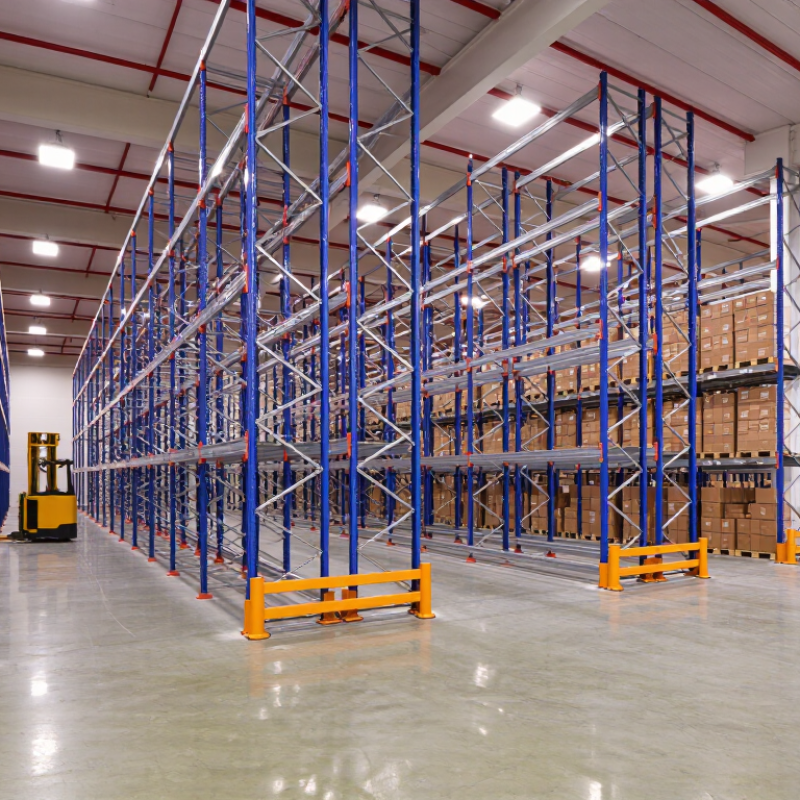
China Top 10 Beam Pallet Racking Manufacturers

What Beam Pallet Racking Is and How It Works

Beam pallet racking is a steel storage system built from upright frames and horizontal beams. The frames stand in rows, while beams connect them at selected heights to create pallet positions. Pallets sit on the beams, leaving open access to each storage level. It is modular.

In a typical setup, a forklift lifts a pallet and places it onto a pair of beams. Operators can adjust beam height to suit different loads, provided the rack is designed for that configuration. A selective layout gives forklift access to each pallet position, though it may use more floor space than some denser systems. The details matter: pallet dimensions, beam span, load weight, and floor conditions all affect safe capacity.

The clean diagrams can make installation look effortless. It isn’t always. Connectors must engage correctly, frames need suitable anchoring, and loads should remain within the capacity specified for the installed arrangement. A pallet that overhangs, damaged beam, or leaning upright deserves attention, not a workaround. Regular visual checks help identify impact damage before it becomes a larger problem. A rack can be strong and still be poorly used.

How China’s Leading Racking Manufacturers Are Assessed

Assessing China’s leading beam pallet racking manufacturers takes more than comparing price lists. A careful review checks engineering documents, production controls, and evidence from completed projects. Inspect beam connectors, upright perforations, welds, and coating consistency. Small defects matter. Ask how load ratings were calculated and whether the stated capacity matches the proposed beam length and storage layout.

Reliable suppliers should explain their inspection process and provide traceable test records. Factory visits can reveal how raw steel is checked, how dimensions are sampled, and how finished parts are protected for shipment. Reviewers should also assess technical support: Can engineers respond clearly when pallet sizes or aisle plans change? A polished sample is useful, but it cannot prove every batch is consistent. Even a detailed checklist has limits.

Tips: Request a drawing, load table, and sample inspection report for the same configuration. Compare them line by line. Ask for references from projects with similar loads and operating conditions. Note unclear answers instead of filling gaps with assumptions; assessments are rarely perfect, and that uncertainty should remain visible.

Profiles of 10 Beam Pallet Racking Manufacturers in China

This guide profiles ten Chinese beam pallet-racking manufacturers through the details buyers can verify: product range, engineering support, production quality, and project experience. China’s logistics sector provides important context. The China Federation of Logistics and Purchasing reported that total social logistics costs reached 18.2 trillion yuan in 2023, equal to 14.4% of GDP. This is a broad measure of logistics activity, not a rack-sales figure, but it helps explain demand for efficient storage.

The profiles examine adjustable selective racks, beam and upright specifications, load testing, surface finishes, and installation support. Buyers should compare drawings and stated load capacities against their actual pallet weights and forklift dimensions. Details matter. A 2.7-meter aisle may suit one operation and constrain another. Ask how manufacturers handle uneven floors, rack protection, and future reconfiguration. These questions can reveal practical differences beyond catalog photos.

The comparison also has limits: published specifications do not prove consistent performance across every production batch. Request project references and inspection records where possible. Some suppliers may provide stronger documentation than others; that gap deserves attention. These profiles offer a starting point for evaluation, not a substitute for site-specific engineering review.

China Top 10 Beam Pallet Racking Manufacturers - Profiles of 10 Beam Pallet Racking Manufacturers in China

Data note: This is an application-based comparison of ten common beam pallet racking product profiles, not a verified ranking or a set of company-specific claims. Dimensions and load figures below are indicative design ranges; actual capacities depend on the rack layout, steel grade, beam and upright sections, connection details, floor conditions, and applicable engineering checks.

Profile Typical application Configuration Typical bay width Typical frame depth Typical beam-level load range Common design considerations
Profile 1: General-purpose selective racking Warehouses requiring direct access to most pallet positions Single-deep rows; adjustable beam levels 2.3–2.7 m 0.9–1.1 m 1,000–3,000 kg per beam level Forklift aisle width, pallet overhang, beam deflection, and floor anchorage
Profile 2: High-bay selective racking Facilities using tall buildings and reach or turret trucks Single-deep, multi-level frames 2.3–2.7 m 0.9–1.1 m 1,000–3,000 kg per beam level Building clearance, upright stability, seismic design where required, and lifting equipment limits
Profile 3: Narrow-aisle racking Operations seeking higher storage density while retaining selective access Single-deep rows served by narrow-aisle trucks 2.3–2.7 m 0.9–1.1 m 1,000–3,000 kg per beam level Guidance system, aisle tolerance, truck turning envelope, and rack protection
Profile 4: Double-deep racking Warehouses storing multiple pallets of the same product Two pallets deep; served by a reach truck with a pantograph or telescopic fork 2.3–2.7 m 1.8–2.2 m 1,000–3,000 kg per beam level Reduced selectivity, load access, pallet support, and equipment reach
Profile 5: Drive-in racking High-density storage for uniform products with low-to-medium SKU variety Forklift enters storage lanes; typically managed as last-in, first-out Lane width designed around the forklift and load Multiple pallet positions deep Designed per lane and support arrangement Impact protection, rail alignment, pallet quality, and operating sequence
Profile 6: Drive-through racking High-density storage where access from both ends is useful Forklift enters from one end and exits at the other; lane operation can support first-in, first-out Lane width designed around the forklift and load Multiple pallet positions deep Designed per lane and support arrangement Access discipline, lane geometry, load stability, and forklift clearance
Profile 7: Push-back racking Medium- to high-density storage for grouped product lines Pallets travel on nested carts or rollers; typically last-in, first-out Commonly 2.3–2.7 m per bay Several pallet positions deep Designed per level and cart system Cart compatibility, lane slope, pallet condition, and controlled loading and unloading
Profile 8: Pallet-flow racking High-throughput stock rotation and date-sensitive inventory Inclined roller lanes; typically first-in, first-out Bay width matched to pallet and lane layout Several pallet positions deep Designed per lane, roller bed, and support structure Brake rollers, speed control, pallet specification, and lane maintenance
Profile 9: Selective racking with wire decking Mixed pallet sizes or operations needing a distributed shelf surface Selective frames with wire mesh decks on beams 2.3–2.7 m 0.9–1.1 m Set by the rack design and deck rating Deck load rating, beam compatibility, sprinkler requirements, and point loads
Profile 10: Heavy-duty selective racking Dense or heavy palletized goods and industrial storage Reinforced beams and frames; single-deep or project-specific layout Project-specific; often based on pallet and handling equipment Project-specific; commonly around 0.9–1.2 m for single-deep layouts Project-engineered; no universal capacity applies Verified load data, connection capacity, upright bracing, slab strength, and safety clearances

Comparing Their Products, Capabilities, and Certifications

Comparing ten beam pallet racking manufacturers means looking beyond quoted price. Compare beam profiles, upright thickness, connector design, and stated load capacity. Ask whether ratings apply to the exact beam length and frame configuration you plan to install. Small changes matter. A longer beam or uneven floor can alter real-world performance.

Manufacturing capability is visible in details: consistent welds, clean punched holes, uniform coating, and traceable material records. Request sample inspection reports and load-test documentation, not just product brochures. The 2024 MHI Annual Industry Report found that 55% of surveyed supply-chain professionals identified labor shortages as a challenge. That context makes clear rack labeling and straightforward assembly useful, but they do not replace proper design review.

Certifications and standards need careful comparison. ISO 9001 indicates a quality-management system; it does not certify every rack’s load rating. Ask whether designs follow applicable guidance, such as ANSI MH16.1 or EN 15512, and request project-specific calculations. Check seismic assumptions, anchoring details, and inspection support. I would not treat a certificate as proof of a safe installation. Paperwork can look complete, yet still omit the conditions behind the stated capacity.

Key Considerations When Choosing a Chinese Manufacturer

China Top 10 Beam Pallet Racking Manufacturers

Choosing a Chinese beam pallet racking manufacturer starts with clear warehouse requirements. Share pallet dimensions, maximum load per level, bay width, and the planned rack height. Ask how the supplier verifies beam capacity and upright performance. Confirm the steel specifications, connector design, weld quality, and coating process. Details matter. Request drawings and test documents that match the exact configuration you intend to order, not a similar rack shown in a catalogue.

Tips: Send a simple layout with aisle widths and forklift details. Ask for a sample beam connector or a small production sample when practical. Compare quotations line by line, including packaging, inspection, spare parts, and installation guidance. A low price may exclude important checks. It is easy to miss that.

Before committing, review the factory’s quality procedures and ask how it handles dimensional tolerances, damaged goods, and production changes. Check whether the team can explain its inspection records in clear English. Confirm lead times, packing methods, and how components will be identified after delivery. A video call from the production floor can help, but it cannot replace documented checks. Keep specifications and approvals in writing; small misunderstandings about load ratings or beam lengths can create costly delays.

FAQS

What is beam pallet racking?

It uses upright steel frames and horizontal beams to create pallet storage levels. It is modular.

How are pallets placed on the rack?

A forklift lifts each pallet onto a pair of beams. Operators can adjust beam heights when the rack design allows it.

What affects a rack’s safe capacity?

Pallet size, beam span, load weight, floor condition, and the installed configuration all matter. Small changes matter.

What are the benefits and limits of selective racking?

Forklifts can reach each pallet position directly. The layout may use more floor space than denser systems.

What should be checked during installation and use?

Check connectors, anchoring, and load limits. Look for leaning uprights, damaged beams, or pallets that overhang. Don’t improvise.

How can buyers compare manufacturers?

Compare beam profiles, upright thickness, connector design, coating, and stated capacity. Request drawings and inspection records.

Do certificates prove a rack is safe?

No. A quality-management certificate does not prove every rack’s load rating. Project-specific calculations and installation details still matter.

What documents and experience should buyers request?

Ask for load-test records, material traceability, project references, and installation support. Published specifications alone may not show consistent production quality.

Why is site-specific engineering review important?

Aisle width, uneven floors, forklift dimensions, and seismic assumptions can affect the design. Catalog details leave gaps. That uncertainty deserves attention.

Conclusion

This article explains how Beam Pallet Racking works and why it is widely used to organize palletized goods in warehouses. It outlines the main components and operating principles, then describes how leading manufacturers in China can be assessed through factors such as product design, manufacturing capacity, quality control, service, and relevant certifications. The profiles of ten manufacturers offer a structured overview of the range of suppliers available, without treating any single company as a universal choice.

A side-by-side comparison considers product options, customization capabilities, production resources, and documented standards. The article also highlights practical points to review before selecting a manufacturer, including load requirements, warehouse layout, safety features, delivery schedules, installation support, and after-sales service. Together, these topics provide a useful starting point for buyers seeking to compare potential suppliers and identify a racking solution suited to their operational needs.

Julian

Julian

Julian is a professional marketing specialist with a strong understanding of the company’s products, customer needs, and evolving market trends. With a practical, research-driven approach, he transforms complex product information into clear, useful, and engaging content for both industry......