Warehouse Pallet Racks shape how goods move from receiving to storage and dispatch. The right system can make space easier to use, improve access, and reduce unnecessary forklift travel. But no rack type solves every warehouse problem. A layout that works for fast-moving cartons may frustrate a site handling bulky, slow-moving pallets.
This guide introduces the main options, including selective, double-deep, drive-in, push-back, pallet-flow, and cantilever racks. Each has a different balance of storage density, selectivity, and equipment needs. Selective racks give forklifts direct access to each pallet, while drive-in systems use deeper lanes that can hold more stock. Pallet-flow racks move loads along rollers, often helping busy operations manage product rotation. Cantilever racks suit long items such as pipes or timber. Small details matter. Aisle width, pallet dimensions, load weight, ceiling height, and forklift turning space can change which system is practical. A rack that looks efficient on a drawing may feel awkward during a crowded shift.
The sections ahead compare these designs, their common uses, and the trade-offs worth checking before installation. That trade-off matters. Storage density can increase while immediate access decreases, and daily picking habits are easy to underestimate. Reliable planning starts with verified load data and a clear picture of how inventory moves—not with choosing the rack that holds the most pallets.
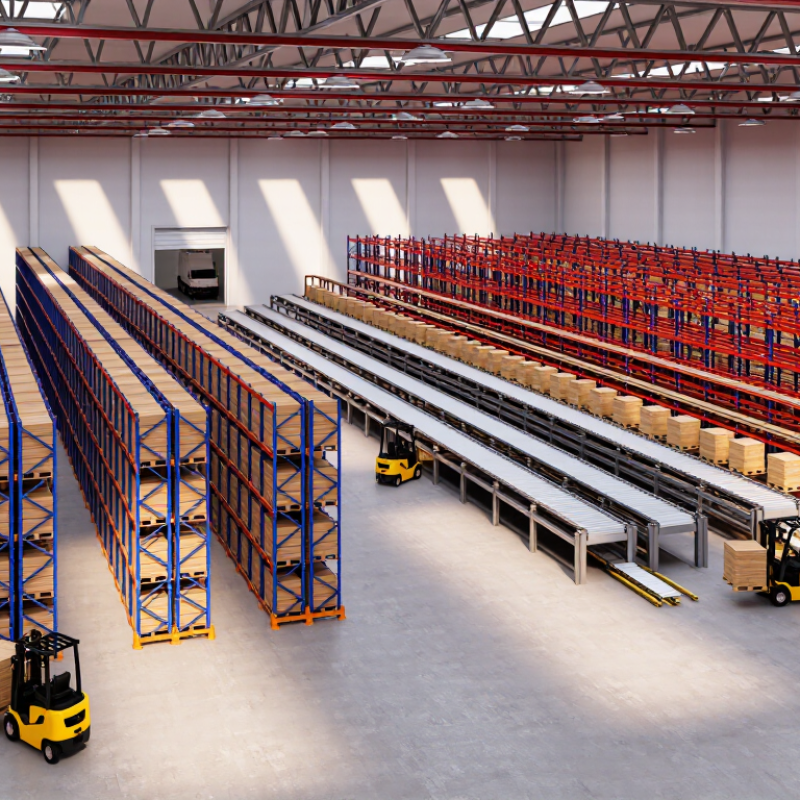
A warehouse pallet rack is a steel storage structure that holds palletized goods above the floor. Upright frames support horizontal beams, creating levels where pallets rest. The rack itself does not lift or move products; forklifts or other handling equipment place and retrieve them. Simple idea. The exact configuration depends on the goods, building, and workflow.
A well-planned system accounts for pallet size, product weight, load distribution, aisle width, and forklift turning space. Beam levels should leave enough clearance for safe placement, while the floor and rack design must suit the expected loads. Some systems also use wire decking, row spacers, or column guards. These details are easy to overlook when a layout looks tidy on paper. It may still be awkward in daily use. Operators need clear sightlines and room to position pallets without striking frames. Rack capacity information should be available to staff, and damaged components or visibly displaced beams warrant prompt assessment by a qualified professional. Regular checks help catch issues such as bent uprights, loose connections, or overloaded levels before they become more serious.
Pallet racks are often classified by how goods enter, move through, and leave a storage lane.
Selective rack gives a forklift direct access to every pallet position. It suits varied stock and frequent picking, but uses more aisle space.
In a busy warehouse, that means operators can reach a blue pallet on the top beam without moving its neighbors.
Simple access comes at a density cost.
High-density systems reduce aisles or store pallets several deep.
Drive-in racks let forklifts enter lanes, usually making the last pallet loaded the first retrieved. Drive-through layouts can support first-in, first-out handling when loading and unloading happen at opposite ends.
Push-back racks also tend toward last-in, first-out retrieval. Pallet-flow racks use gravity rollers to move loads toward the picking face, supporting first-in, first-out rotation.
The trade-off is easy to miss. Lane depth, pallet condition, and forklift clearances all affect real performance.
Automated storage and retrieval systems use machinery to place and retrieve loads, often in tall, narrow aisles.
MHI’s 2024 Annual Industry Report surveyed more than 1,000 supply-chain professionals; 55% planned to increase technology investment. That figure signals interest in automation, not a guarantee of savings for every site.
Measure daily pallet movements, SKU variety, and rotation needs before choosing a method. A dense rack can look efficient on a plan and still slow down picking.
Selective pallet racks are the familiar choice: each pallet has a direct aisle-facing position, making stock checks and picking straightforward. They suit mixed products, though wide aisles can consume valuable floor space. Double-deep racks store pallets two positions deep, increasing density but requiring a reach truck and more careful rotation. Access is less direct.
Drive-in and drive-through racks let forklifts enter storage lanes, reducing aisle space for larger runs of similar goods. Drive-in systems usually load and retrieve from one end; drive-through systems allow access at both ends. Push-back racks use carts on inclined rails, while pallet-flow racks use rollers to move loads toward the picking face. Both offer higher density, but SKU turnover and pallet condition matter. Small differences matter.
Cantilever racks hold long or awkward loads, such as timber or tubing, on projecting arms. The MHI 2024 Annual Industry Report found that 55% of surveyed companies planned to increase supply-chain technology investment. That is not a rack-selection statistic, but it signals why layouts should leave room for changing equipment and workflows. The best fit depends on pallet dimensions, load weight, selectivity, and replenishment patterns. I would check these assumptions against real stock records; a dense design can look efficient on paper and still slow daily picking.
| Rack Type | How It Works | Pallet Access | Storage Density | Best Suited For | Main Considerations |
|---|---|---|---|---|---|
| Selective Pallet Rack | Standard upright frames and horizontal beams form individual pallet locations in rows. | Direct access to each pallet from the aisle. | Low to moderate; aisles are needed between rack rows. | Warehouses with many SKUs, mixed products, and frequent picking. | Offers high selectivity and straightforward stock rotation, but uses more floor space for aisles than high-density systems. |
| Double-Deep Rack | Two pallet positions are placed one behind the other, typically requiring a deep-reach forklift. | Direct access to the front pallet; the rear pallet is accessed after the front one is moved. | Moderate to high; fewer aisles are needed than with single-deep selective rack. | Operations storing multiple pallets per SKU with relatively predictable stock movement. | Reduces selectivity and may require last-in, first-out (LIFO) handling for each lane. |
| Drive-In Rack | A forklift enters the rack lane and places pallets on supporting rails, often loading and retrieving from the same end. | Access is typically from one end of each lane. | High; rack lanes reduce the number of aisles. | Large quantities of the same product and operations where space utilization is a priority. | Usually operates on a LIFO basis. Forklifts travel inside the structure, so careful driving and rack protection are important. |
| Drive-Through Rack | Similar to drive-in rack, but lanes can be accessed from both ends. | Access from opposite ends supports loading from one side and retrieval from the other. | High; suitable for deep storage lanes. | High-volume goods that benefit from separate loading and unloading sides. | Can support first-in, first-out (FIFO) flow when managed correctly, but needs access aisles at both ends. |
| Push-Back Rack | Each pallet rests on a nested cart or inclined track; loading a new pallet pushes earlier pallets farther back. | Each lane is generally accessed from the front. | High; multiple pallets are stored deep within each lane. | Several pallets per SKU where faster access than deep-lane drive-in storage is useful. | Typically follows LIFO. The number of pallet positions per lane depends on the system design and load requirements. |
| Pallet Flow Rack | Pallets move by gravity along inclined roller or wheel tracks from the loading end to the picking end. | Loading and retrieval occur at opposite ends of the lane. | High; deep lanes can reduce aisle requirements. | High-throughput inventory with consistent pallet sizes and FIFO rotation needs. | Typically supports FIFO. Track design, pallet condition, load consistency, and maintenance affect reliable movement. |
| Automated Pallet Shuttle Rack | A powered shuttle moves pallets along storage lanes; an operator or control system directs loading and retrieval. | Access is managed through lane openings, with the shuttle transporting pallets inside the rack. | Very high; deep lanes and fewer aisles can maximize storage capacity. | High-volume, high-density storage with repeated handling patterns and compatible pallet loads. | Requires investment in shuttle equipment, controls, and system-specific operating procedures. |
| Cantilever Rack | Horizontal arms extend from upright columns instead of using front posts and beams across the load face. | Open-front access along the rack arms. | Varies by layout; designed for long or irregular loads rather than standard pallet density. | Long, bulky items such as lumber, pipe, or sheet materials, including goods stored on suitable pallets. | Arm length, column spacing, and load capacity must be selected for the dimensions and weight of the stored goods. |
Selective pallet racks provide direct access to every stored pallet. A forklift can reach one load without moving another. This makes picking flexible, especially when inventory changes often. The trade-off is wider aisles and more space between product lanes.
Drive-in racks place pallets several positions deep on support rails. Forklifts enter the structure, so fewer aisles are needed and storage density rises. Access is less selective: workers usually remove the nearest pallet first. That can complicate stock rotation when different products share a lane. It also calls for careful driving and consistent pallet sizes. Small differences matter.
Push-back racks store pallets on nested carts, allowing several loads per lane while keeping access from the aisle. Pallet-flow racks use gravity rollers to move loads toward the picking face. Both can reduce travel and aisle space, but their moving parts need inspection. A jammed roller is not a small inconvenience. It can stop a lane.
The right choice depends on how quickly stock turns, how many product types are stored, and how often each pallet must be reached. Measure actual aisle widths and test the forklift path before committing. A dense layout may look efficient on paper, yet feel awkward during a busy shift. That deserves a second look.
Relative comparison of common pallet rack systems. Ratings are qualitative (1 = low, 5 = high), not standardized measurements.
How to read this: Selective racks provide direct access to each pallet but use more aisle space. Double-deep racks and compact systems such as drive-in, push-back, and pallet-flow racks increase storage density while reducing direct access to individual pallets. System choice depends on inventory rotation, pallet variety, and handling equipment.
Choosing a pallet rack system starts with the inventory, not the rack catalogue. Record pallet dimensions, loaded weight, SKU count, and daily pallet movements. Then compare these figures with clear height, column spacing, floor condition, and forklift turning space. High SKU variety and frequent picking usually call for direct access to each pallet. Slower-moving stock may suit denser storage. Access matters. A layout that looks efficient on paper can create long travel paths on the floor.
Consider growth and equipment, too. MHI’s 2024 Annual Industry Report found that 88% of respondents viewed digital supply chains as a competitive advantage. That makes future automation worth discussing early, even if it is not in this year’s budget. Check whether rack aisles, pallet positions, and load data can support likely changes. A tidy spreadsheet may still miss odd-sized pallets or a busy dispatch corner; measure actual operations before final design. Have a qualified rack professional verify load assumptions and building constraints.
Tips: Bring a week of movement records, pallet measurements, and forklift specifications to the planning meeting. Mark columns and turning areas on the floor with tape. Walk the proposed route during a busy shift. Small details matter.
It is a steel structure with upright frames and horizontal beams. Pallets rest on its levels, above the floor.
No. Forklifts or other handling equipment place and retrieve them. The rack stays put.
Consider pallet size, product weight, load distribution, and aisle width. Forklifts also need room to turn.
Clear space helps operators place pallets without striking frames. Poor visibility can make a tidy layout awkward.
It gives direct access to each pallet. That helps when inventory changes often, but usually needs wider aisles.
It stores pallets several positions deep, reducing the number of aisles. Workers usually take the nearest pallet first.
Push-back racks use nested carts. Pallet-flow racks use gravity rollers to move loads toward the picking face.
Look for bent uprights, loose connections, displaced beams, or overloaded levels. Damaged parts need prompt assessment.
Measure aisle widths and test the forklift path. Paper plans can miss a tight turn. Recheck the assumptions.
Warehouse Pallet Racks are structural systems designed to store palletized goods safely and make efficient use of warehouse space. They can be classified by how products are stored and accessed, including systems that provide direct access to each pallet and systems that prioritize higher storage density by placing pallets closer together. Common options include selective, drive-in, drive-through, push-back, pallet-flow, and mobile racks, each suited to different inventory patterns and operational needs.
Rack types differ in accessibility, capacity, and how quickly products can be retrieved. Choosing a system involves considering the available floor space and ceiling height, inventory volume and turnover, product dimensions and weight, equipment used for handling pallets, and the need for selectivity. Matching these factors to a suitable rack design can support organized storage, efficient movement of goods, and effective use of warehouse space.