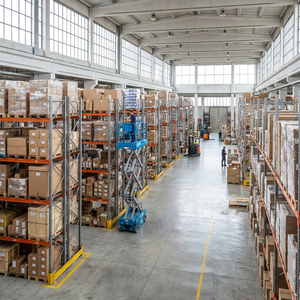
Professional Industrial Racking System Steel Warehouse Equipment
- Beam Load: 1,000–4,500 kg/level
- Steel Grade: Q235B / Q355B / S355
- Height Pitch: 50mm / 75mm adjust
- Design Code: EN 15512 / FEM 10.2.02
Standard and customized racking solutions engineered for high density, seismic safety, and full compatibility with Euro (EPAL 1200×800mm) and ISO industrial pallets.
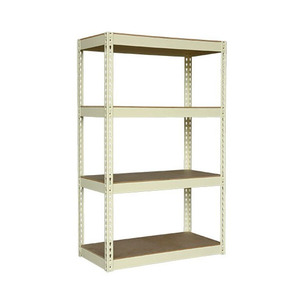
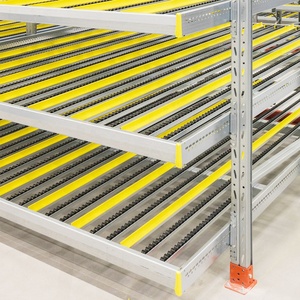
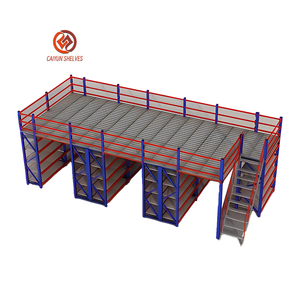
Industrial storage racking is classified across the European Union and international markets as a load-bearing steel structure subject to the Construction Products Regulation (EU CPR 305/2011). Under this mandatory legal framework, storage systems cannot be treated as passive commercial shelving; they must be systematically designed, calculated, manufactured, and inspected according to harmonized European Norms (EN standards).
The standard EN 15512 governs the structural analysis of adjustable pallet racking systems fabricated from cold-formed thin-walled steel profiles. Unlike conventional hot-rolled structural steel, cold-formed members are susceptible to complex stability failures, including local buckling, distortional buckling, and flexural-torsional buckling. Certified manufacturers implement advanced Finite Element Method (FEM) modeling and empirical stub-column test verification:
EN 15620 defines precise operational clearance classes ranging from Class 400 (wide aisle reach-truck configurations) down to Class 100 (automated high-bay warehouses with tolerance bands measured in single millimeters). A CE-compliant installation guarantees that pallet overhang does not compromise upright stability, maintaining a standardized 75mm minimum horizontal buffer between parallel pallet back-stops and 100mm between upright face profiles and material handling equipment.
Under workplace safety guidelines and EN 15635, warehouse operators must implement structured inspection regimes identifying mechanical damage induced by forklift impacts. CE certified installations come with calibrated load warning plaques detailing maximum bay capacities, compartment heights, and color-coded risk categorizations:
| Racking System Type | Floor Space Utilization | Direct Selectivity | Typical Payload / Level | Stock Rotation | Applicable EN Standard |
|---|---|---|---|---|---|
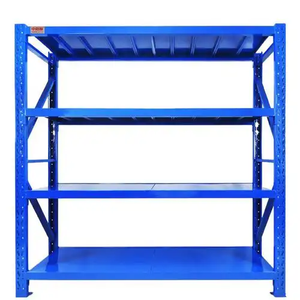
| Selective Pallet Racking | 40% – 50% | 100% Direct | 1,000 – 4,500 kg | FIFO / LIFO Flexible | EN 15512, EN 15620 |
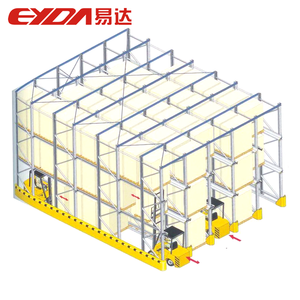
| Drive-In / Drive-Thru | 70% – 80% | Low (Lane-based) | 1,000 – 2,000 kg/pallet | LIFO (Drive-In) / FIFO | EN 15512, FEM 10.2.07 |
| Radio Shuttle Automation | 80% – 85% | Medium (Automated) | 1,500 kg per pallet position | Software Managed FIFO/LIFO | EN 15512, Machinery Dir. |
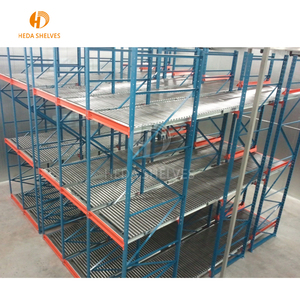
| Gravity Pallet Flow | 75% – 85% | High at picking face | 1,200 kg per roller pallet | Strict Physical FIFO | EN 15512, EN 15629 |
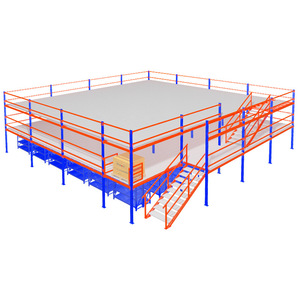
| Structural Steel Mezzanine | 100% – 200% Floor Gain | 100% Area Utility | 300 – 1,200 kg/m² | Multi-Process Picking | EN 1090-2 (Execution Cl. 2) |
Procurement executives and supply chain directors are navigating shifting regulations, automated facility expansions, and carbon transparency mandates across international warehousing hubs.
With the implementation of the EU Carbon Border Adjustment Mechanism (CBAM) and corporate Scope 3 emission targets, leading procurement teams demand third-party Environmental Product Declarations (EPDs). Specifying steel coils produced via Electric Arc Furnace (EAF) utilizing recycled scrap significantly lowers total embodied carbon compared to traditional blast-furnace routes.
CBAM Compliant TraceabilityProcuring static racking without future automation headroom creates early obsolescence. Facilities increasingly mandate that all new static wide-aisle installations feature pre-punched connector uprights, laser-calibrated rail brackets, and baseplate anchoring certified for future conversion into Autonomous Mobile Robot (AMR) lanes or Radio Shuttle tunnels.
Zero-Tear Down UpgradabilityForward-thinking buyers evaluate Total Cost of Ownership (TCO) across 15-year lifecycles. Low-cost non-certified racks lead to higher maintenance overhead, frequent beam deformation, and insurance premiums. Investing in hot-dip galvanized bottom upright sections, pre-installed polymer floor protectors, and certified cold-rolled steel drastically reduces total operational expenditure.
40% Lower Lifetime MaintenanceGeopolitical disruptions have forced industrial manufacturers to shift from strictly lean "Just-In-Time" (JIT) to resilient "Just-In-Case" (JIC) inventory models. This has triggered high demand for ultra-tall vertical pallet racking (heights exceeding 12m) to maximize volumetric cubic utilization without acquiring costly additional real estate acreage.
Volumetric Cubic DensificationHow structural metallurgy, embedded telemetry, and cold-chain materials science are redefining reliability in harsh industrial operating environments.
Integration of low-power wireless strain gauge sensors and MEMS tri-axial accelerometers embedded directly within critical upright profiles. These sensors detect forklift impact strikes exceeding 50 Joules and structural live-load imbalances, instantly alerting warehouse safety managers via cloud dashboards before micro-fractures propagate into catastrophic progressive collapses.
Real-Time Impact TelemetryR&D transitions from standard commercial Q235B steel toward micro-alloyed, high-yield cold-forming steels such as S350GD and S420MC. These advanced metallurgical formulations allow for a 15% reduction in rack tare dead-weight while improving yield strength ($R_e \ge 420 \text{ MPa}$), facilitating higher continuous column loading, and drastically lowering long-distance freight shipping footprints.
S420MC Micro-Alloyed GradesIn blast freezer warehouses operating between -25°C and -35°C, standard commercial carbon steels suffer ductile-to-brittle transition, making welded joints prone to rapid cleavage cracking. Next-gen cold storage racking utilizes fully silicon-killed, aluminum-stabilized steels compliant with Charpy V-notch impact energy verification of at least 27 Joules at -30°C.
Charpy Tested at -30°CThe convergence of rapid e-commerce parcel fulfillment and heavy pallet storage has fueled modular hybrid multi-tier racking platforms. These systems blend heavy-duty lower-tier selective pallet racking carrying palletized replenishment inventory with 2 to 4 vertical mezzanine tiers dedicated to high-density carton live picking and automated spiral conveyor chutes.
Multi-Tier Omni-Channel LayoutsGuangzhou Heda Shelves Co., Ltd. (founded 2001) is a specialized manufacturer delivering complete structural warehouse systems across 120+ countries, supported by in-house engineering and end-to-end CE & ISO compliance.
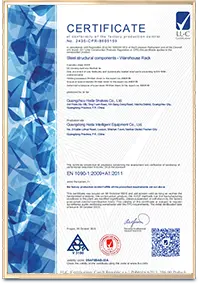
Fully accredited under official CE Certificate No. 2435-CPR-8605159, verifying adherence to harmonized EU Construction Products Regulation requirements. Our quality management system operates under ISO 9001:2015 (Certificate No. 18624Q00169R0M) alongside RoHS certified surface finishing.
Our engineering department of 300+ technical personnel supplies free customized structural CAD schematics, full 3D rendering perspectives, and calculation dossiers within 24 to 48 hours. We calibrate aisle clearances precisely around your forklift turn radiuses and pallet dimension envelopes.
From raw coil slitting, high-precision continuous roll-forming lines, automated column punch matrices, to multi-stage degreasing, zinc phosphating pre-treatment, and automated electrostatic powder coating. Every single stage is audited for dimensional accuracy and structural paint adhesion.
Direct containerized export shipping from Guangzhou port to all major worldwide container hubs including Rotterdam, Hamburg, Antwerp, Valencia, Felixstowe, and Long Beach. Every component is bundled with durable seaworthy steel strapping, numbered layout markers, and full bilingual assembly manuals.



Detailed technical answers to common queries regarding compliance, Euro pallet configurations, structural calculation packages, and lead-time logistics.
Connect with our technical design office today. Submit your warehouse floor plan, pallet dimensions, and operational parameters to receive an engineered layout, bill of materials, and transparent factory-direct pricing within 24 to 48 hours.