Flagship Heavy-Duty & Dynamic Storage Implementations
Precision-manufactured pallet racking, mobile bases, live storage lanes, and automated picking architectures engineered direct from our 30,000 m² factory.

Engineering Architecture of Modern Movable Pallet Racking Systems
An authoritative technical analysis of motorized mobile chassis, rail integration, structural load transfer, and spatial efficiency gains in contemporary intralogistics.
1. Core Operating Principles: The Kinematic Mobile Chassis
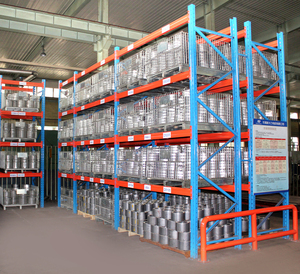
Movable pallet racking systems (commonly designated in heavy industrial warehousing as motorized mobile pallet racking or heavy-duty mobile base racks) represent the pinnacle of mechanical density optimization. Traditional selective pallet racking layouts mandate dedicated operating aisles for counterbalance, reach, or articulated forklifts, which perpetually consumes between 50% and 65% of total cubic floor plate space purely for machine clearance. Mobile racking resolves this systemic footprint deficit by mounting conventional, heavy-duty racking superstructures onto electronically synchronized, wheel-bearing structural steel bogies traversing embedded floor guidance rails.
Under standard operational protocols, only one single operating access aisle remains open at any given moment. When warehouse operators require access to a specific storage channel, an automated PLC radio-frequency command, industrial remote trigger, or aisle-mounted HMI console initiates variable-frequency driven (VFD) three-phase induction electric motors. The entire block of racks glides smoothly across the ground rails at calculated speeds of 4.5 to 5.5 meters per minute, opening a dedicated working aisle directly before the requested pallet bay.
2. Mechanical & Structural Engineering Integrity
The manufacturing complexity of movable pallet racking exceeds static racking due to the introduction of dynamic inertia, acceleration-deceleration harmonics, and localized track deflection forces. China's premier racking manufacturing facilities utilize high-tensile cold-rolled micro-alloyed steel (specifically Q235B and Q355B grades) configured according to strict EN 15512 (Steel static storage systems – Adjustable pallet racking systems) and FEM 10.2.07 safety parameters.
Key structural sub-assemblies engineered into high-specification mobile systems include:
- Laser-Aligned Guidance Rails: Flat-top and crane-rail profile steel sections embedded flush within secondary concrete screeds or cast directly into high-flatness industrial slabs according to DIN 18202 standards.
- Multi-Drive Motorized Bogies: Solid-machined ductile iron travel wheels mounted on heavy-gauge box-section chassis, driven by decentralized shaft-mounted helical gear motors synchronized via fieldbus networks.
- Multi-Zone Optical Safety Envelopes: Dual-channel category 4 optoelectronic light grids positioned at floor level and pedestrian heights to immediately halt chassis translation if personnel, lift trucks, or displaced cargo breach the movement zone.
- Intelligent Distance Ultrasonic Sensors: Continuously monitor inter-bay parallelism during travel to prevent structural crabbing, skewing, or excessive torsional strain along the vertical upright profiles.
| Racking Topology | Cubic Utilization | Pallet Direct Access | Structural Footprint | Capital Investment | Typical Industrial Fit |
|---|---|---|---|---|---|
| Movable Pallet Racking | 85% – 90% (Maximum) | 100% Selective Access | Ultra-Compact | Medium – High | Cold Storage, 3PL Warehousing, High-Value Inventory |
| Standard Selective Racking | 35% – 45% (Baseline) | 100% Selective Access | Extensive Aisle Footprint | Low (Baseline) | Fast Turnaround, Multi-SKU Distribution |
| Drive-In / Drive-Through | 70% – 80% (Dense) | Poor (LIFO / FIFO Lanes) | Compact Block | Low – Medium | Uniform FMCG, Raw Bulk Ingredients |
| Radio Shuttle Automation | 80% – 85% (Very Dense) | Channel-Dependent | Deep-Lane Matrix | High | Food & Beverage Pallet Buffering |
Product Future Procurement Trends in Industrial Storage
Key strategic factors shifting global procurement behaviors toward specialized, automated, and high-efficiency movable racking from top-tier Chinese manufacturers.
Skyrocketing square-meter land acquisition and warehouse rental costs across Europe, the Middle East, and North America have rendered low-density racking financially unsustainable. Procurement direct from Chinese engineering manufacturers allows enterprises to double their storage density without expanding the brick-and-mortar building envelope.
Refrigerated warehouse facilities face substantial electricity consumption charges. In freezer facilities operating between -18°C and -30°C, cooling unused empty corridors represents severe fiscal waste. Movable pallet systems condense refrigerated air volumes by up to 40%, generating ongoing operational energy ROI.
Global procurement directors are abandoning intermediate trading middlemen to partner directly with qualified Chinese original design manufacturers (ODMs). This shift ensures complete structural transparency, factory load certifications (CE No. 2435-CPR-8605159), mill test sheets, and millimetre-accurate custom CAD/3D drafting.
Product Development Trends: Industry 4.0 & Smart Mobile Logistics
How next-generation movable pallet racking is converging with autonomous mobile robots (AMRs), predictive AI diagnostics, and smart IoT sensor architectures.
Seamless AGV/AMR Fleet Orchestration
The traditional movable racking interface relies upon human forklift drivers pressing physical remotes to open an aisle. Next-generation systems coming out of premier Chinese fabrication centers integrate open-API WCS (Warehouse Control System) bridges. Autonomous guided forklifts communicate directly with the mobile racking controller over industrial 5G/Wi-Fi 6 protocols. The racking pre-emptively separates and opens the required bay while the AGV is in transit, completely eliminating operational dwell times and achieving continuous zero-human material handling.
Embedded Structural Health Monitoring (SHM)
By embedding strain-gauge piezoelectric sensors and continuous-mesh vibration telemetry along critical vertical uprights and base chassis assemblies, modern racks detect sub-millimeter foundation subsidence, seismic micro-tremors, or lift-truck impact shocks in real time. Rather than relying solely on annual manual inspections, facility QHSE managers receive instantaneous cloud alerts regarding structural fatigue, ensuring continuous compliance with European EN 15635 standard guidelines.
Low-Carbon Electrostatic Finishing & Green Steels
In accordance with global corporate ESG mandates, production lines are rapidly standardizing on heavy metals-free, zero-VOC electrostatic powder coatings and certified scrap-recycled structural steel profiles. Non-phosphating zirconium surface pre-treatments lower carbon footprint during factory rolling without sacrificing 500-hour salt spray corrosion resistance.
Why Choose Guangzhou Heda Shelves Co., Ltd.
Over 25 years of specialized storage manufacturing, backed by verified credentials, automated CNC machinery, and end-to-end European project engineering.
Founded in 2001, Guangzhou Heda Shelves brings a quarter-century of specialized engineering knowledge across industrial warehouse storage and heavy racking fabrications.
Independently certified holding CE Certificate No. 2435-CPR-8605159, ISO 9001:2015 No. 18624Q00169R0M, and full RoHS compliance documentation on steel finishes.
In-house technical engineering teams produce millimetric floor layouts, static deflection profiles, and structural calculations referencing EN 15512 and EN 15620 guidelines prior to manufacturing.
Complete maritime container packing with numbered piece marks, shipping consistently to Rotterdam, Hamburg, Antwerp, Valencia, Gdańsk, and Felixstowe with rapid 15–30 day factory lead times.
Scale, Automation & Quality Management
Operating out of Guangzhou, China, our 30,000 square meter modernized plant houses 10 integrated production stages: from ultrasonic raw steel testing and automated upright roll-forming to 12-gun electrostatic powder coating lines and individual bay load testing.
Frequently Asked Questions: Racking Procurement
In-depth technical answers addressing civil engineering requirements, load tables, floor tolerances, and factory export specifications.
What specific floor slab tolerances are required for installing movable pallet racking rails?
Can HEDA movable racking be engineered for European EPAL and standard industrial pallets?
What emergency safety interlocks and photoelectric systems protect warehouse personnel?
What documentation and certifications are provided for local municipal inspections?
What is the typical production lead time and maritime delivery process?
Do you offer private-label (OEM/ODM) manufacturing for regional racking distributors?
Optimize Your Warehouse Footprint With Factory-Direct Engineering
Submit your architectural CAD drawing, clear building ceiling height, pallet weight specifications, and handling equipment model to receive an engineered layout, load calculation tables, and an upfront project estimate within 24 hours.