Order Picking FIFO
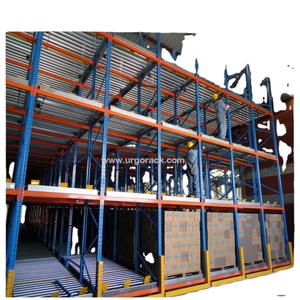
High Efficiency Order Picking Racking System, Gravity Flow Roller Racking System
Split Roller Tracks
Light to Medium Duty
Fast Turnover
Manufactured using high-tensile cold-rolled steel (Q235B & Q355B) conforming to EN 15512 and FEM 10.2.02 standards. Explore our precision roller flow channels, carton live picking bays, and heavy-duty gravity-fed pallet racks.
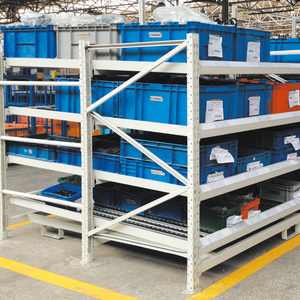
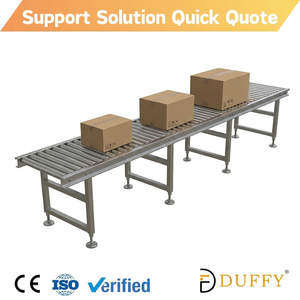
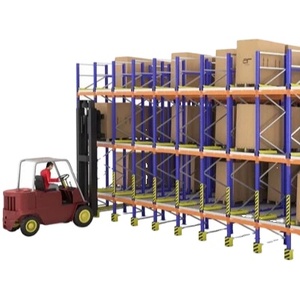
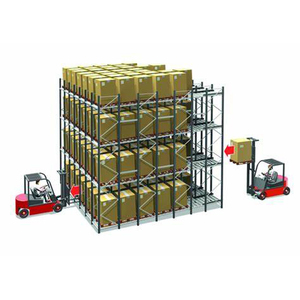
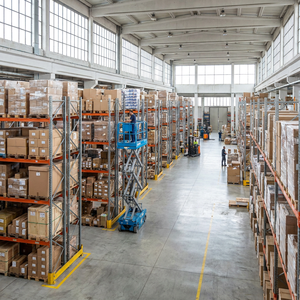
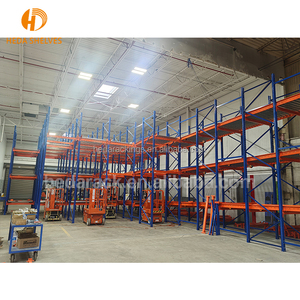
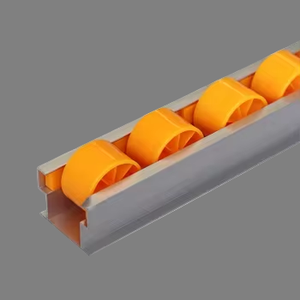
Gravity feed pallet racking (commonly termed Pallet Flow Racking or Live Storage) represents the pinnacle of dynamic, energy-autonomous warehouse densification. By utilizing gravitational potential energy, palletized inventory automatically glides from the loading (charge) aisle to the retrieval (discharge) face along an engineered gradient track.
The fundamental efficiency of a dynamic pallet flow lane depends strictly on matching the angle of inclination to the rolling friction coefficient of the pallet base. For standardized Euro pallets (1200 × 800 mm) and GMA pallets (48 × 40 in) bearing weights between 500 kg and 1,500 kg, the industry-standard gradient ranges between 3.0% and 4.0% (approximately 1.7° to 2.3°).
Excessive inclination leads to dangerous terminal impact velocity at the discharge stop, while insufficient slope induces stick-slip hesitation or complete lane stall. In high-density lanes exceeding 4 pallets in depth, uncontrolled gravitational acceleration poses severe hazards to structural uprights and equipment. To counter this kinetic accumulation, precision centrifugal brake rollers or magnetic eddy-current dampeners are positioned at calculated intervals (typically every pallet pitch, or 1.2 to 1.4 meters). These dampeners govern the pallet glide velocity at a constant, controlled rate of 0.25 to 0.30 m/s, completely irrespective of whether the pallet weighs 250 kg or 1,500 kg.
In a 20-pallet-deep flow lane loaded with 1,000 kg pallets, the cumulative hydrostatic-like thrust exerted against the front-most pallet—termed line pressure—can exceed 1,200 kgf. Under this crushing mechanical force, a forklift operator attempting extraction faces intense friction against the beam stops, risking mast strain, pallet splintering, or disastrous load destabilization.
Top Chinese manufacturers like HEDA Shelves overcome this by integrating heavy-duty pneumatic or mechanical Pallet Separators. Positioned before the final extraction position, the mechanical separator arrests the queued pallets behind an articulated stop. When the forklift operator elevates the primary pallet, the mechanism automatically unlocks, allowing the subsequent pallet to roll into the picking face at zero back-pressure, re-locking instantly behind it.
| Storage System Architecture | Density Index | Stock Rotation Metric | Throughput Speed (Cycles/hr) | Forklift Collision Risk | Operating Power Cost |
|---|---|---|---|---|---|
| Gravity Feed Pallet Racking | Very High (Up to 85%) | Strict FIFO (100% Rotation) | High (Independent In/Out) | Ultra Low (Aisle Only) | $0.00 (Zero Power) |
| Standard Selective Pallet Racking | Low (40% - 50%) | LIFO / Random Access | Moderate (Single Aisle Congestion) | Moderate to High | $0.00 (Manual Lift Only) |
| Drive-In Racking System | High (70% - 75%) | Strict LIFO | Low (Forklift Enters Deep Lane) | Severe Risk (Mast Impacts) | $0.00 |
| Push-Back Pallet Cart Racks | Medium-High (60% - 70%) | LIFO (2–6 Pallets Deep) | Moderate | Moderate | $0.00 |
| Radio Shuttle Semi-Automated | Maximum (85% - 90%) | FIFO or LIFO Programmable | Very High | Ultra Low | Requires Battery Recharging |
The global materials handling landscape is pivoting toward energy-passive sustainability, hybrid automation integration, and stringent lifecycle resilience. Supply chain directors must navigate four overarching macroeconomic and engineering evolutions.
With the rapid expansion of global biopharma distribution and temperature-controlled food cold chains (-25°C to -30°C), traditional centrifugal brake rollers containing mechanical fluid or internal brake shoes suffer from grease freezing and thermal wear. Sourcing is shifting definitively toward non-contact, maintenance-free Eddy-Current Magnetic Braking Rollers that provide identical deceleration profiles across extreme thermal variations without physical friction.
Modern mega-distribution hubs are eliminating direct forklift interface on live flow lanes. Progressive engineering designs pair automated storage and retrieval systems (AS/RS) or stacker cranes with gravity feed output staging lanes. Pallets dropped at high speeds by cranes roll passively via gravity to dispatch staging docks, creating zero-power accumulation buffers that decouple machine transit cycles from truck dock turnaround.
European and North American buyers are requiring verifiable Environmental Product Declarations (EPD) and compliance with CBAM (Carbon Border Adjustment Mechanism). Chinese manufacturing leaders are revamping production lines: implementing clean electric induction heating, zinc-nickel eco-plating for rollers, and zero-VOC heavy polyester powder finishes, reducing the embodied cradle-to-gate carbon footprint by up to 28%.
Empowering logistics contractors, third-party logistics (3PL) providers, and industrial distributors globally since 2001.
Sourcing gravity feed racking systems directly from an accredited Chinese original equipment manufacturer (OEM/ODM) eradicates intermediary markups, ensures structural accountability, and delivers customized dimensional compliance.
All racking beams, upright profiles, and gravity tracks are engineered under rigorous quality protocols holding CE Certificate No. 2435-CPR-8605159 and ISO 9001:2015 No. 18624Q00169R0M. Load tables and structural calculations reference EN 15512 and FEM 10.2.02 codes for seamless permit approvals.
Unlike competitors who outsource dynamic components, HEDA manufactures roller frames, high-precision carbon steel zinc-coated rollers, impact feeder stations, and mechanical separators in-house. This guarantees absolute concentricity, vibration-free roller rotation, and zero pallet deviation.
Our dedicated team of 30+ project engineers provides complete spatial optimization drawings, aisle turning radius verification, gradient simulation, and bill-of-materials within 24 to 48 hours of initial architectural brief submission—at zero upfront cost.
We use exclusively certified virgin steel coils from premier mills (such as Baosteel). Cold-rolled into proprietary omega-profile upright columns with reinforced ribs, our racks offer elevated yield strength under seismic and high-frequency pallet dynamic drop stresses.
Situated strategically in Guangzhou, adjacent to major international deep-water container ports (Nansha, Shenzhen, Hong Kong), orders are securely strapped, wrapped in water-resistant protective membranes, and palletized for zero-damage maritime shipping to Rotterdam, Hamburg, Valencia, Long Beach, or Jebel Ali.
We supply specialized racking distributors, automated conveyor integrators, and logistics general contractors across Europe and the Americas with custom RAL powder-coating colors, customized punch pitches (50mm, 75mm, 76.2mm), and customized private labeling packaging.
Every gravity pallet racking component passes through an automated, repeatable verification sequence.
Spectrometry & tensile verification of Q235B steel.
High-precision edge trimming and shearing.
Automated pitch punching for upright tear/diamond holes.
Continuous 18-station cold bending for uprights & beams.
Robotic CO2 shielded welding of beam end connectors.
Automated bearing press-fit & roller dynamic balance test.
Multi-bath acid pickling, degreasing, and phosphating.
Electrostatic automatic thermosetting epoxy (60-80μm).
Deflection verification under 150% rated design limit.
Steel-banded moisture-proof bundling for container stowing.
Detailed engineering answers covering pitch tolerances, pallet specifications, brake configurations, and international delivery protocols.
Supply your building floor plan (DWG or PDF), clear eave height, pallet dimensional parameters (including overhang), maximum unit weights, and forklift turning specifications. Our senior structural engineers will generate a fully compliant layout and static load simulation within 24–48 hours.