High Density
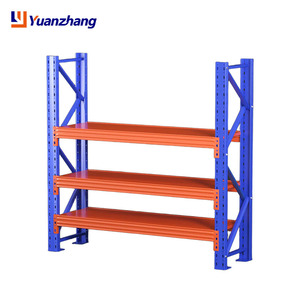
Heavy Duty Double Deep Pallet Racking, Universal Steel Storage Shelves
- Capacity: 1,000 - 4,500 kg / level
- Steel Grade: Certified Q235B / Q355B
- Application: Cold room, workshop, factory
Navigating global warehouse infrastructure demands precise static calculations, premium steel metallurgy, and strict compliance with global building codes. As China's premier racking manufacturer, we supply certified cold-formed structural steel storage systems engineered for maximum cubic volumetric efficiency, operational durability, and seismic resilience.
Explore our primary structural configurations built for Euro pallets, industrial wire cages, double-deep staging, and harsh cold-chain logistics environments.
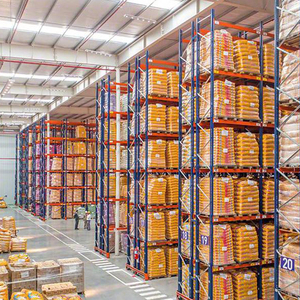
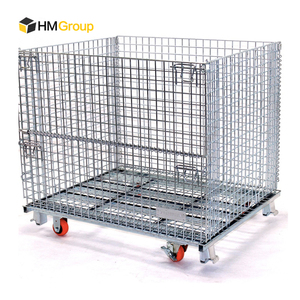
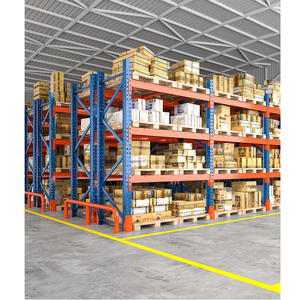
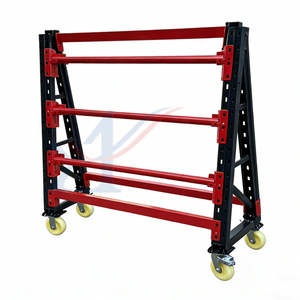
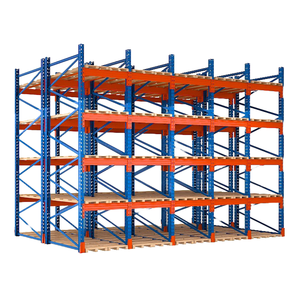
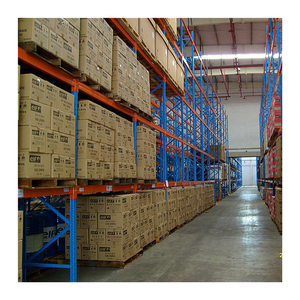

In high-density pallet racking systems, safety is directly governed by static balance, torsional stiffness, and dynamic impact tolerance. Modern pallet racking engineered by tier-one Chinese factories does not simply bend cold steel; it integrates structural mechanics under FEM 10.2.02 (European Racking Federation) and EN 15512:2020 (Steel Static Storage Systems). Upright columns and box beams undergo advanced finite element analysis (FEA) to calculate second-order torsional and flexural buckling effects under asymmetrical live loading.
A critical metric evaluated by international structural inspectors is the maximum allowable vertical beam deflection limit. International codes enforce an operational deflection threshold of δ ≤ L/200 under nominal working load limit (WLL), whereas seismic or automated VNA applications often require a stringent δ ≤ L/300 to guarantee automated turret trucks and narrow aisle sensors operate without optical parallax error. Uprights are formed with continuous omega profiles with cold-worked flanges that enhance load-bearing capability through work hardening without brittle fracture risks.
| Racking Topology | Storage Density | Selectivity Ratio | Pallet Turnover Mode | Typical Beam Clearances | Safety Deflection Target |
|---|---|---|---|---|---|
| Selective Pallet Racking | Baseline (100%) | 100% Immediate | FIFO / LIFO Adaptive | 75mm - 100mm Lateral | L/200 Structural Norm |
| Double Deep Racking | +30% to +40% | 50% Direct Access | LIFO Batch Optimized | 100mm Aisle Clearance | L/200 to L/250 |
| Drive-In / Drive-Through | +60% to +75% | Low (Lane Dedicated) | LIFO (Drive-In) / FIFO | Cantilever Guide Rail | L/250 Static Guide |
| Radio Shuttle Automation | +80% Maximize | High (Channel Select) | Automated FIFO / LIFO | Autonomous Optical Track | L/300 Precision Track |
| Very Narrow Aisle (VNA) | +45% to +55% | 100% Direct Access | High Throughput FIFO | Inductive / Mechanical Rail | L/300 Anti-Sway Strict |
| Gravity Pallet Flow | +70% High Cube | Face Accessible | Strict FIFO Gravity | Brake Roller Pitch 3-4% | L/250 Dynamic Braked |
Beyond deflection limits, the choice of steel alloy directly determines factory safety over a 20-year lifespan. Our facility exclusively sources certified prime structural steels: Q235B (yield strength $R_{eH} \ge 235 \text{ MPa}$) for general beam and horizontal bracing duties, and high-tensile Q355B (yield strength $R_{eH} \ge 355 \text{ MPa}$) for multi-tier mezzanines and heavy high-bay vertical upright frames. All raw coils are verified via chemical spectrometer testing to confirm carbon equivalent values (CEV), ensuring optimal weldability for robotic beam connector welding lines.
B2B procurement leaders are moving away from spot purchases toward total lifecycle reliability, system interoperability, and lower carbon footprints across high-volume distribution nodes.
Warehouses are transitioning from manual forklift maneuvers to semi-automated and fully autonomous operations. Modern procurement specifications demand beam connectors and baseplate assemblies that can accommodate Autonomous Mobile Robots (AMRs), automated pallet shuttles, and pick-to-light wiring brackets without structural field modifications.
Rising ocean freight indices necessitate structural cross-section optimization. Enterprise engineering teams favor high-strength steel grades (like Q355B and S355JR) that reduce dead-load steel tonnage by 12% to 18% while sustaining identical uniform distributed loads (UDL). This drastically optimizes 40HQ container load distribution and port handling charges.
Environmental Product Declarations (EPDs) and RoHS-compliant finishing systems have become mandatory for tier-1 European and North American projects. Buyers reject solvent-based wet sprays in favor of continuous automated electrostatic powder coating with zero-VOC emissions, paired with closed-loop silane pickling lines that minimize wastewater.
From extreme sub-zero cold chain durability to intelligent vibration detection, industrial racking systems have evolved into sophisticated dynamic structural frameworks.
Traditional structural carbon steel undergoes dangerous ductile-to-brittle transitions when temperatures drop below -20°C in quick-freeze blast cells. Modern export-grade cold storage racking incorporates micro-alloyed manganese formulations with elevated Charpy V-notch impact energy absorption ratings, preventing catastrophic impact fracturing from handling equipment.
Modern warehouse integration no longer accepts standalone 2D drafting. Every system is synthesized via 3D Building Information Modeling (BIM) in Revit and Tekla Structures. This enables structural clash-detection against building fire sprinkler arrays, HVAC trunking, and roof truss clearances, delivering turnkey CAD drawings before steel roll-forming begins.
Warehouses located in active seismic zones (conforming to Eurocode 8 or US IBC/RMI MH16.1) utilize engineered energy-dissipating ductile anchor baseplates. These anchor systems dissipate cyclical lateral ground acceleration through controlled plastic deformation, safeguarding vertical uprights from structural collapse during ground tremors.
Founded in Guangzhou in 2001, Guangzhou Heda Shelves Co., Ltd. operates as a dedicated original equipment manufacturer (OEM) and turnkey engineering exporter for industrial warehouse systems across Europe, the Americas, Australia, and the Middle East.
Quarter-century dedicated solely to structural shelving and automated racking fabrication.
Automated multi-roll forming lines, continuous punching, and robotic beam welding cells.
CE Certificate No. 2435-CPR-8605159, ISO 9001:2015 No. 18624Q00169R0M, and RoHS testing.
Complimentary structural layouts, bay load calculations, and warehouse engineering assessments.
Every component manufactured in our 30,000 m² factory passes through an exhaustive, traceable ten-phase quality control pipeline before dispatch to international seaports:
Authoritative guidance covering Euro pallet compatibility, structural certifications, container freight logistics, and on-site engineering verification.
Submit your warehouse architectural drawings (DWG/PDF), clear internal ceiling heights, pallet sizes, and load requirements. Our senior structural engineers deliver a comprehensive 3D layout, static calculation preview, and containerized pricing within 24 to 48 hours.