The Paradigm Shift in Smart Warehouse Racking: Engineering, Autonomy, and Compliance
Modern global logistics infrastructure is navigating unprecedented macro-economic pressures: escalating commercial land values, extreme labor shortages in cold-chain logistics, and the rigorous operational demands of omnichannel order fulfillment. Consequently, international procurement directors and supply chain planners are pivoting away from legacy, static selective racks toward highly orchestrated, semi-automated and fully autonomous storage geometries. China has rapidly established itself as the global epicentre for smart warehouse racking manufacturing, pairing world-class metallurgical production with advanced control integration.
For international enterprise buyers across Europe, North America, Oceania, and Southeast Asia, procuring smart warehousing systems from tier-one Chinese manufacturers is no longer merely an exercise in capital expenditure minimization. It represents an engineering strategy to obtain modular, seismic-certified, EN 15512-compliant structural frameworks seamlessly integrated with autonomous guided vehicles (AGVs), automated storage and retrieval systems (AS/RS), and four-way radio shuttle fleets. Navigating this procurement landscape requires comprehensive insight into engineering tolerances, steel metallurgy, software integration protocols, and life-cycle validation.
Structural High-Bay Integrity
Engineered cold-formed structural steel profiles (Q235B, Q355B) featuring continuous roll-forming tolerance controls within ±0.5mm, critical for AS/RS mast travel safety up to 40 meters.
Intelligent Fleet Interoperability
Standardized mechanical track geometries and sensor mounting channels compatible with global 4-way shuttles, high-speed vertical reciprocating conveyors (VRC), and autonomous pallet movers.
Verified Rigorous Certification
Independent physical shear testing, seismic dynamic analysis, CE factory production control certification, and strict alignment with EN 15512, EN 15620, and FEM 10.2.02 codes.
Future Sourcing Trends in the Smart Warehouse Racking Sector (2025–2030)
The next five years will fundamentally transform how global enterprises procure and deploy storage infrastructure. When benchmarking Chinese racking manufacturers, forward-thinking procurement teams assess four overarching structural and technological trends:
- Convergence of Static Steel Racks into Active Robotics Grids: Warehouses are moving away from passive metal frameworks toward hybrid structures. Modern uprights incorporate embedded optical waveguides, power distribution tracks, and IoT sensor brackets designed directly into the cold-roll tooling. Racks now serve as physical kinetic highways for fleets of lightweight, AI-dispatched autonomous shuttles.
- Ultra-High Density 4-Way Radio Shuttle Matrixes Over Classic VNA: Very Narrow Aisle (VNA) systems, while efficient, rely heavily on driver skill and expensive turret trucks. Global projects are aggressively adopting 4-way pallet shuttle systems. By operating across X, Y, and Z axes via precision-profiled rail channels and vertical lifts, these configurations yield up to 40% higher space utilization while operating in pitch-dark, sub-zero cold storage facilities.
- Digital Twin Commissioning & BIM (Building Information Modeling) Integration: Enterprise buyers require IFC/Revit-compliant digital models before production starts. Leading Chinese suppliers provide finite element analysis (FEA) alongside full digital twins. This eliminates on-site clashes with fire suppression sprinklers, HVAC ducting, and automated guided path lines during site erection.
- Decarbonization, CBAM Compliance, and High-Performance Electrostatic Coatings: With environmental accountability taking center stage—notably the European Union’s Carbon Border Adjustment Mechanism (CBAM)—tier-one manufacturers utilize low-carbon recycled steel billets, automated closed-loop pickling, and lead-free thermosetting epoxy-polyester electrostatic powder coatings to ensure extreme corrosion resistance without toxic environmental runoff.
Evolutionary Technological Milestones of Warehouse Racking
The progression of warehouse storage engineering over the past three decades highlights the transition from brute load bearing to digital, dynamic optimization:
- Generation 1 (Selective & Drive-In Systems): Focus was exclusively placed on static load-bearing capacities. Safety factors were calculated via manual empirical tables. Floor space utilization rarely surpassed 45%, leaving expansive aisle volumes unoccupied.
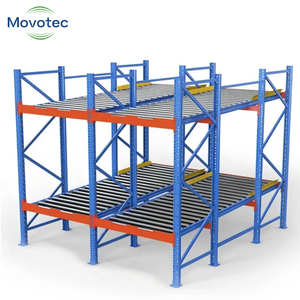
- Generation 2 (Gravity Pallet Flow & Push-Back Racks): Integrated dynamic gravity rollers and cart systems introduced mechanical velocity control. While this established strict First-In-First-Out (FIFO) or Last-In-First-Out (LIFO) material flows without forklift entry, mechanical wear and brake maintenance remained high.
- Generation 3 (Semi-Automated Radio Pallet Runners): Single-direction radio shuttles operating in deep storage tunnels mitigated rack impact damage. Forklifts merely placed shuttles at the lane threshold, significantly expediting pallet throughput in cold rooms and FMCG buffer depots.
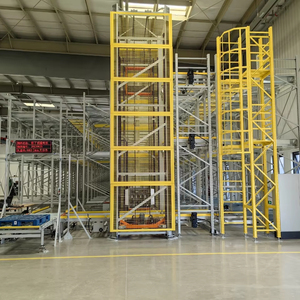
- Generation 4 (Fully Autonomous 4-Way Shuttles & AS/RS High Bays): The contemporary frontier. High-precision cold-formed steel towers exceeding 30 meters integrate with automated stacker cranes, high-speed elevators, and intelligent WMS/WCS software. Floor utilization rates climb beyond 85%, pallet dispatch latency drops to seconds, and systems operate seamlessly 24/7.
HEDA Shelves Manufacturing & Global Export Competence
Founded in 2001, Guangzhou Heda Shelves Co., Ltd. operates a 30,000 m² advanced fabrication plant, delivering complete warehouse storage systems to over 120 countries worldwide with single-source accountability.
Factory In-House Scale
30,000 m² manufacturing plant staffed by 300+ technical experts, operating automated continuous roll-forming lines.
30,000 Tons / Month
Massive monthly production capacity guaranteeing rapid fulfillment of heavy industrial & high-bay logistics contracts.
Free 3D & CAD Layouts
Complimentary architectural DWG layouts, load tables, and FEA calculations prepared before project commitment.
Euro & Global Standard
Engineered specifically for EUR/EPAL (1200×800mm) and ISO pallets under verified CE & ISO 9001:2015 certifications.
Strategic Sourcing & Engineering FAQ
How do Chinese smart racking manufacturers ensure compatibility with European EN 15512 and seismic codes?
Top-tier Chinese manufacturers utilize high-tensile structural steel (primarily Q235B and Q355B structural grades conforming to international equivalents such as S235JR and S355JR). Engineering teams utilize finite element analysis (FEA) software to model frame elastic stability, dynamic seismic loading, and beam deflection under full operational capacity. Structural calculations referencing EN 15512, EN 15620, and seismic Eurocode 8 are provided alongside certified factory CE certificates (e.g., CE No. 2435-CPR-8605159) for local structural sign-off.
What specific input data is required to generate an optimized CAD layout and price quotation?
To engineer an accurate proposal, our engineering team requires:
1. Architectural floor plan (DWG or vector PDF) showing column grids, building obstacles, service doors, and clear height under sprinkler heads.
2. Complete pallet profiles: physical dimensions (Length × Width × Height including cargo overhang) and maximum gross weight.
3. Material handling fleet specifications: forklift model, mast collapsed/extended height, turning radius (Ast), and reach capacity.
4. SKU distribution metrics and required inventory rotation rule (FIFO vs. LIFO) along with daily pallet throughput velocity.
How does 4-way radio shuttle racking compare with conventional Drive-In systems in cold storage ROI?
While conventional Drive-In racking exhibits a lower initial steel capital cost, 4-way radio shuttle racking offers dramatically superior total cost of ownership (TCO) in refrigerated facilities. Drive-In racking requires forklifts to physically enter deep lanes, causing elevated rack collision damage, slow pallet turnarounds, and severe operator fatigue in sub-zero environments. Shuttle systems eliminate forklift rack entry, boost storage density by 25–40%, lower lighting and energy loads, and reduce per-pallet refrigeration costs by upwards of 35%.
What surface treatment technologies protect racking against rust in high-humidity or cold environments?
Component durability hinges on multi-stage chemical pretreatment followed by electrostatic finishing. Steel members pass through continuous degreasing, acid pickling, phosphating, and deionized water rinsing to eradicate oxidation. Subsequently, an automated electrostatic powder coat applies thermosetting epoxy-polyester powders cured at 180°C–200°C. This yields an impact-resistant, uniform coating (60–90 μm thickness) that complies with RoHS guidelines and withstands severe temperature swings without cracking or peeling.
What are the typical manufacturing lead times and international ocean shipping arrangements?
Standard production cycles range between 15 to 30 calendar days depending on tonnage and project complexity. Materials are bundled into seaworthy steel-strapped bundles with protective plastic wrap, custom timber pallets, and numbered piece markings for container loading. Direct sea freight from our Guangzhou production base to major destination ports (such as Rotterdam, Hamburg, Antwerp, Valencia, Felixstowe, or Los Angeles) typically spans 25 to 40 days. Clear assembly blueprints and remote video installation guidance are provided with every shipment.