2001
Established Since
30,000m²
Production Complex
30,000t
Monthly Throughput
10,000+
Global Projects Handled
Factory Direct Catalog
Core Engineering: High-Density & VNA Storage Systems
Direct supply from Guangzhou manufacturing facilities. Every structural upright and beam profile undergoes strict finite-element dynamic load simulation and automated cold-roll forming.
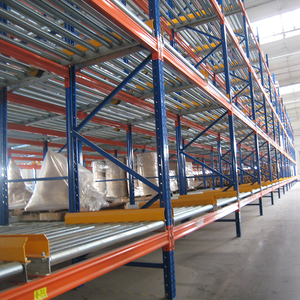
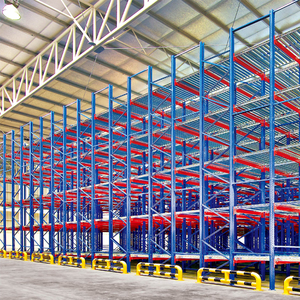
Engineering Excellence: The Mechanics of Very Narrow Aisle (VNA) Systems
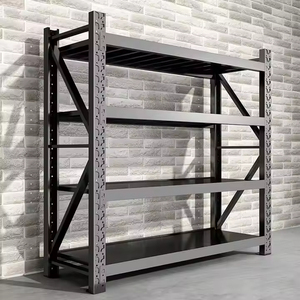
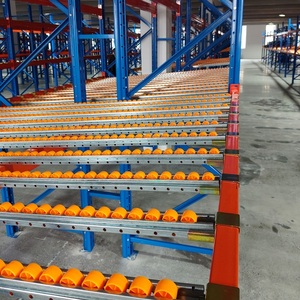
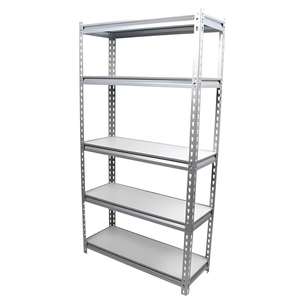
As global supply chains navigate surging industrial land acquisition costs and escalating commercial leasing rates, the transition from conventional Selective Pallet Racking to engineered Very Narrow Aisle (VNA) Racking Systems represents the definitive benchmark for space optimization. Manufactured across our automated 30,000 square meter industrial complex in Guangzhou, our VNA frameworks reduce working corridor requirements from typical counterbalanced widths (3,200 mm – 3,800 mm) down to an ultra-compact 1,500 mm – 1,800 mm footprint. This structural reconfiguration reclaims up to 45% to 50% of otherwise unutilized horizontal floor space, permitting high-bay vertical configurations scaling up to 18 meters without sacrificing structural integrity.
Technical Insight: By channeling lift assets through dedicated floor-anchored low-profile guide rails (typically 100×50×5mm cold-formed angles) or inductive wire-guidance frequencies, lateral sway tolerances are held within sub-millimeter allowances. This design completely eliminates horizontal mast collision risks during simultaneous hoisting and high-bay traverse cycles.
Optimized Steel Metallurgical Standards: Q235B & Q355B Grade Profiles
Our VNA structural uprights are precision roll-formed from premium certified cold-rolled high-tensile steel coils sourced from premier mills (Baosteel and Shougang). Utilizing proprietary 13-to-18-stage cold-roll-forming profiles, we engineer upright frames with high moment-of-inertia cross-sections. Beam-to-column connections utilize heavy-duty 4-claw and 5-claw high-ductility connector plates locked with automatic spring-steel safety pins. This configuration prevents dynamic dislodgement caused by high-cycle man-up turret trucks and automated articulated reach cranes operating under relentless multi-shift schedules.
Surface Passivation and Corrosion Mitigation
Longevity under cold storage, ambient humidity, and chemical exposure environments is guaranteed through an integrated 10-step surface pre-treatment line. Uprights and horizontal beams undergo automated continuous shot blasting, acid pickling, zinc phosphating, and deionized neutralization before entering automated electrostatic powder coating booths. Finished components achieve an architectural-grade polyester resin cure (70 to 90 microns thickness), achieving superior salt-spray corrosion resistance that surpasses DIN 50021 and ASTM B117 standards.
Direct Factory Advantage
Why Global Logistics Engineers Partner With Our Factory
From initial DWG structural schematics to certified seaworthy sea containers, we deliver an end-to-end original manufacturing workflow that removes distributor markups.
Accredited Certifications
Fully compliant with CE Certificate No. 2435-CPR-8605159, ISO 9001:2015 quality control criteria, and validated against EN 15512 and EN 15620 engineering thresholds.
Complimentary Engineering & CAD
Our dedicated structural engineering department provides free 3D modeling, finite element stress reports, seismic analysis, and custom bay layout calculations prior to project sign-off.
Massive Scale & Fast Lead Times
With an active monthly output reaching 30,000 metric tons, standard batch orders ship within 15 to 25 days, supported by automated CNC punching and robotic laser profiling cells.
International Turnkey Exporting
Turnkey FOB, CIF, or DDP logistics management across Europe, the Americas, and Australasia, complemented by color-coded component tagging and step-by-step structural erection blueprints.
Future Sourcing & Procurement Trajectories in VNA Infrastructure
Procuring industrial racking has moved well beyond comparing bulk steel tonnage pricing. Corporate asset managers, facility planners, and 3PL procurement executives now implement strict life-cycle evaluation frameworks. Understanding how automated hardware, environmental governance, and modern material handling systems intersect is vital for mitigating long-term capital risk.
AGV & AMR Integration
Traditional manually-steered turret trucks are rapidly yielding ground to autonomous mobile robots and automated guided VNA lift trucks. Future-proof procurement requires ultra-tight bay deflection standards (L/300 or tighter) and exact floor anchoring to facilitate uninterrupted optical and LiDAR robot docking.
Standardized Modular Compatibility
Global warehouse operators increasingly require standardized beam pitching (50mm or 75mm Euro-increments) that can interface directly with standard Euro pallets (1200×800mm) and ISO containers without requiring costly bay welding or column cutting during retrofit cycles.
ESG & Carbon Border Compliance
With stringent trade guidelines such as the European Union's Carbon Border Adjustment Mechanism (CBAM), smart sourcing mandates verifiable scrap-rate reductions, low-emission automated powder recovery facilities, and non-toxic zinc phosphate pretreatment systems.
Dynamic Safety and Preventative Structural Maintenance
Modern high-bay VNA racks bear substantial static and dynamic loads. A single bay failure at an 18-meter elevation presents severe life-safety and operational continuity hazards. Next-generation installations combine physical safety barriers—such as heavy-gauge wrap-around column protectors, reinforced end-of-aisle bollards, and dynamic back-stop safety netting—with real-time sensor monitors. Our structural teams evaluate dynamic seismic zones, wind suction (for rack-supported warehouse buildings), and building slab geotechnical parameters to engineer balanced base-plate footprints that distribute high axial stresses safely into the underlying foundation.
Procurement Directives
Frequently Asked Questions: Technical Sourcing & Compliance
Clear, direct answers addressing structural standards, tolerances, shipping ergonomics, and factory warranties.
What warehouse floor slab specifications are required for a high-bay VNA racking system?
VNA installations operating above 10 meters mandate super-flat floor profiles conforming to DIN 18202 (Table 3, Line 4) or the TR34 'Free Movement' (FM2/FM1) classification standards. Minimal floor waviness and strict levelness prevent mast wobble and dynamic harmonic sway as the man-up reach truck moves under peak payload conditions.
Can HEDA factory customize beam profiles to match mixed Euro and US pallet footprint sizes?
Yes. Our roll-forming tooling can produce custom clear-entry lengths—from standard 2,700mm bays (for three Euro 1200×800mm pallets) to 2,300mm configurations (for two US 48×40-inch pallets). We calculate precise structural overhang margins (50mm–100mm) and include heavy-duty drop-in wire decks or cross-pallet support bars where required.
What engineering documentation accompanies factory export shipments?
Every export shipment includes comprehensive Mill Test Certificates (MTC) proving steel tensile and chemical compositions, CE Declarations of Performance, certified 3D CAD fabrication diagrams, finite element deflection reports, and stamped loading calculation placards conforming to EN 15635 compliance rules.
What are the primary differences between mechanical rail guidance and wire guidance systems?
Mechanical guidance uses cold-formed structural angle steel (typically 100×50×5mm) bolted to the concrete slab, creating an impenetrable physical rail for lateral guide wheels. Wire guidance involves cutting a thin channel into the warehouse slab to lay a low-frequency energized antenna wire. Mechanical rails offer superior physical impact resistance at lower initial tech complexity; wire guidance frees up lower level ground clearance and simplifies overall floor sanitation.
What packaging and moisture prevention safeguards protect products during long ocean transits?
All components undergo automated seaworthy packaging. Upright frames and beams are nested on heavy wooden skids, banded with heavy steel strapping, separated by corrugated foam buffering, and completely enclosed in heat-shrink polyethylene stretch wrap with industrial desiccant bags. This keeps profiles pristine and rust-free throughout 30- to 45-day ocean transit cycles.
Design Your VNA System With Our Senior Storage Engineers
Submit your warehouse layout (DWG or PDF), target clear heights, and material handling truck specifications. Our factory engineering team will return a certified structural CAD proposal and competitive wholesale factory quote within 24 business hours.
Contact Us