Standard & Custom Fabricated Warehouse Racks
Precision-formed roll profiles utilizing certified high-tensile Q235B and Q355B coil stock. Built for heavy-payload pallet integration, high-cube automated shuttles, and specialized distribution logistics.
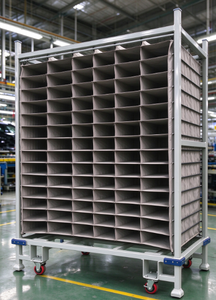
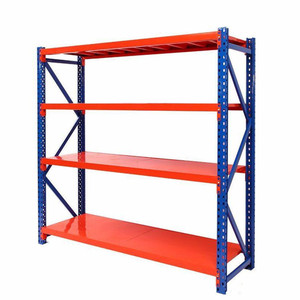
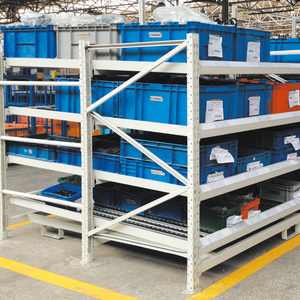
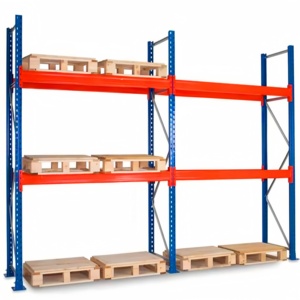
The Engineering Core: Cold-Rolled Forming, Load Dynamics, and Deflection Limits
High-performance OEM/ODM warehouse racking requires strict alignment between mechanical yield thresholds, cross-sectional geometry, and torsional elasticity. Our cold-roll forming processes convert prime steel coil into structural systems that strictly satisfy global engineering criteria.
Certified Coil Chemistry: Q235B vs. Q355B
Structural performance begins with certified steel coil chemistry. We source verified cold-rolled continuous sheets exhibiting minimum yield strengths of 235 MPa (Q235B) for standard high-density configurations and 355 MPa (Q355B) for ultra-tall automated upright frames. Every batch undergoes tensile elongation, impact toughness, and carbon-equivalent weldability verifications (C ≤ 0.20%, P ≤ 0.045%, S ≤ 0.045%).
Deflection Criteria (L/200 vs. L/250)
In compliance with EN 15512 and FEM 10.2.02 guidelines, beam deflection under maximum working uniform distributed loads (UDL) is structurally engineered to maintain a safety limit not exceeding L/200 for standard pallet setups and L/250 for automated retrieval channels. This prevents dynamic displacement during MHE (Material Handling Equipment) loading maneuvers and eliminates premature fatigue in welded beam connector pins.
Precision Upright Profile Geometry
Continuous roll-forming lines execute multi-station gradual cold bending with up to 18 rolling passes. This eliminates internal residual stress within the profile corners, ensuring cold-hardened structural steel columns with web thicknesses from 1.5mm to 3.0mm. Punching dies provide a precise 50mm, 75mm, or 76.2mm pitch pattern with an allowable hole pitch tolerance within ±0.1mm across a 12-meter continuous span.
The 10-Step Heavy-Duty Fabrication Workflow
Total traceability from bare hot/cold-rolled steel coils to finished epoxy-powder systems ready for maritime container dispatch. Every station runs against predetermined ISO 9001:2015 QC criteria.
Raw Material Audit
Spectrometry and ultrasonic testing verifying sheet thickness, yield tolerance, and uniform carbon structure.
Precision Slitting
CNC rotary shear decoiling lines slit coils into dimensionally stabilized profile strips with cut edges deburred.
Automated Punching
Continuous servo punches pierce teardrop, diamond, or hex upright holes with zero cumulative pitch drift.
Multi-Pass Cold Roll
Gradual 14-to-18 station roller sets form complex closed box beams and multi-flanged omega upright sections.
Flying Cut-to-Length
High-speed hydraulic flying saw blades cut running members at mill tolerances within ±0.5mm linear accuracy.
Robotic Beam Welding
Dual-torch robotic fixtures weld 3-claw and 4-claw connector plates onto step beams under CO2/Argon shielding.
Chemical Pretreatment
Submersion pickling and zinc phosphating remove rolling scale and oils, creating an anti-corrosion etch primer.
Electrostatic Powder
Automated electrostatic spray booths apply high-adhesion polyester resin coatings at 60-80μm uniform thickness.
High-Temp Curing
Gas-fired tunnel ovens cure polymer chains at 180°C-200°C for 25 minutes, achieving pencil hardness ≥ 2H.
Export Bundling & NDT
Ultrasonic weld inspection, cross-hatch adhesion verification, steel banding, and ocean-freight palletization.
Strategic Procurement Shifts: 2025–2030 Warehouse Storage Trends
Procurement teams and EPC logistics developers are moving away from commodity steel purchases toward integrated system readiness. The following parameters represent current baseline expectations for Tier-1 supply chains.
1. High-Bay AS/RS & Shuttle Tolerances
Traditional manual pallet rack tolerances (±3.0mm) are no longer sufficient for automated systems. Next-generation automated pallet shuttles, automated guided vehicles (AGVs), and stacker cranes running above 14 meters require structural tolerance control matching EN 15620 Class 300 / 400. Millimetrical rail leveling, zero-deviation runout, and pre-engineered sensor mounting points are standard OEM design requirements.
2. Seismic Damping & Dynamic Base Anchors
Industrial zoning across seismic belts (e.g., Eurocode 8, RMI MH16.1 seismic zones 3-4, AS 4084) requires ductile moment-resisting baseplates and anchored dynamic shims. OEM engineers must run finite-element modal simulations to prevent second-order P-Delta collapse effects during ground accelerations, balancing horizontal elastic drift with floor slab shear capability.
3. Traceable Low-Emissions EPD Steel
Corporate ESG benchmarks and European Carbon Border Adjustment Mechanism (CBAM) compliances demand audited material provenance. Enterprise procurement requires mills providing verified Environmental Product Declarations (EPDs), utilizing scrap-supplemented Electric Arc Furnace (EAF) production lines to reduce the embedded carbon footprint per stored pallet position.
Storage System Engineering Matrix & Comparative Metrics
Compare mechanical properties, aisle configurations, and capital expense trade-offs to select the optimal OEM racking configuration for your floor layout and forklift fleet.
| Racking Topology | Floor Space Utilization | Selectivity Ratio | Stock Rotation Strategy | MHE Requirement | Optimal Industry Application |
|---|---|---|---|---|---|
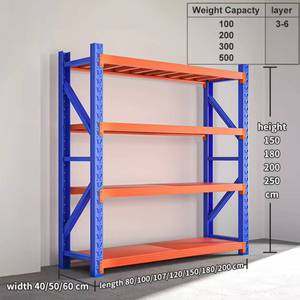
| Selective Pallet Racking | 40% - 45% | 100% Direct Pick | FIFO / Random Access | Counterbalance / Reach Truck | 3PL hubs, wholesale retail, fast-moving mixed SKUs |
| Double Deep Racking | 55% - 60% | 50% Immediate Access | LIFO | Deep-Reach Pantograph Forklift | Dry goods, paper printing, multi-pallet per SKU batches |
| Drive-In / Drive-Thru | 65% - 75% | 15% - 20% Direct Access | LIFO (FIFO if Drive-Thru) | Narrow Counterbalance / Reach | Cold storage, bulk beverage, seasonal commodity warehousing |
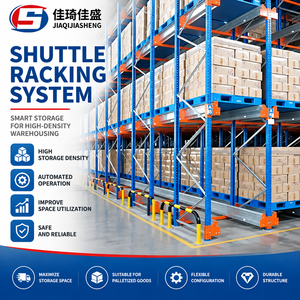
| Radio Shuttle Automation | 75% - 85% | Lane-Level Selectivity | Automated FIFO / LIFO | Standard Forklift + Battery Carrier | High-throughput cold chain, automated meat/dairy, fast FMCG |
| Gravity Flow Racking | 70% - 80% | 100% Face Pick Row | Strict Mechanical FIFO | Standard Handling Fleet | Pharmaceutical, food expiration-sensitive cross-docking |
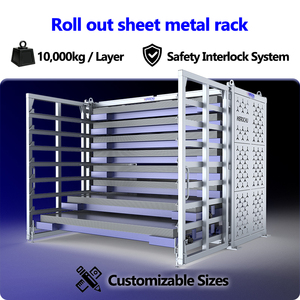
| Heavy Duty Cantilever | Linear Footprint | 100% Frontal Linear Access | Variable Batch Pick | Side Loader / Four-Way Truck | Structural timber, PVC conduits, steel coils, sheet stock |
| Rack-Supported Mezzanine | 100% - 200% Floor Area Gain | 100% Deck Access | Manual Sort / Conveyor Integration | Pedestrian, Pallet Jack, VRC Lift | E-commerce fulfillment centers, automotive parts distribution |
Technical & Commercial Due Diligence FAQ
Answers to standard technical inquiries posed by logistics directors, civil engineers, and supply chain managers during structural audits and RFP processes.