Featured Industrial Storage & Warehouse Racking Solutions
Engineered to comply with strict international standards (EN 15512, FEM 10.2.02, and ANSI MH16.1), our heavy-duty racking configurations maximize vertical cube utilization, streamline pallet handling throughput, and guarantee absolute structural stability.
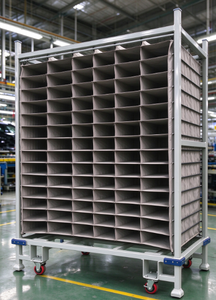
Heavy Duty Steel Automotive Parts Storage Rack Powder Coated Floor-Standing Bumper Shelf
- Custom cantilevered tubular steel arms
- Protective rubber bumper padding
- Electrostatic chip-resistant powder coating
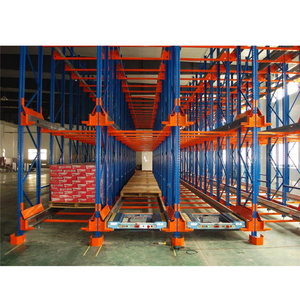
Heavy-Duty Steel Warehouse Racks with Automated Radio Shuttle Racking Equipment
- High-density FIFO & LIFO lane navigation
- Cold chain certified down to -25°C
- Payload up to 1,500 kg per pallet runner
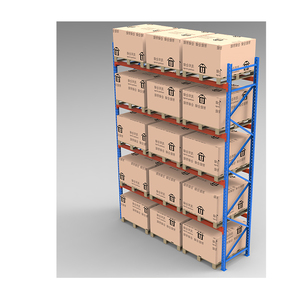
Heavy Duty Adjustable Metal Shelves Racking System Stacking Warehouse Storage Pallet Rack
- 100% direct accessibility to every SKU
- Pitch adjustability on 50 mm / 75 mm increments
- Beam capacities rated up to 4,500 kg/pair
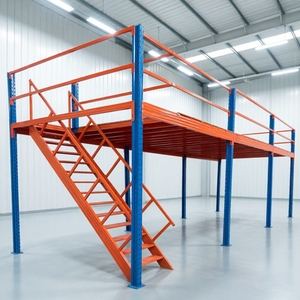
Competitive Price Heavy Duty Steel Mezzanine Floor Rack System Warehouse Loft Platform
- Multi-tier structural or rack-supported formats
- Decking capacity: 300 to 1,200 kg/m²
- Integrated safety handrails, stairs & drop gates
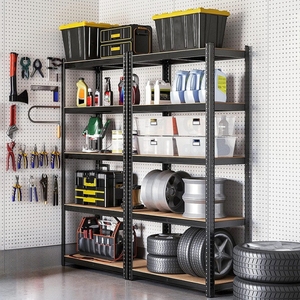
5-Level Boltless Steel Warehouse Storage Rack Slotted Angle Adjustable Shelving System
- Quick rivet-lock assembly without hardware
- Load capacity: 150 - 300 kg per tier
- Cold-rolled steel decks or wire decking option
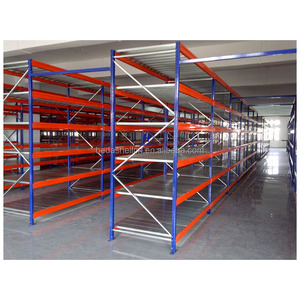
Factory Storage Shelves Garage 4 Layer Long Span Rack System Medium Duty Shelving
- Optimal for hand-loaded unpalletized cartons
- Span widths up to 2,500 mm per clear bay
- Interchangeable steel plates or wire mesh shelves
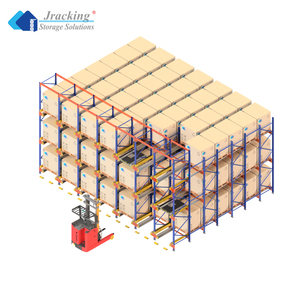
Jracking Automatic Warehouse System Four Way Radio Shuttle Rack Automated Pallet Runner
- Omnidirectional lateral & longitudinal travel
- Full WCS & WMS software integration
- High-speed battery swap / rapid auto-charging
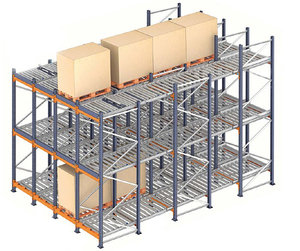
Steel Heavy Duty Large Load Capacity Gravity Pallet Racking System for Food Beverage
- Pure mechanical gravity roller track decline
- Strict First-In First-Out (FIFO) rotation
- Integrated centrifugal speed controller brakes
Evaluating the Top 10 Shelving Warehouse Manufacturer & Factory Landscape
Selecting an industrial shelving and pallet racking partner requires auditing technical manufacturing capabilities rather than relying merely on catalog marketing. Leading international original equipment manufacturers (OEMs) operate under rigorous structural testing protocols, automated roll-forming quality gates, and high-yield steel certifications.
| Evaluation Parameter | Tier-1 Factory Standard (e.g. HEDA Shelves) | Generic Commodity Manufacturer | Impact on Logistics TCO & Risk |
|---|---|---|---|
| Steel Grade & Metallurgy | Certified Q235B / Q355B (equivalent to European S235JR & S355JR) mill-tested high tensile coils. | Uncertified secondary scrap or inconsistent hot-rolled sub-grades lacking yield test sheets. | Catastrophic Risk Potential unexpected upright buckling under rated dynamic pallet drop loads. |
| Roll-Forming Tolerances | Continuous multi-station cold roll-forming lines with cross-section profile tolerance within ±0.5 mm. | Manual brake press bending or low-station roll lines with angular twisting exceeding 2.0 mm per meter. | Operational Friction Misaligned connector tabs, unstable beam clip locks, and severe out-of-plumb bays. |
| Surface Pretreatment & Coating | Full 8-stage automated chemical immersion (degreasing, acid pickling, phosphating) + electrostatic powder cure. | Simple manual solvent wipe-down followed by single-pass air-dry paint or low-cure spray. | Corrosion Hazard Early delamination, blistering rust, and rapid failure in ambient humidity or cold store environments. |
| Structural Design Compliance | Full adherence to EN 15512:2020, EN 15620, FEM 10.2.02, and ANSI/RMI MH16.1 specifications with PE stamps. | Generic unverified load estimates without Finite Element Analysis (FEA) or beam deflection criteria. | Insurance Liability Facility shutdown by local health and safety labor inspectors (e.g., OSHA, HSE, CE audits). |
| Seismic Engineering Capability | Site-specific seismic calculation packages factoring ground acceleration parameters (Eurocode 8, ASCE 7). | One-size-fits-all static baseplates with standard wedge anchors regardless of geographic seismic zone. | Asset Protection Complete structural integrity and life safety during progressive cyclic seismic events. |
Continuous Cold-Form Profile Automation
Premier manufacturing facilities maintain continuous automated punch and roll-forming setups. Upright profiles (such as 80mm, 90mm, 100mm, and 120mm Omega posts) are cold-formed through up to 24 progressive rolling passes. This eliminates localized residual stress while guaranteeing uniform wall thickness and absolute hole pitch accuracy for hook-in beam connectors.
Pretreatment & Anti-Corrosion Chemistry
The durability of industrial warehouse racking is deeply dependent on steel passivation. Industrial rack factories utilize automatic multi-stage hot alkaline washing, pickling to dissolve mill scale, and zinc-iron phosphating. This establishes a micro-porous conversion layer that anchors the electrostatic thermosetting powder coat (60-80 microns thickness) and guarantees salt-spray resistance exceeding 500 hours.
Empirical Testing & Stub Column Analysis
Genuine factory engineering relies on real-world destructive testing rather than theoretical estimates alone. Standard quality protocols mandate regular stub column compression tests, beam end-connector cantilever tests, and cyclic weld shear testing. These physical testing regimens establish precise moment-rotation curves used in non-linear structural design calculations.
Future Warehouse Racking Procurement Trends (2025–2035)
Modern distribution logistics is experiencing a major transformation driven by soaring urban land costs, severe labor constraints, e-commerce order profiling, and stringent ESG compliance mandates. Enterprise procurement teams must strategically future-proof their racking investments.
01. Transition to 4-Way AS/RS High-Density Radio Shuttles
While traditional selective racking yields approximately 40% floor area cube utilization, robotic 4-way shuttle systems achieve upwards of 85% storage density. The industrial supply chain is aggressively adopting automated pallet runners capable of horizontal and lateral travel inside specialized deep-lane rails. These systems eliminate traditional forklift driving aisles, lower energy consumption in temperature-controlled cold stores by 45%, and operate under lights-out 24/7 automated control.
02. Multi-Tier Mezzanine Engineering vs. New Civil Construction
With industrial real estate lease rates climbing across primary transport corridors, warehouse operators are prioritizing vertical volume over horizontal square footage. Installing multi-level structural steel platforms and rack-supported mezzanine floors offers up to a 300% floor space increase within an existing facility footprint. This eliminates zoning hurdles, lengthy building permits, and major capital expenditure associated with new brick-and-mortar facilities.
03. Low-Carbon Green Steel Metallurgy & Recyclable Finishes
Scope 3 carbon emissions are rapidly becoming central to corporate supply chain audits. Leading rack manufacturers are transitioning to scrap-based Electric Arc Furnace (EAF) steel coils, reducing the carbon intensity per ton of fabricated racking by more than 60% compared to traditional blast furnace methods. Furthermore, heavy solvent-based paints are completely replaced by zero-VOC, heavy-metal-free TGIC electrostatic powder coatings that are 100% recyclable in production recovery booths.
04. BIM Level 3 Modeling & Real-Time IoT Structural Health
The procurement of warehouse racking is migrating from static 2D DWG drafting to cloud-collaborative Building Information Modeling (BIM Level 3 / Revit). This enables precise clash detection against HVAC ducting, ESFR sprinkler systems, and structural building columns. In automated high-bay facilities, upright baseplates are increasingly pre-fitted with wireless strain gauges and 3-axis IoT impact sensors that alert logistics managers to accidental forklift strikes in real time before systemic collapse occurs.
Ready to future-proof your upcoming logistics hub layout?
Our application engineering team provides comprehensive BIM modeling, dynamic pallet flow design, and seismic load analyses.
Structural Engineering Principles & Design Standards
Warehouse racking systems are skeletal steel civil structures subjected to complex dynamic, live, and seismic load interactions. Ensuring absolute workplace safety requires adhering to rigorous engineering codes during layout conception and structural roll-forming.
Deflection Limit Criteria (L/200 vs L/300)
Under European EN 15512 and US RMI MH16.1 codes, the maximum allowable vertical deflection for a pallet beam under full rated service load is restricted to δ = L / 200 (where L is the clear bay span). For automated crane-served AS/RS or specialized radio shuttle lanes, deflection is restricted to δ = L / 300 to prevent mechanical binding of robotic carriers and ensure clean pallet entry.
Perforation Geometry & Upright Buckling
The perforations along upright columns (diamond, teardrop, or slotted profiles) enable beam height adaptability, but also introduce localized buckling vulnerabilities. Advanced manufacturers use custom cold-formed Omega profiles engineered with stiffening ribs along the column flanges and web. This geometry maximizes the section modulus and raises the torsional-flexural buckling resistance under elevated axial compressive loads.
Safety Lock Connectors & Shear Pins
Beam-to-column connection joints represent a primary point of dynamic shear during pallet loading. Modern beams utilize welded 3-claw or 4-claw end connectors with high wrap-around engagement around the upright. Each connector is fitted with an autonomous steel safety lock pin rated to withstand an upward vertical dislodgement force exceeding 5,000 N, preventing accidental beam disengagement during rapid forklift extraction.
The 10-Stage Industrial Manufacturing Protocol
Raw Material Metallurgical QA
Spectrometric verification of chemical composition, yield strength, and tensile limits on all incoming steel coils.
CNC High-Speed Slitting
Precision coil slitting into calibrated widths with edge conditioning to eliminate micro-burrs prior to forming.
Automated Pitch Punching
Continuous mechanical press punch lines cutting 50mm / 75mm teardrop and slot arrays with zero accumulated pitch error.
Multi-Stage Cold Roll-Forming
Up to 24 progressive roll passes shaping high-rigidity Omega uprights, step beams, and interlocking box beams.
Automated High-Frequency Welding
Robotic seamless seam welding of beam bodies and end connectors guaranteeing uniform weld penetration and zero slag.
Shot Blasting & Surface Conditioning
Centrifugal shot blasting achieving Sa 2.5 surface cleanliness, stripping rust, grease, and mill scale completely.
Multi-Stage Chemical Phosphating
Automated immersion pickling, rinsing, and zirconium/phosphating producing a dense anti-corrosive passivation seal.
Electrostatic Powder Application
Automatic reciprocating spray guns applying heavy-duty thermosetting polyester/epoxy resin powder evenly across all profiles.
Infrared Thermal Polymerization
Continuous 200°C curing oven guaranteeing thorough cross-linking, superior chip-resistance, and high impact tenacity.
Seaworthy Export Bundling
Protective corner guards, moisture-resistant heat-shrink wrapping, and timber dunnage packing for ocean transport.
Why Tier-1 3PLs & Industrial Distributors Source Direct from HEDA Shelves
Founded in 2001, Guangzhou Heda Shelves Co., Ltd. has evolved into an elite global manufacturing powerhouse specializing in high-load pallet racking, radio shuttle AS/RS setups, and multi-tier mezzanine engineering. By bypassing commercial trading intermediaries, our global enterprise clients unlock significant cost efficiencies, direct structural engineering oversight, and predictable factory lead times.
Audited Certifications: CE & ISO 9001:2015
Complete traceability and international regulatory acceptance. We hold accredited CE Certificate No. 2435-CPR-8605159, certified ISO 9001:2015 (Certificate No. 18624Q00169R0M), and formal RoHS compliance documentation. Our load calculation notes and structural PE stamps seamlessly clear local European, North American, and Australian municipal building audits.
Complimentary 3D & CAD Layout Consultation
Eliminate costly site installation clashes before placing manufacturing orders. Our dedicated team of 30+ warehouse layout engineers reviews your DWG building plans, clear ceiling heights, column grids, forklift aisle turn radii, and pallet profile specifications to deliver complete 3D layout visual models, bay elevation load diagrams, and comprehensive bill of materials free of charge within 24 hours.
Direct Global Seaport Shipping & OEM Labeling
Our direct export operations feature scheduled maritime freight shipments to leading international transshipment hubs, including Rotterdam, Hamburg, Antwerp, Valencia, Felixstowe, Los Angeles, and Jebel Ali. For overseas racking distributors, installers, and system integrators, we provide custom OEM/ODM private-label packaging, branded load capacity warning plates, and custom RAL powder coat matching.
Frequently Asked Questions: Warehouse Shelving & Racking Procurement
Authoritative answers addressing engineering tolerances, pallet sizing configurations, international freight logistics, and structural safety verification.
Can your selective racking systems accommodate European Standard (EUR/EPAL) and US Standard pallets?
What structural calculation documentation and certificates accompany factory shipments?
What is the standard production lead time and ocean transit schedule to major seaports?
How do you prevent transit abrasion, salt-spray corrosion, and container loading damage?
Can our engineering or third-party auditing team inspect the factory before shipment?
How does a Rack-Supported Mezzanine compare economically to a Structural Mezzanine?
What essential facility data is required to generate a complete custom CAD layout?
Do you offer OEM private-label manufacturing for regional shelving distributors?
Request an Engineered Layout & Factory Cost Estimate
Send your project parameters to our structural engineering team. We deliver complete 3D warehouse layout models, certified bay load calculation sheets, and competitive direct factory pricing within 24 hours.
- Free DWG / Revit Layout Design
- EN 15512 & RMI Certified Math
- Direct Factory Pricing (No Broker)
- Full Seaport Logistics Support
Connect with a senior racking application engineer. We review technical specifications in fluent English.
Inquire Now