Engineered Heavy-Duty Racking & Industrial Storage Systems
Precision-machined structural configurations designed for high-bay stability, strict dynamic load capacities, and seamless integration with modern material handling equipment (MHE).
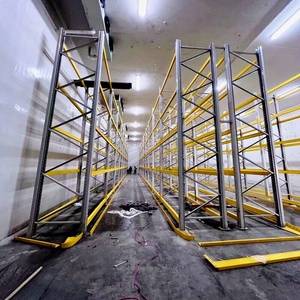
Heavy Duty VNA Metal Warehouse Storage Rack
Very Narrow Aisle (VNA) system reducing aisle widths up to 50% for maximized cube utilization with wire-guided or mechanical rail turret trucks.
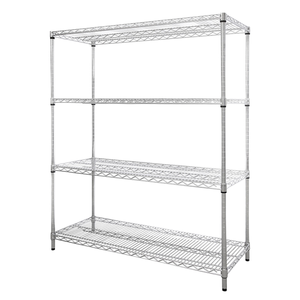
5-Tier Chrome Wire Mesh Industrial Shelving
Heavy-duty open wire ventilation shelving engineered to minimize dust accumulation, facilitate ESFR sprinkler penetration, and resist industrial corrosion.
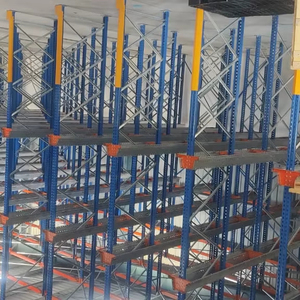
High-Density Drive-In Pallet Racking System
Continuous lane storage eliminating work aisles for uniform SKU batches, cold storage facilities, and bulk manufacturing operations requiring 1200kg+ capacity.
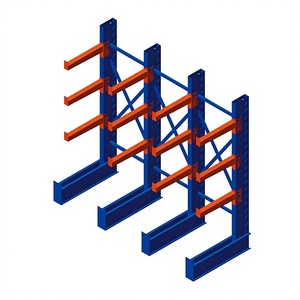
Industrial Structural Cantilever Racking
Unobstructed frontal access for non-standard, linear profiles including timber, steel bars, plastic extrusions, and heavy sheet stock with modular arm configurations.
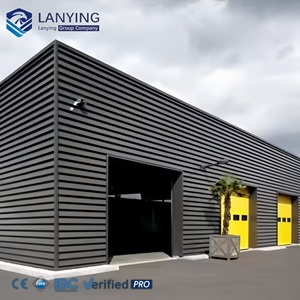
Prefabricated Logistics Steel Structure Warehouse
Turnkey prefabricated portal frame engineering designed concurrently with internal racking grid points to eliminate internal column-to-rack spatial interference.
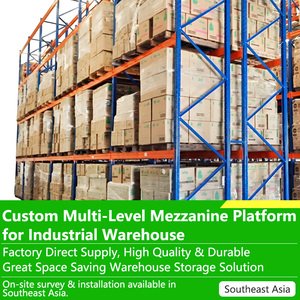
Selective Heavy Duty Pallet Racking
The benchmark storage architecture for distribution hubs requiring 100% direct access to every SKU, featuring 75mm/50mm pitch adjustable beam levels.
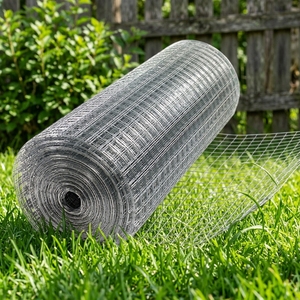
Anti-Collapse Galvanized Wire Mesh Decking
High-tensile wire mesh containment and flue-space safety cladding preventing rear pallet slippage, product fall-through, and ensuring flue integrity under NFPA codes.
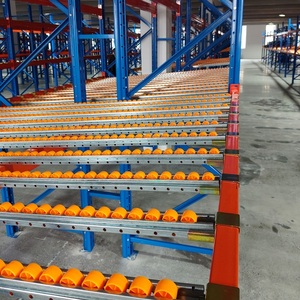
Dynamic Gravity Pallet Flow Racking
Gravity-driven inclined roller tracks providing flawless First-In, First-Out (FIFO) stock turnover with integrated centrifugal speed controllers for perishables.
Why Global Distribution Centers Rely On HEDA Shelves
Guangzhou Heda Shelves Co., Ltd. (established in 2001) operates a state-of-the-art 30,000 square meter integrated manufacturing facility, delivering turnkey storage solutions to over 120 countries.
Stringent EN & ISO Certification
Full compliance with European Racking Standard EN 15512:2020 and EN 15620. Audited and certified under CE Certificate No. 2435-CPR-8605159 and ISO 9001:2015 No. 18624Q00169R0M with independent mechanical stress testing.
Automated Precision Cold-Forming
Employing high-yield cold-rolled structural steel (Q235B and Q355B). Continuous automated punch lines guarantee sub-millimeter hole spacing accuracy on uprights, ensuring beam connectors lock with zero play to mitigate frame sway.
Turnkey Engineering & Free 3D CAD
Comprehensive layout consultation before commercial commitment. In-house engineering teams produce structural calculations, slab load assessments, seismic anchoring configurations, and 3D architectural CAD drawings matching regional building codes.
Engineering Foundations: Mechanical Integrity & Load Mechanics
An in-depth structural review of beam deflection criteria, frame buckling calculations, seismic shear forces, and surface pre-treatment chemistries.
Industrial heavy-duty racking systems are not static steel furniture; they are complex, unbraced or semi-braced civil steel structures subjected to combined dynamic, dead, and live transient loads. Structural failure in high-bay racking systems often cascades catastrophically, endangering warehouse personnel and causing catastrophic inventory destruction. Therefore, evaluating a top-tier racking manufacturer requires an rigorous audit of their mathematical modeling, yield strength ratings, and adherence to international design codes including FEM 10.2.02 (European Federation of Materials Handling), EN 15512, and RMI ANSI MH16.1 (Rack Manufacturers Institute).
The Engineering Physics of Beam Deflection Limits (L/200 vs L/300)
Under standard EN 15512 guidelines, beam deflection under maximum uniformly distributed load (UDL) must not exceed δ = L / 200 for standard pallet storage, where L is the clear distance between uprights. However, when deploying automated guided vehicles (AGVs), automated storage and retrieval systems (AS/RS), or fragile handling goods, deflection must be tightly engineered to δ = L / 300 or tighter. Excessive beam sag induces diagonal vector loads against upright column lugs, causing plastic deformation at the connector plate and premature disengagement of safety locking pins.
In selective and double-deep racking, the connection between the vertical upright frame and the horizontal box beam is governed by a semi-rigid joint characteristic, parameterized as rotational stiffness (Cd). Lower-tier manufacturers produce connectors with loose tolerances, forcing the structural frame to absorb excessive lateral sway during lift-truck loading cycles. High-precision cold-formed uprights utilize Omega-profile geometries or multi-flanged diamond punch patterns that yield higher section moduli (Wz) with optimized steel mass, directly preventing torsional flexure and torsional-flexural buckling under concentrated axial loads.
| Racking Topology | Pallet Selectivity | Floor Footprint Utilization | Operating Aisle Width | MHE Compatibility | Relative Capital Expenditure |
|---|---|---|---|---|---|
| Selective Pallet Racking | 100% (Instant) | 35% - 40% (Baseline) | 3.0m - 3.8m | Standard Counterbalance, Reach Truck | Low / Baseline |
| Very Narrow Aisle (VNA) | 100% (Instant) | 55% - 65% (High) | 1.6m - 1.9m | Articulated Trucks, Wire-Guided Turrets | Moderate |
| Drive-In / Drive-Through | 15% - 20% (LIFO/FIFO) | 70% - 80% (Ultra-Dense) | Driven Lane Specific | Counterbalance, Narrow-Chassis Reach | Moderate |
| Pallet Flow (Gravity Roller) | Strict FIFO by Lane | 75% - 85% (Continuous) | Loading & Discharge Aisles | All Standard Forklift Fleets | High (Dynamic Rollers) |
| Semi-Automated Radio Shuttle | FIFO or LIFO by Level | 80% - 90% (Maximum Cube) | Single Transfer Aisle | Shuttle Cart + Reach / Forklift | High (Automated) |
Beyond structural load profiles, surface longevity dictates the lifecycle return on investment (ROI). Industrial warehouse atmospheres are regularly subjected to abrasive micro-particulates, chemical emissions from battery-charging rooms, and extreme condensation cycles in cold-chain logistics. Standard air-dried wet paint systems quickly degrade, crack, and expose the underlying carbon steel to oxidation. HEDA Shelves utilizes a 10-step surface finishing regimen incorporating automated shot-blasting, pickling, acid phosphating, and electrostatic epoxy-polyester powder thermosetting cured at 180°C–200°C. This chemical-thermal bonding achieves an average coating thickness of 60–80 microns, providing salt spray corrosion resistance exceeding 500 hours according to ASTM B117 protocols.
The Evolution of Heavy-Duty Racking: 2025–2030 Roadmap
As warehouse operations transition toward lights-out automation and rigorous ESG governance, structural racking procurement is undergoing structural disruption.
1. Convergence with Autonomous Mobile Robots (AMR/ASRS)
Traditional static racking is increasingly required to interface directly with robotic automated storage retrieval systems (AS/RS), 4-way shuttles, and vision-guided AGVs. This demands ultra-tight manufacturing tolerances (Class 100/200 according to EN 15620) where rack plumbness, rail alignment deviation, and deflection under dynamic braking must not exceed ±1.5mm across vertical bays.
2. Digital Twin Sensors & Structural Health Monitoring
Next-generation racking frameworks integrate IoT strain gauge sensors, laser impact detectors, and RFID inventory tags directly into upright columns. These modules feed telemetry to warehouse management software (WMS), calculating cumulative structural fatigue, registering forklift collisions instantly, and predicting necessary maintenance before catastrophic failure occurs.
3. Decarbonized Steel & Circular Supply Chain Standards
Procurement directors across North America and the European Union are prioritizing Scope 3 emissions under CBAM (Carbon Border Adjustment Mechanism). Forward-thinking racking suppliers are adopting electric arc furnace (EAF) low-carbon recycled steels, non-toxic lead-free powder formulations, and modular reusable beam clamps to facilitate future warehouse reconfigurations with minimal scrap.
Frequently Asked Technical & Sourcing Questions
Key structural, logistics, compliance, and custom manufacturing inquiries answered by senior warehouse structural engineers.
Optimize Your Warehouse Volume With Engineered Racking
Share your warehouse architectural dimensions, clear ceiling heights, and pallet specifications. Our senior structural engineers deliver a comprehensive 3D CAD proposal, load deflection table, and factory-direct quotation within 24 hours.