500kg / Layer
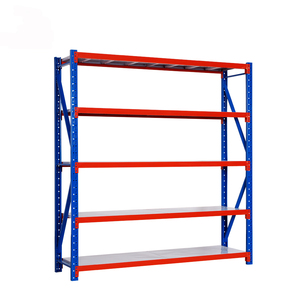
Dongguan Manufacturer Factory 500kg Loading Capacity Medium Duty Warehouse Rack
- Step-beam profile with steel decking plates
- 50mm pitch adjustable upright slots
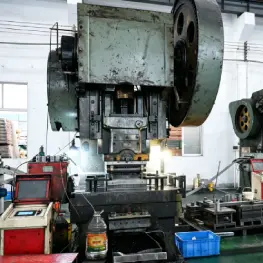
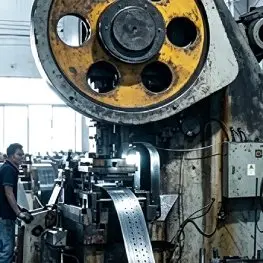
Direct-from-manufacturer heavy-duty, medium-duty, and dynamic carton flow racking systems manufactured with Q235B/Q355B structural steel, high-accuracy automatic punch profiles, and electrostatic corrosion-resistant powder coatings.
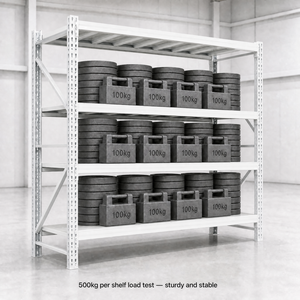
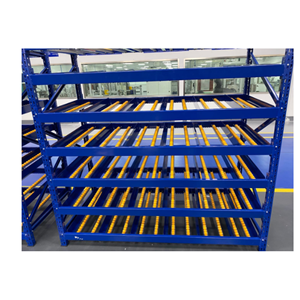
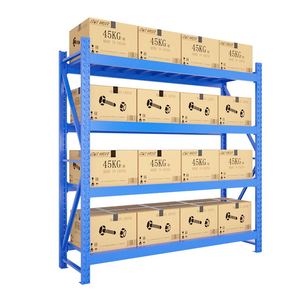
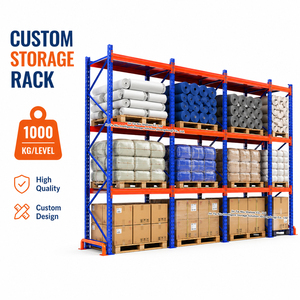
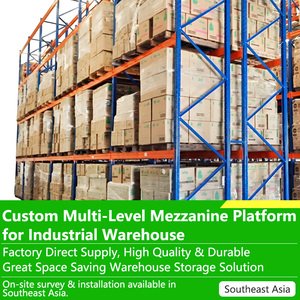
Standard commercial racks rely on basic hot-rolled structural steel with variable yield limits. Our manufacturing facilities utilize certified cold-rolled continuous roll-forming steel coils (grades Q235B and Q355B). Continuous profile roll-forming induces cold working work-hardening, significantly elevating tensile yield stress without adding unnecessary dead load to the slab foundation.
Per European Norm EN 15512 and FEM regulations, frames are engineered against torsional-flexural buckling and second-order (P-Delta) sway displacements. Finite Element Analysis (FEA) simulates real-world stress conditions under asymmetrical live loads, rack-end impact scenarios, and high-bay seismic horizontal accelerations to ensure overall structural stability.
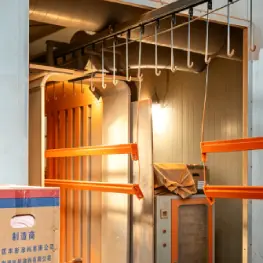
Corrosion mitigation requires precise multi-phase chemical pretreatment. Components pass through an automated 9-tank system featuring alkaline degreasing, acid pickling, rust removal, and zirconium/phosphating passivations before electrostatic polymer powder deposition. This exceeds ISO 12944 C3/C4 corrosion classification standards, even in sub-zero cold chains.
Procurement directors and warehouse project leaders are realigning capital expenditure from fixed static shelving to flexible, automated, and digitally integrated dynamic intralogistics structures. Key trends shaping procurement decisions include:
| Storage Topology | Volumetric Density | Pallet Selectivity | Automation & AGV Readiness | Optimal Industry Scenarios |
|---|---|---|---|---|
| Standard Selective Racking | Baseline (40–45%) | 100% Direct Access | Reach Trucks / VNA Turret | Multi-SKU 3PL Logistics, Retail DCs, Spare Parts |
| Double-Deep Pallet Rack | High (+30% vs Selective) | 50% Immediate Access | Specialized Deep-Reach Forklifts | Wholesale Distribution, Paper & Packaging |
| Radio Shuttle Automation | Maximum (Up to 85%) | Deep-Lane Batched Access | Fully AGV/AMR Autonomous Ready | Cold Storage Facilities, Beverage Hubs, High-Volume FMCG |
| Gravity Pallet Flow | Very High (FIFO Flow) | Lane Face Picking | Gravity Fed / Forklift Interface | Pharmaceuticals, Perishable Foods, Date-Sensitive Stock |
| Rack-Supported Mezzanines | 200% Floor Multiplier | Mixed Pallet & Bin Pick | Conveyors, Vertical Lifts & AMRs | E-Commerce Fulfillment, Fashion Logistics, Spare Parts |
Traditional static racking is evolving to accommodate floor-running AMRs and shuttle bots. Upright profiles require laser-guided tolerances, floor anchoring deflection dampening, and reinforced entry guides to allow robotic shuttles to traverse continuous channels without jamming.
Major enterprise procurement teams now demand Environmental Product Declarations (EPDs). Our manufacturing operations utilize scrap-free precision punching, energy-efficient curing ovens, and high-tensile steel alloys that reduce overall steel mass by 12–15% while matching total load capacity.
Because refrigerated air volume is exceptionally expensive to maintain, cold-storage operators are eliminating wide forklift aisles. High-density radio shuttle and drive-in racking allow up to 80% higher pallet volumes in the same cubic envelope, reducing refrigeration energy consumption per pallet position.
Founded in 2001, Guangzhou HEDA Shelves Co., Ltd. operates as a globally recognized manufacturer of industrial storage systems. We bridge the gap between heavy structural engineering and competitive factory-direct supply chains.
Every batch of upright posts, step beams, and decking platforms undergoes verifiable quality-assurance checkpoints to maintain European CE certification and ISO 9001:2015 traceability.
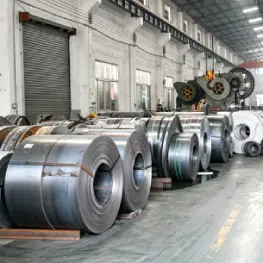 Step 01
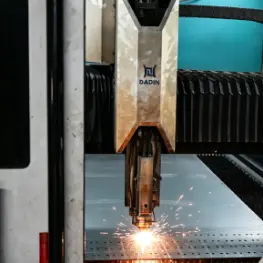 Step 02
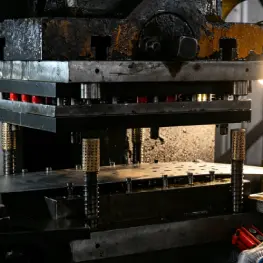 Step 03
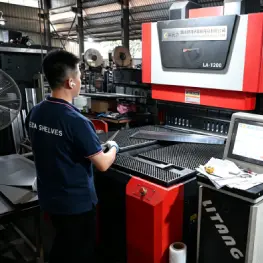 Step 04
 Step 05
 Step 06
 Step 07
 Step 08
 Step 09
 Step 10
We provide full structural documentation for municipal building permits, insurance certifications, and third-party warehouse safety audits. CE Certificate No. 2435-CPR-8605159, ISO 9001:2015 Certificate No. 18624Q00169R0M, and RoHS compliant finishes.
Our dedicated engineering group drafts custom DWG layouts, elevation views, static calculations, and 3D visual renderings before production commences. This guarantees precise aisle clear widths for your chosen forklift fleet (counterbalance, reach truck, or VNA).
For industrial equipment distributors, racking installers, and logistics general contractors, we provide tailored OEM manufacturing. This includes custom RAL electrostatic powder colors, specific post slot profiles, custom branded load charts, and export container bundling.
Clear, data-driven answers to structural calculations, European/US pallet compatibility, safety factors, and overseas freight configurations.
Under European Norm EN 15512, horizontal rack beams must not exceed a maximum vertical deflection limit of L/200 under full rated design load (where L is the clear span distance between upright columns). For sensitive automated picking corridors, this limit is often engineered to L/300. In addition, beams incorporate mechanical locking pins with an upward shear dislodgement resistance exceeding 5.0 kN per connector hook.
Yes. Frame depth and beam spans are custom-configured for your primary load footprint. For standard Euro-pallets (EUR 1: 1200 mm deep × 800 mm wide), we engineer frame depths of 1100 mm to allow a 50 mm front and rear overhang. For US GMA pallets (48″ × 40″ / 1219 × 1016 mm), we engineer 42″ or 44″ frame depths, incorporating flanged pallet support bars or wire mesh decking to avoid pallet roll-off.
Grade Q235B exhibits a minimum yield strength of 235 MPa and a tensile threshold of 370–500 MPa, making it ideal for standard beam levels and medium-duty shelving. In contrast, Q355B (equivalent to European S355JR or ASTM A572 Grade 50) delivers a 355 MPa yield strength. We utilize Q355B for high-bay upright columns, heavy-duty cantilever arms, and mezzanine main beams to increase load capacity while minimizing self-weight.
In cold chain environments, humidity condensation during thermal cycling can accelerate underfilm rust on inferior coatings. For low-temperature facilities (-20°C to -30°C), we apply specialized low-cure polyester epoxy powders with elevated elastomeric properties that resist thermal embrittlement, or hot-dip galvanized steel frames compliant with ISO 1461 for maximum rust protection.
A structural steel mezzanine utilizes heavy universal columns (H-beams/I-beams) on wider column grids (e.g., 6m × 6m), which is ideal for open-plan picking zones or office installations, but requires substantial concrete footings. A rack-supported mezzanine uses standard pallet racking or longspan shelving uprights to support the upper floor, providing integrated ground-level storage at 30–45% lower capital cost.
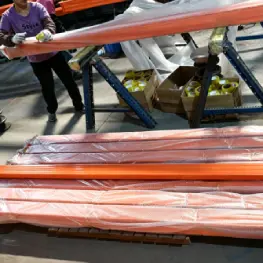
Heavy steel components can be damaged by vibration, shifting, and saltwater vapor during ocean transport. Our packaging lines bundle upright frames using corrugated separation buffers, steel strapping, and plastic stretch film wrapping. Smaller components (connectors, base plates, bolts, safety pins) are boxed and crated on export-grade fumigated wooden pallets to ensure zero-defect arrival at global ports.
Submit your facility floor plan (DWG/PDF), clear internal ceiling heights, pallet dimensions, and target throughput metrics. Our senior intralogistics engineering team will deliver a comprehensive CAD layout, 3D visualization, and structural quotation within 24 hours.