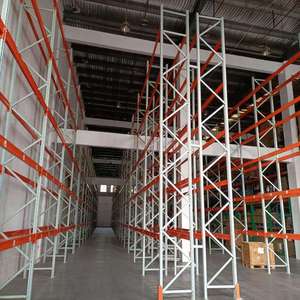
Industrial Racking Portfolio
Engineered Warehouse Racking Solutions Ready for Deployment
Explore our heavy-duty industrial storage systems manufactured with high-tensile cold-rolled steel, automated continuous roll-forming lines, and certified loading dynamics.

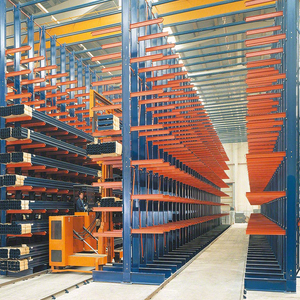
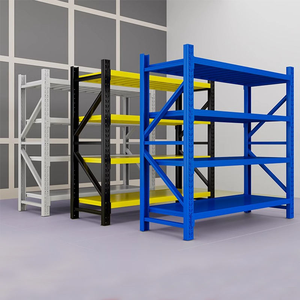
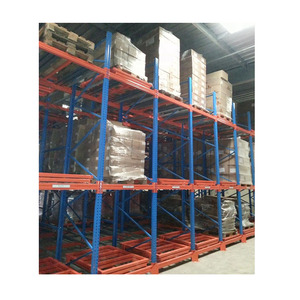
25+
Years Engineering (Est. 2001)
30,000m²
Modern Manufacturing Plant
30,000t
Monthly Steel Output
10,000+
Global Projects Completed
Architectural Deep Dive: The Mechanics of Radio Shuttle Racking Systems
In modern supply chains, the demand for vertical cube utilization has rendered traditional wide-aisle racking economically inefficient. A Radio Shuttle Racking System (often referred to as a Pallet Runner or Pallet Shuttle system) is a high-density, semi-automated deep-lane storage methodology that utilizes an intelligent, battery-powered carrier platform to navigate inside storage tunnels.
Unlike Drive-In systems where forklifts must physically enter racking corridors—a primary cause of beam impacts, upright damage, and cycle-time degradation—the radio shuttle cart runs along specialized continuous galvanized rails. The operator deposits the shuttle into the desired lane via standard counterbalanced or reach trucks. The shuttle then automatically lifts, transports, and deposits pallets at the deepest available position using precision optical sensors, rotary encoders, and intelligent acceleration ramp profiles.
Structural & Operational Matrix: Dense Storage Comparison
| Evaluation Parameter | Radio Shuttle Racking | Drive-In Racking | Push-Back Cart System | Standard Selective |
|---|---|---|---|---|
| Volumetric Capacity | Extreme (Up to 85% space use) | High (65%–75% space use) | Moderate (60%–70% space use) | Baseline (40%–50% space use) |
| Lane Depth Potential | Up to 40+ pallets deep | Max 8–10 pallets deep | Max 4–6 pallets deep | Single or double deep (1–2) |
| Structural Integrity Risk | Minimal (Zero forklift contact) | High (Constant upright rubbing) | Low (Aisle loading only) | Low to moderate |
| Stock Rotation Flexibility | Both FIFO & LIFO configurable | Strictly LIFO (Drive-Through FIFO) | Strictly LIFO | 100% Direct Accessibility |
| Throughput Speed (Cycles/hr) | Rapid (Simultaneous handling) | Slow (Cautious lane traversal) | Moderate | Fast single-cycle handling |
| Cold Room Thermal Overhead | Minimized air-pocket loss | Moderate air movement | Moderate | High wasted cooling volume |
By transferring internal transport mechanics to autonomous carriers, warehouse operators eliminate over 80% of mast-collision structural liabilities while reducing forklift labor requirements by up to 45%. This performance makes the radio shuttle system the undisputed benchmark for high-velocity FMCG distribution, cold chain logistics, and regulated pharmaceutical holding.
Market Intelligence
Future Procurement Trends in High-Density Pallet Warehousing
Strategic logistics leaders are shifting away from static infrastructure toward modular, smart-ready automation that aligns with ESG targets, labor shortages, and IoT visibility.
1. Shift to Low-Emission Cold Chains
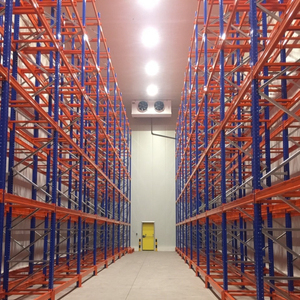
Refrigerated real estate commands the highest operating expenditures globally. Future procurement mandates minimum cubic energy expenditure. Radio shuttle installations running in -30°C environments reduce refrigeration load per pallet by up to 35% compared to selective racking arrays.
2. EN 15512 & CE Certified Integrity
Procurement teams increasingly require mill certificates, cold-bend testing verifications, and structural engineering validated against European standards EN 15512 and EN 15620. Auditable compliance protects facility insurability and seismic safety ratings.
3. Total Cost of Ownership (TCO) Prioritization
Initial CapEx is no longer the sole procurement metric. Buyers prioritize systems with low maintenance overheads, brushless shuttle motors, supercapacitor or LiFePO4 fast-charge batteries, and modular rails that allow easy future expansion into full AS/RS cranes.
Innovation Trajectory
Technological Horizons of Radio Shuttle Automation
How cutting-edge telematics, smart energy storage, and 4-way kinematics are redefining shuttle performance standards across industrial facilities.
4-Way Shuttle Kinematics
Evolution from traditional 2-way linear shuttles to omnidirectional 4-way systems, enabling cross-aisle transfers without forklift interventions and powering complete multi-level matrix picking hubs.
WMS / WCS API Integration
Direct bidirectional interfaces between radio shuttle controllers and enterprise Warehouse Management Systems via 5G and industrial Wi-Fi mesh networks, providing real-time inventory counts and heatmaps.
LiFePO4 & Fast-Charging
Replacement of heavy lead-acid packs with lithium iron phosphate (LiFePO4) battery modules featuring automated charging docking bays at the rail entrances, providing 24/7 continuous operations.
Sensory AI & Pallet QC
Integration of onboard LiDAR and 3D time-of-flight cameras on shuttles to scan for broken pallet runners, product overhang, or displaced loads prior to lane movement, preventing catastrophic jams.
Manufacturing Excellence
Direct From Factory: 25 Years of Storage Engineering
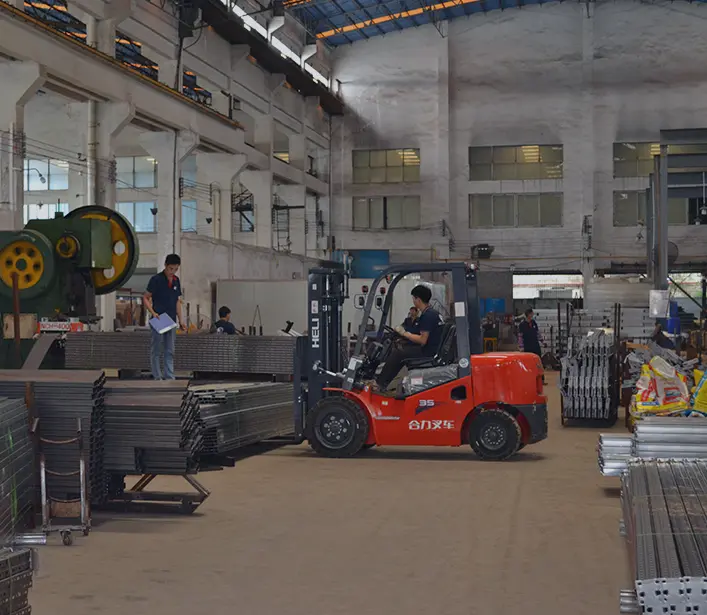
Established in 2001, Guangzhou Heda Shelves Co., Ltd. operates a specialized 30,000 m² smart production base staffed by over 300 experienced technical personnel. We deliver direct-from-factory pricing with structural integrity certified for global compliance.
- 30,000 Tonnes Monthly Capacity: Continuous automated roll-forming, laser steel profiling, and robotic welding lines guarantee short lead times on large-scale logistics hub rollouts.
- Complimentary 3D & CAD Engineering: Complete building analysis, forklift aisle optimization, and custom pallet clearance calculations prior to contract execution.
- Auditable Quality Control: Certified under CE No. 2435-CPR-8605159 and ISO 9001:2015 No. 18624Q00169R0M, utilizing high-grade Q235B/Q355B cold-rolled steel.
- Surface Durability: In-house multi-stage pickling, phosphating, and electrostatic powder coating ensuring maximum resistance against corrosion and chipping.
- Seaworthy Logistics & Global Shipping: Precision bundling, numbered component tagging, and container layout optimization for seamless discharge across all major global ports.
Procurement Advisory
Frequently Asked Questions: Radio Shuttle Sourcing & Engineering
Direct, technically verifiable answers to standard procurement queries encountered during the design, specification, and validation stages.
How does a Radio Shuttle Racking System compare to Drive-In Racking regarding ROI?
While Radio Shuttle racking entails a higher initial capital expenditure due to the electro-mechanical carrier units and precision rails, the operational return on investment is achieved within 14 to 22 months. Drive-In racking suffers from chronic forklift impact damage, upright deformation, and slow transit speeds inside corridors. Radio Shuttle eliminates equipment intrusion, increases storage density by up to 30% through deeper lane capability, and reduces operator cycle times by up to 50%, saving significant labor and maintenance capital.
Can HEDA Shelves Radio Shuttle systems accommodate both Euro (1200x800mm) and ISO pallets?
Yes. Our shuttle carrier platforms and rail profiles are custom-engineered to handle standard EUR/EPAL (1200 × 800 mm), UK/Industrial (1200 × 1000 mm), and American GMA (48 × 40 in) pallets. Dual-depth rail designs and intelligent optical sensors detect pallet dimensions and adjust lifting positions automatically to ensure safe load seating and optimal beam clearances.
What certifications and structural engineering documentation are supplied with each project?
Every project manufactured in our plant is supported by structural load documentation compliant with CE certificate No. 2435-CPR-8605159 and ISO 9001:2015 management standards. Comprehensive load calculation sheets, raw material tensile certificates (Q235B/Q355B), and engineering layouts referencing European structural codes EN 15512, EN 15620, and EN 15635 are provided for local municipal and building inspectorate sign-off.
How do the battery systems perform in sub-zero cold chain and blast freezer environments?
Our cold chain radio shuttle variants are engineered specifically for continuous operation in temperatures down to -30°C. They utilize heated control cabinets, condensation-sealed IP65 electronic enclosures, cold-grade lubricants, and specialized thermal-insulated lithium batteries (LiFePO4) delivering 8 to 10 hours of heavy-load cycles per charge with automated fast-charge terminal return capability.
What parameters are needed to generate a free 3D and CAD layout proposal?
To generate an optimized structural layout and load quote, our engineering team requires: (1) Warehouse architectural drawings (DWG/PDF) indicating clear ceiling heights, column grids, and floor obstacles; (2) Pallet specifications including overall dimensions, overhanging margins, and maximum gross weight; (3) Forklift model, mast lift height, and turning radii; and (4) Throughput requirements (FIFO vs. LIFO rotation rules and daily pallet movement velocity).
What installation guidance and after-sales support are provided internationally?
Every shipment arrives with color-coded, CNC-labeled racking components and detailed 3D step-by-step assembly diagrams. We provide remote engineering supervision via video link, comprehensive operational manuals, and spare parts packs. For large-scale distribution centers and logistics parks, our factory can dispatch certified installation field supervisors directly to your site to oversee mechanical assembly, rail alignment calibration, and shuttle commissioning.