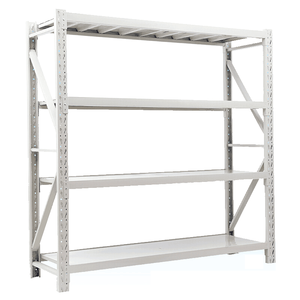
4-Shelf Light Duty Boltless Rivet Shelving Metal Storage Racks HJQ-105
- Tool-free drop-in rivet beam locks
- 150–300 kg per tier uniform load
- Surface: Electrostatic powder coat
Precision-machined warehouse storage architectures compliant with Mexican seismic load demands, configured for standard GMA 48"×40" and EUR/EPAL pallet platforms.
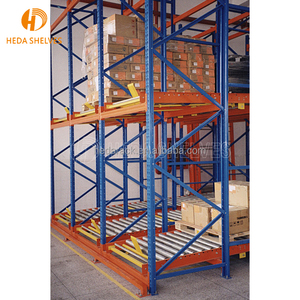
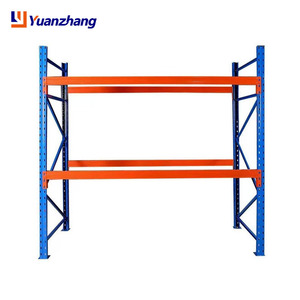
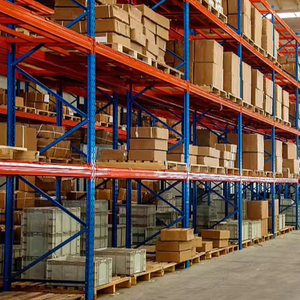
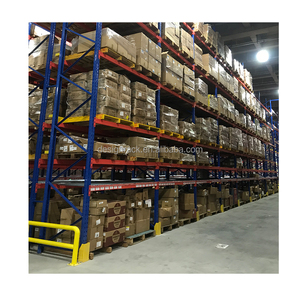
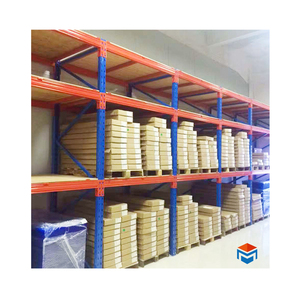
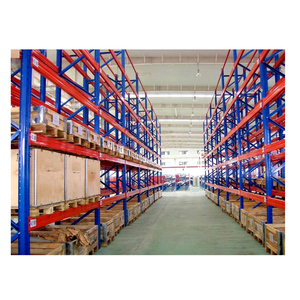
Push back racking represents the premier dynamic Last-In-First-Out (LIFO) solution for operations requiring deep-lane storage without requiring forklift operators to enter the structural racking frame.
Push back pallet racking operates on an inclined rail framework—typically configured with a 2.5% to 3.0% gravitational slope—utilizing nested, low-profile rolling carts. When the first pallet is deposited into a bay, it rests directly onto the uppermost nested carriage. When the forklift introduces a second pallet, the operator pushes the initial pallet gently rearward, exposing the sub-tier carriage beneath it.
This kinetic sequence repeats up to 6 pallets deep. Upon product retrieval, the removal of the forward pallet permits gravity to safely advance rear pallets toward the front picking face at a governed velocity. Flanged industrial steel wheels riding along heavy-duty structural steel channel tracks prevent derailment even under uneven pallet loading.
Unlike Drive-In systems that expose uprights to severe mast and chassis collisions, push back systems isolate forklift activities strictly to the external aisle face. This architectural containment reduces structural rack impact risk by more than 70%, dramatically lowering ongoing maintenance and safety recertification costs.
| Storage Topology | Volumetric Density | Stock Flow Policy | SKU Selectivity | Forklift Impact Risk | Ideal Mexico Application |
|---|---|---|---|---|---|
| Push Back Racking (HEDA) | Very High (85%) | LIFO (Gravity Return) | Medium (1 SKU per lane) | Very Low (Aisle-bound) | Nearshoring tier-suppliers, cold stores |
| Selective Pallet Racking | Low (40-50%) | FIFO / LIFO Direct | 100% Immediate | Medium | E-commerce fulfillment, cross-docking |
| Drive-In / Drive-Through | High (70-80%) | Strict LIFO / FIFO | Poor (Batch level) | High (Forklift enters lane) | Seasonal agricultural bulk storage |
| Radio Shuttle Automation | Maximum (90%+) | Programmable FIFO/LIFO | Lane Dependent | Negligible | Automated cold stores, megahubs |
| Double Deep Racking | Medium (60-65%) | LIFO (Panto-reach) | 50% Immediate | Medium | Wholesale dry goods distribution |
The aggressive relocation of advanced manufacturing under the USMCA trade pact has produced record-low vacancy rates in Mexican industrial real estate. Chinese-manufactured push back racking systems deliver the exact spatial density required to mitigate escalating per-square-meter facility leasing costs.
Driven by automotive and metal-mechanic mega-plants in Apodaca, Santa Catarina, and Ramos Arizpe. Push back systems hold critical staging buffers for sub-assemblies, stamping dies, and raw coils destined for US-bound freight.
Covering Querétaro, Guanajuato, and San Luis Potosí. Tier-1 and Tier-2 suppliers deploy 3-deep and 4-deep push back systems to synchronize batch Kanban inventories directly into just-in-sequence assembly lines.
Centered in Cuautitlán Izcalli, Tultitlán, and Tepotzotlán (the CTT logistics belt). FMCG, pharmaceutical, and retail distributors utilize high-density push back racks to maximize expensive, premium-rate warehousing space.
Jalisco's electronics manufacturing, packaging, and agro-export cold storage operations utilize heavy-duty galvanized cart push back systems inside humidity-controlled and sub-zero cold rooms.
For high-volume, multi-lot stamping parts and transmission assemblies, push back racking allows dedicated lane-by-lane batching without the structural risk of driving heavy counterbalanced trucks into tight structural tunnels.
Thermal loss in Mexican frozen distribution hubs (TIF certified) carries extreme operating costs. Push back systems compact refrigerated cubic space, yielding up to 65% higher density than standard selective racks while functioning reliably in sub-zero climates.
Mexican major retailers demand rapid pallet turnover. Push back provides clear SKU separation along the aisle face while buffering 3 to 5 pallets behind, balancing instant visibility with exceptional storage density.
Designing warehouse storage structures in Mexico requires rigorous engineering alignment with aggressive tectonic zones, specialized foundation slab behaviors, and federal safety mandates.
Mexico is characterized by four distinct seismic classifications ranging from Zone A (minimal tectonic acceleration in the northeast) to Zone D (severe acceleration in the south and Pacific belt). Facilities located in Mexico City (CDMX) face additional geotechnical challenges due to deep lacustrine clay beds that dramatically amplify earthquake energy.
At HEDA Shelves, our structural engineering department designs every export push back racking installation in accordance with the Manual de Diseño de Obras Civiles de la Comisión Federal de Electricidad (CFE) and the international RMI (ANSI MH16.1) standards. We tailor frame thickness, upright profile geometry, moment-resisting beam-to-column connections, and diagonal x-bracing topologies to withstand dynamic lateral base-shear accelerations.
We supply fully stamped structural dossiers and third-party finite element analysis (FEA) packages to support your municipal construction permits and insurance underwriters across all Mexican states.
Headquartered in Guangzhou with over two decades of global fabrication leadership, HEDA Shelves delivers direct factory engineering accountability to industrial procurement executives across North America and Mexico.
Founded in 2001, Guangzhou Heda Shelves Co., Ltd. operates an advanced 30,000 m² automated production facility equipped with high-precision roll-forming lines, automated laser profiling, and multi-axis CNC punching presses. Our enterprise supplies over 120 countries, delivering fully engineered, certified warehouse racking systems directly to project sites.
Critical operational, fiscal, and regulatory answers addressing maritime logistics, Mexican import tariffs, seismic compliance, and turnkey installation support.
For installations in Central, Western, and Bajío regions (CDMX, Guadalajara, Querétaro, Guanajuato), containers ship directly from our plant in Guangzhou (Nansha/Huangpu port) to the Port of Manzanillo (Colima) or Port of Lázaro Cárdenas (Michoacán). Total maritime transit typically ranges from 18 to 25 days.
For Northern industrial zones such as Monterrey, Saltillo, and Tamaulipas, shipments frequently route through the Port of Altamira or Veracruz on the Gulf Coast, or enter via Manzanillo followed by bonded intermodal rail (Ferromex/KCSM) directly to inland intermodal terminals.
Steel warehouse racking falls under Mexican Harmonized Tariff Schedule (HS) classification 7308.90 (Structures and parts of structures of iron or steel). Mexican importers must be registered on the official Padrón de Importadores. Depending on active trade remedies, products may be subject to standard import duties (IGE) plus the 16% Value Added Tax (IVA).
For facilities operating under an authorized IMMEX (Maquiladora) program, duties and IVA can frequently be deferred or credited when components support export production. HEDA Shelves provides commercial invoices, packing lists with net/gross weights per bundle, mill test certificates (MTC), and certificates of origin for flawless clearance via your Mexican Customs Broker (Agente Aduanal).
Yes. While European systems frequently focus on 1200×800 mm formats, our Mexican export systems are engineered around the standard GMA 48" × 40" (1219 × 1016 mm) wooden and composite pallets common across Mexico, the United States, and Canada. Push back carriage widths, stop flanges, and rail inclinations are tailored so that bottom pallet deck-boards slide cleanly without snagging on nested carriage rims.
Yes. For every engineering proposal, we generate comprehensive structural calculation dossiers detailing live and dead loads, seismic design category (SDC), anchor bolt pull-out shear demands, and frame deflections referencing CFE seismic guidelines and RMI/ANSI MH16.1 specifications. These documents satisfy requirements from structural reviewers (Peritos Corresponsables en Seguridad Estructural) and insurance auditors (e.g., FM Global).
Every shipment is packaged with marked, numbered bundles corresponding directly to an indexed CAD assembly blueprint. We provide clear installation manuals in Spanish and English. For project managers utilizing local Mexican assembly contractors, our structural engineers conduct remote video installation audits. For large-scale multi-bay distribution centers, we can dispatch on-site bilingual erection supervisors to guide your local team through rail alignment, carriage calibration, and seismic anchor torque verification.
HEDA push back systems utilize heavy-duty machined steel wheels equipped with permanently lubricated, sealed ball bearings rated for operating temperatures from -30°C to +50°C. Under normal warehouse operations, the mechanical carriages require no lubrication maintenance. Regular visual inspections are restricted to confirming debris-free rail channels and ensuring column impact guards remain intact per NOM-006-STPS guidelines.
Send your warehouse architectural DWG/PDF drawings, building clear heights, and pallet load profiles. Our senior racking design engineers will return a complete 2D/3D layout, lane capacity analysis, and direct factory quotation within 24 hours.