CDMX Logistics Engineering

Fifo Racking System Supplier & Exporter for the Mexico City Market

Precision First-In, First-Out High-Density Dynamic Pallet Storage Engineered for Vallejo, Cuautitlán, Tultitlán, and Tepotzotlán Logistics Corridors

Heavy-Duty Warehouse Portfolio

Engineered Storage Solutions Ready for Mexico City & CTT Hubs

Certified structural steel storage assemblies fabricated under ISO 9001:2015 control, built to streamline fast-moving pallet turnover across North American intermodal supply networks.

Comprehensive Technical Analysis

Engineering FIFO Gravity Racking for the Valley of Mexico Basin: Structural Dynamics & Seismic Reliability

Deploying high-density First-In, First-Out (FIFO) gravity flow racking systems within Greater Mexico City (Zona Metropolitana del Valle de México - ZMVM) requires an advanced level of geotechnical and structural calculation that standard industrial racking suppliers frequently overlook. Mexico City sits upon a paleolake bed consisting of hyper-saturated lacustrine clays prone to high soil deformability, long seismic wave periods, and site amplification during earthquake occurrences. Consequently, industrial racking installations in major logistics epicenters—such as Cuautitlán Izcalli, Tultitlán, Tepotzotlán (the CTT corridor), Vallejo, and Huehuetoca—cannot merely conform to typical non-seismic static guidelines; they must rigorously integrate with Mexico's Normas Técnicas Complementarias (NTC-RCDF) and international RMI (Rack Manufacturers Institute) standards.

Lacustrine Seismic Amplification

The soft subsoil conditions of Zone III (Lake Bed) in CDMX amplify long-period seismic waves. Our engineering team conducts dynamic response spectrum calculations, selecting certified Q235B cold-rolled profiles with enlarged footplates (≥12mm baseplates) and specialized chemical epoxy anchors to dissipate lateral cyclic racking loads without catastrophic frame buckling.

Slope & Velocity Control Dynamics

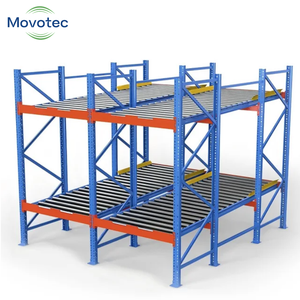
Pallet flow lanes utilize an engineered pitch between 3.5% and 4.0% inclination. To prevent runaways of palletized loads up to 1,500 kg per position, centrifugal brake rollers are calibrated every 1 to 2 pallet depths. This ensures steady velocity control (approx. 0.25 m/s) irrespective of ambient high-altitude pressure variances between 2,240m elevation and standard sea levels.

Impact-Resilient Separation

At the picking face, static hydraulic line load pressure from rear pallets can deform forklift forks and endanger operators. Our installations incorporate mechanically synchronized pallet separators that physically isolate the discharge pallet from oncoming queue pressure, enabling effortless extraction and zero-damage inventory turnover.

Market Specific Use-Cases

Targeted Application Scenarios Across Greater Mexico City

How our custom FIFO gravity pallet systems solve physical footprint and operational bottlenecks across Mexico's premier commercial and industrial sectors.

FMCG & Dairy (Cuautitlán)

For fresh food, cold chain, and fast-moving consumer packaged goods operating within the Cuautitlán distribution hub, strict expiration date control is paramount. Gravity FIFO racking provides automatic stock staging without power consumption, eliminating out-of-date product obsolescence.

Pharma Logistics (Tlalnepantla)

Pharmaceutical distribution centers in Tlalnepantla and Naucalpan operate under strict COFEPRIS temperature and batch management regulations. Roller flow beds with smooth galvanized steel rollers prevent dust accumulation while maintaining absolute batch segregation per lane.

Tier-1 Automotive (Toluca & Vallejo)

Just-in-Time (JIT) and Just-in-Sequence (JIS) manufacturing lines require uninterrupted kitting buffer stations. FIFO flow racking integrates adjacent to staging docks, ensuring automotive assembly plants receive sequential body components without material cross-handling.

Cross-Dock E-Commerce (Tepotzotlán)

High-turnover 3PL operators managing omnichannel order fulfillment experience severe dock congestion. Installing gravity FIFO racks directly behind loading docks transforms raw floor square footage into automated multi-tier replenishment channels.

Engineering Comparison

System Architecture: FIFO Flow Racking vs. Alternative High-Density Racks

Evaluate operational velocity, volumetric utilization, and capital expenditure when engineering pallet storage inside high-cost Mexican industrial facilities.

Evaluation Parameter FIFO Gravity Flow Racking Drive-In Racking System Push-Back Cart Racking Radio Shuttle Racking
Inventory Rotation Logic Strict FIFO (100% Guaranteed) LIFO (Last-In, First-Out) LIFO (Last-In, First-Out) Flexible FIFO or LIFO
Floor Space Utilization Up to 75% Active Usable Area Up to 70% Active Usable Area Up to 65% Active Usable Area Up to 85% Active Usable Area
Forklift Aisles Needed Two (Dedicated Load & Pick) One per system aisle access One Single Operating Aisle One or Two Aisles
Forklift Rack Penetration None (Zero upright impact risk) High (Frequent mast collision) None (Operates at aisle face) None (Automated shuttle entry)
Operating Energy Costs 0 kWh (Pure gravity dynamic flow) Vehicle fuel only 0 kWh (Pure gravity push) Lithium Battery Recharge Cycles
Seismic Tolerance (CDMX) Superior (Distributed gravity loads) Moderate (Unbraced drive bays) Good (Nested channel bracing) High (Interlocked rail guides)
25+
Years Racking Production Experience
30,000m²
Manufacturing Facility Footprint
30,000t
Monthly Cold-Formed Steel Capacity
10,000+
Global Warehousing Implementations
Macro Economic Growth Vector

Nearshoring Dynamics & The Surging Demand for High-Density Storage in CDMX

The ongoing nearshoring transformation driven by USMCA (T-MEC) integration has created historic supply constraints across Central Mexico’s industrial real estate sector. With logistics vacancy rates in premier clusters like Cuautitlán, Tultitlán, and Tepotzotlán dipping below 1.5%, the price per square meter has risen to unprecedented heights. Industrial developers and 3PL third-party logistics operators can no longer afford to squander vertical space or maintain inefficient wide-aisle storage systems.

To maintain operating margins amidst rising land lease valuations, facilities are aggressively retrofitting standard selective racks with dynamic FIFO gravity lanes. A conventional selective racking layout typically consumes up to 60% of total warehouse floor area in access aisles alone. By transitioning to high-density FIFO pallet flow lines that run 5 to 20 pallets deep, enterprise operators achieve up to a 65% increase in pallet storage capacity within the identical physical footprint, while eliminating hundreds of hours of unproductive forklift transit travel.

Moreover, with the Federal District and State of Mexico pushing stringent labor safety regulations and corporate ESG mandates, gravity-based non-powered flow lanes offer an unmatched sustainability profile: zero electricity consumption, zero charging emissions, reduced equipment maintenance, and total physical separation between loading mast vehicles and picking pedestrian staff.

Certified Engineering Integrity

10-Step Quality Control & Fabrication Workflow

Every beam, upright column, roller bracket, and brake mechanism is precision manufactured under strict ISO 9001:2015 and CE certification parameters.

01

Steel Verification

Mill inspection of high-yield Q235B steel coils with chemical analysis.

02

Precision Slitting

High-tolerance automated cutting and laser trimming of raw plate strips.

03

Column Punching

Automated high-speed CNC punching ensuring precise 50mm pitch holes.

04

Cold Roll Forming

Multi-station roll forming machines generating continuous upright channels.

05

Profile Roll Bending

Box beam roll forming with structural interlocking robotic seam welding.

06

Surface Polishing

Mechanical de-burring and high-pressure grit shot-blasting treatment.

07

Robotic Welding

Multi-claw beam connector welding for superior structural shear strength.

08

Pickling Treatment

Complete multi-bath chemical acid pickling and zinc-phosphating bath.

09

Electrostatic Coating

High-adhesion thermal-cure electrostatic polyester powder coating.

10

Seaworthy Export Packing

Rigid timber cushioning, anti-scratch strapping, and custom container lashing.

Buyer Guidance

Frequently Asked Questions by Mexico Logistics & Plant Managers

Clear answers regarding shipping logistics, pallet standards, import customs, and seismic engineering for installations across the Mexican Republic.

Does your FIFO racking support standard North American 40x48 inch GMA pallets used in Mexico?
Yes. While European systems center on 1200x800mm EUR/EPAL dimensions, our FIFO gravity systems engineered for Mexico are specifically customized for the 40x48 inch (1016x1219 mm) GMA pallet, standard plastic hygiene pallets, and CHEP pool pallets. Roller configurations, clearance track widths, and bottom guide rails are calibrated to accommodate bottom-board configurations without binding.
What seismic documentation do you provide for verification with local municipal inspectors (DRO)?
For projects in Mexico City, State of Mexico, and Guadalajara, we deliver comprehensive structural engineering calculation packages. These include Finite Element Analysis (FEA), load distribution diagrams, and anchor plate shear force data calculated according to NTC-RCDF and RMI guidelines, enabling your registered Structural Engineer / Director Responsable de Obra (DRO) to conduct expedited on-site certification.
What are the typical sea freight transit timelines from your plant to Mexico City (CDMX)?
Standard containerized shipments depart via Guangzhou, Shenzhen, or Ningbo ports directly to the Port of Manzanillo (Colima) or Port of Lázaro Cárdenas (Michoacán). Ocean transit spans approximately 20 to 28 days. Once custom-cleared, bonded intermodal rail or direct freight truck delivery to logistics parks in Cuautitlán, Tultitlán, or Tepotzotlán typically takes an additional 3 to 5 business days.
Can you handle customs documentation, Mexican NOM requirements, and DDP terms?
We provide full commercial invoices, packing lists with numbered components, Certificates of Origin, Mill Test Certificates (MTC), and CE/ISO declarations required by your Mexican Customs Broker (Agente Aduanal). We regularly support FOB, CIF, and through our regional freight forwarding partnerships, Door-to-Door / DDP arrangements.
How are damaged rollers or brake mechanisms serviced or replaced over time?
All roller assemblies and speed controllers are modular. Rather than dismantling an entire lane, individual rollers or speed controllers clip into place via high-strength snap-in hexagonal spring shafts. We supply a calculated spare parts package (rotary brakes, entry guides, and rollers) with each container order, ensuring zero unplanned operational downtime.

Design Your Custom FIFO Storage Layout for Mexico City

Submit your warehouse CAD layout (.DWG or .PDF), clear ceiling height, pallet load specifications, and handling fleet details. Our senior racking engineers will generate a complimentary 3D rendering, seismic capacity calculation, and FOB/CIF quotation within 24 hours.