Factory Inventory & Engineered Systems
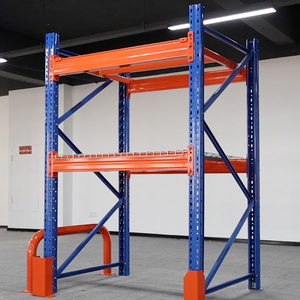
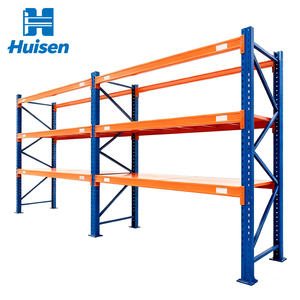
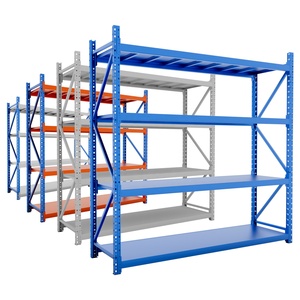
Featured Industrial Warehouse Racking & Pallet Solutions
Browse our factory-direct engineered rack modules, gravity feed lanes, and industrial storage systems manufactured with certified structural steel, delivered to Santiago, Valparaíso, San Antonio, and Puerto Montt.
Industrial Whitepaper & Market Insights
Gravity Pallet Flow Dynamics Under Chilean Operational Realities
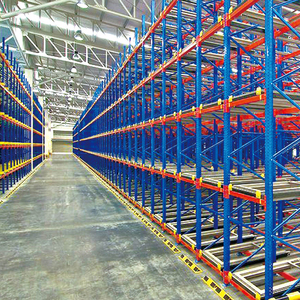
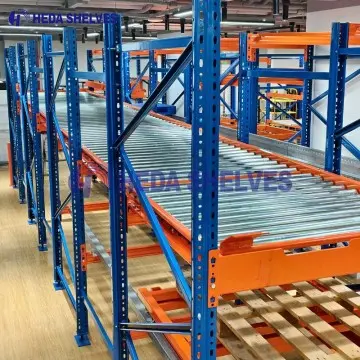
A Gravity Flow Racking System (also known in Latin American operations as Racks Dinámicos por Gravedad) utilizes inclined roller tracks set at a slope between 3% to 4%. Powered purely by gravitational force and controlled by hydraulic speed controllers (frenos centrífugos), pallets move smoothly from the loading replenishment face (pantalla de carga) to the unloading picking face (pantalla de descarga). This structure guarantees an absolute First-In, First-Out (FIFO) product turnover cycle.
For Chilean supply chain engineers, gravity flow systems overcome the dual challenges of extreme land valuation in the Región Metropolitana (Pudahuel, San Bernardo, Lampa, Quilicura) and rapid turnover requirements in the agro-export and salmon industries. By eliminating intermediate forklift access aisles, dynamic gravity flow racks reclaim up to 60% of floor area compared to conventional selective pallet racking, while cutting internal forklift transit distances by half.
Furthermore, because Chile is located in one of the world's most active subduction zones, pallet flow systems exported to Chile cannot rely on generic static calculations. Every structural upright, heavy-duty footplate, chemical anchor bolt, and bracing node must be calculated in strict compliance with Chilean Norms NCh2369.Of2003 (Seismic Design of Industrial Structures and Installations) and NCh433, accounting for horizontal acceleration without risking pallet derailment or frame buckling.
Localized Application Scenarios
Where Gravity Flow Racking Solves Chile's Complex Logistics Bottlenecks
Tailored engineering answers the specific demands of Chile's leading export pillars, cold storage chains, and high-frequency urban fulfillment centers.
Agro-Export & Fresh Fruit Logistics (O'Higgins, Maule & Valparaíso)
Chile is the Southern Hemisphere's premier fresh fruit exporter (cherries, table grapes, blueberries, and stone fruits). Packing plants and seasonal cold facilities require strict FIFO tracking to ensure fruit cartons packed earliest reach port reefers at San Antonio or Valparaíso first. Gravity flow eliminates inventory batching errors, reduces bruising by minimizing handling touches, and guarantees seamless cold chain continuity.
Salmon & Seafood Freezers (Los Lagos & Aysén)
In Puerto Montt and southern maritime processing facilities, refrigerated cubic volume commands steep electricity overheads. Operating at -18°C to -25°C, gravity flow systems consolidate hundreds of salmon pallets into continuous channels up to 16 pallets deep. Low-temperature resistant rollers and sealed centrifugal speed retarders prevent grease freeze-up and preserve lane reliability without electrical wiring inside the freezer.
Retail FMCG, E-Commerce & Wine Hubs (Santiago Metropolitan Area)
Chilean hypermarket giants (Cencosud, Falabella, Walmart Chile) and Central Valley wineries rely on gravity pallet flow at distribution centers along the Ruta 5 and Américo Vespucio ring. By segregating replenishment corridors from order staging picking corridors, warehouse managers eliminate forklift collisions and expedite rapid cross-dock dispatch schedules.
Engineering Comparison Guide
Gravity Pallet Flow vs. Alternative High-Density Systems in Chile
Evaluate operational metrics to select the right storage geometry based on selectivity, cycle speed, seismic resilience, and power dependency.
| System Architecture | Stock Rotation Strategy | Space Utilization Ratio | Forklift Aisle Requirements | Energy / Automation Requirement | Chilean Market Fit |
|---|---|---|---|---|---|
| Gravity Flow Racking | Strict FIFO (100% Guaranteed) | Very High (Up to 80% footprint) | Separate Infeed & Pick Aisles | Passive (Gravity + Centrifugal Brakes) | Best for Fresh Fruit, Dairy, Pharma & Fast FMCG |
| Push Back Racking | LIFO (Last-In, First-Out) | High (Up to 70% footprint) | Single Front Aisle | Passive (Gravity-nested push carts) | Medium SKU velocity, wholesale manufacturing |
| Drive-In Racking | LIFO (FIFO requires Drive-Through) | High (Up to 75% footprint) | Internal Drive Lanes | Zero (Requires truck entry into racks) | Seasonal bulk holding, homogeneous slow SKUs |
| Radio Shuttle System | Flexible FIFO or LIFO | Maximum (Up to 85% footprint) | Aisle-face access only | Active (Lithium-ion shuttle carriers) | Large-scale cold storage & deep channels |
| Selective Pallet Racking | Unrestricted Access | Standard (approx. 40% footprint) | Aisle between every rack row | Manual forklift handling | General multi-SKU retail and distribution |
Strategic Industry Trends
Seismic Engineering Standards & Warehouse Modernization in Chile
The modernization of Chile’s supply chain infrastructure has accelerated dramatically over the past five years. Rising industrial lease rates across Greater Santiago have prompted logistics operators to move away from low-density, low-rise rack structures toward high-bay, space-efficient, dynamic gravity setups. However, high-density compact storage introduces significant mass concentrations that respond aggressively during seismic events.
Under the seismic provisions of NCh2369, warehouse pallet racks are categorized as non-building industrial structures requiring specific ductility reductions ($R$), structural period validations, and dynamic modal analysis. In gravity flow systems, our engineering team integrates several key seismic safeguards:
- Anti-Derailment Guide Flanges: Rollers with raised lateral steel ridges prevent Chilean 1000 × 1200 mm and European 800 × 1200 mm pallets from jumping the track during lateral ground shaking.
- Robust Pallet Separators: Automatic mechanical load separators isolate the forward-most pallet at the pick face from the hydrostatic accumulation line behind it, preventing backpressure shock loads on operators during ground motion.
- Reinforced Baseplates & Heavy-Duty Uprights: High-tensile Q235B and Q355B cold-formed steel sections with oversized footplates and multi-point Hilti-rated anchor assemblies dissipate lateral shear stresses safely into the reinforced concrete slab.
Factory Strengths & Export Infrastructure
Why Chilean Importers & Integrators Source Direct From Us
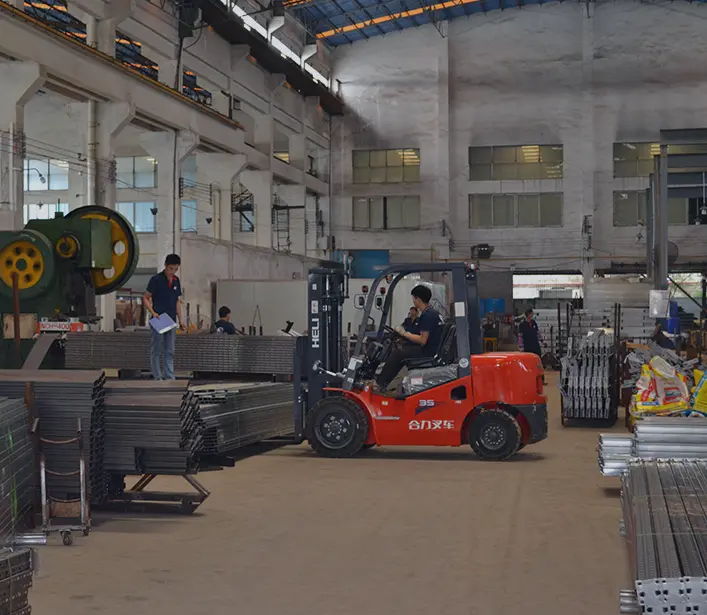
Since 2001, Guangzhou Heda Shelves Co., Ltd. has delivered end-to-end manufacturing, custom seismic engineering, and export-ready logistics support across 120+ nations worldwide.
25+
Years Manufacturing
Continuous production and design expertise in heavy-duty racking, industrial mezzanines, and gravity flow dynamic tracks since 2001.
30,000m²
Factory Production Base
State-of-the-art facility featuring automated continuous cold roll-forming lines, robotic CNC beam welding, and electrostatic powder coating plants.
30,000t
Monthly Capacity
High-volume fabrication capability guarantees prompt 15-to-25-day production turnaround times for multi-container enterprise contracts.
100%
Certified Quality
Full compliance with CE Certificate (No. 2435-CPR-8605159), ISO 9001:2015 management systems, and factory mill test material verification.
Standardized 10-Step Export Manufacturing Flow
01. Raw Steel Inspection
Strict metallurgical yield strength testing on certified high-tensile structural coil sheets.
02. Precision Roll-Forming
Continuous cold-bending forming guaranteeing millimeter-perfect upright and beam geometries.
03. Pre-Treatment Finishing
Pickling, phosphating, and de-greasing baths ensure anti-corrosion bonding for humid coastal transit.
04. Export Bundling & Shipping
Numbered components, sea-freight steel banding, and direct shipping lines to Valparaíso and San Antonio.
Procurement Guidance & Technical Support
Frequently Asked Questions by Chilean Buyers & Logisticians
Direct technical clarification on dimensions, maritime logistics, import documentation, and seismic structural requirements.
Does your gravity flow racking accommodate traditional Chilean and Latin American pallet sizes?
Yes. While Europe relies heavily on the 800 × 1200 mm EUR-pallet, warehouses in Chile frequently utilize the standard GMA / Mercosur pallet (1000 × 1200 mm) as well as heavy fruit export bins. Our roller track width, roller pitch (spacing between rollers), and intermediate brake drums are calculated precisely according to your specific pallet base geometry, bottom board orientation, and dynamic weight spectrum.
Can you supply structural calculation reports that comply with Chilean seismic standards (NCh2369 / NCh433)?
Yes. For major industrial installations and logistics facilities, our engineering design department generates comprehensive 3D CAD models, finite element stress simulations, and structural calculations referencing ANSI MH16.1, EN 15512, and local seismic acceleration values required by Chilean municipal inspectors and structural peer reviewers (Revisores Estructurales).
What is the average sea freight transit time to Chilean ports (Valparaíso and San Antonio)?
Direct ocean vessels departing from southern China (Guangzhou, Shenzhen, or Nansha) to the main ports of Chile (Puerto de San Antonio or Puerto de Valparaíso) typically take between 28 to 38 days depending on the shipping line (such as MSC, Maersk, or Hapag-Lloyd). Our factory prepares complete export-compliant packing with fumigation-free pallets, clear weight-distribution packing lists, and Certificate of Origin documents to simplify Chilean customs clearance (Servicio Nacional de Aduanas).
How does the gravity roller system perform in sub-zero frozen fish and agro cold stores?
In deep freeze installations down to -30°C (such as salmon cold stores in the Décima Región), standard gravity rollers and grease lubricants can seize. We supply specialized low-temperature carbon steel rollers fitted with sealed stainless bearings and synthetic low-temperature viscous fluid centrifugal brakes that maintain reliable speed control without freezing.
What preliminary warehouse data is required to obtain a free customized CAD layout and quotation?
To produce an optimized proposal, our engineering team needs: (1) Architectural warehouse layout drawing (DWG or clear PDF) indicating clear ceiling height, column locations, and fire sprinkler clearances; (2) Pallet dimensions (W × D × H) including overhang and maximum gross weight; (3) Number of SKUs and operational pallet throughput per hour; (4) Forklift mast reach and operating aisle turning radius.
Do you offer installation supervision and OEM branding for local Chilean racking dealers?
Yes. We actively support Chilean racking distributors, logistics integrators, and industrial shelving contractors. We offer full OEM manufacturing including custom RAL electrostatic powder colors (safety orange, ultramarine blue, signal grey), private labeling, and step-by-step 3D assembly guides. For enterprise scale distribution projects, on-site installation supervisors or real-time remote engineering assistance can be coordinated.