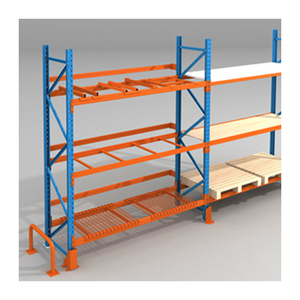
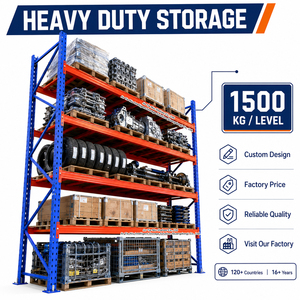
Dual-Purpose Industrial Warehouse Racking System 5-Layer All Metal Corrosion Protected Heavy Duty Storage Rack
5-Layer Storage
Anti-Corrosion
CE Compliant
Direct factory manufacturing featuring Q235B cold-rolled structural steel profiles, automated CNC multi-hole punching, and electrostatic thermoset epoxy-polyester coatings for harsh warehouse environments.
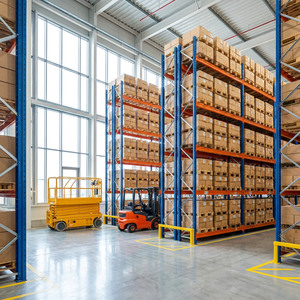
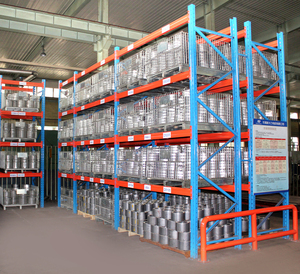
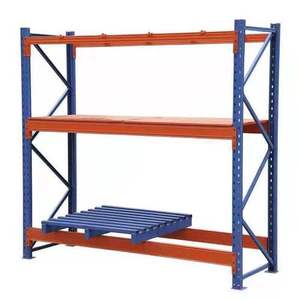
An analytical examination of volumetric efficiency, steel ductility, and logistical throughput demands across the French mainland warehouse corridor.
Modern supply chain infrastructures throughout France—stretching along the high-velocity logistics spine from Lille through Île-de-France, down to the Auvergne-Rhône-Alpes corridor in Lyon and toward Marseille-Fos—are navigating severe commercial land pressures and stringent safety mandates. Warehouse operators, third-party logistics providers (3PLs), and retail fulfillment networks increasingly turn toward medium-duty pallet racking systems. These specialized storage configurations bridge the structural gap between heavy industrial selective pallet racking and lightweight manual longspan shelving.
In the French logistical ecosystem, a "medium-duty" profile typically characterizes racking assemblies engineered to handle load capacities ranging between 800 kg and 1,800 kg per beam level (Uniformly Distributed Load - UDL). Unlike standard light-duty shelving units, medium-duty systems utilize cold-rolled Omega-profile structural uprights, interlocked via welded 3-claw or 4-claw beam connectors with integrated security pins. This mechanical design accommodates standard EUR-1 pallets (800 mm × 1,200 mm) and EUR-2 industrial pallets (1,000 mm × 1,200 mm) without requiring the excessive steel thickness and foundation anchors dictated by multi-tier high-bay installations carrying 4,000 kg per level.
French Structural Directive Insight: All racking assemblies exported to mainland France must align with the mechanical computation rules outlined in NF EN 15512 (Racking Systems: Principles for Structural Design), supplemented by the operational inspection criteria of NF EN 15635 and safety recommendations drafted by the Institut National de Recherche et de Sécurité (INRS ED 771).
From an operational standpoint, medium-duty racking systems eliminate excessive structural overhead for distribution centers handling fast-moving consumer goods (FMCG), electrical appliances, automotive component assemblies, and wine or agricultural consignments. By matching steel gauge thickness precisely to actual volumetric cargo densities, logistics engineers reduce structural procurement capital expenditure by 18% to 27% while fully maintaining requisite safety factors under French seismic Eurocode 8 (NF EN 1998-1) and static loading conditions.
Comparative analysis of racking classes engineered for European warehouse compliance, factoring beam deflection limits (L/200) and steel grades.
| Racking Classification | Typical Beam Load (UDL) | Upright Profile Section | Safety Factor | Primary European Standard | Optimal French Application |
|---|---|---|---|---|---|
| Light Industrial Shelving | 150 kg – 400 kg / level | Angle or 40×40 mm Tube | 1.35 | NF EN 15095 | Manual e-commerce order picking & spare parts bins |
| Medium Duty Pallet Racking | 800 kg – 1,800 kg / level | Omega 80×60 / 90×70 mm | 1.50 | NF EN 15512 / NF EN 15620 | EUR-1 distribution, auto parts, pharmaceuticals & retail hubs |
| Heavy Duty Pallet Racking | 2,000 kg – 4,500 kg / level | Omega 100×70 / 120×95 mm | 1.50 | NF EN 15512 | Bulk chemical drums, heavy machinery, heavy palletized liquids |
| Drive-In / Deep Lane Racking | 1,000 kg – 1,500 kg / pallet | Reinforced 90×70 + Top Tie | 1.60 | NF EN 15512 / EN 15629 | Cold storage facilities, seasonal beverage stocks (LIFO/FIFO) |
| Cantilever Long-Span Rack | 500 kg – 2,500 kg / arm | Hot-Rolled I-Beam (IPE 140-200) | 1.50 | NF EN 1993-1-1 (Eurocode 3) | Timber merchants, PVC extrusion storage, steel pipes |
Under the European standard NF EN 15512, beam design must strictly avoid permanent elastic deformation. For standard box-beams and step-beams carrying medium-duty pallets, the maximum vertical deflection allowable under working service load cannot exceed 1/200th of the span length (Deflection Limit δ ≤ L/200). For example, a standard 2,700 mm clear entry beam—sized precisely to support three EUR-1 pallets (800×1,200 mm) side-by-side—has an upper deflection ceiling of 13.5 mm under maximum UDL.
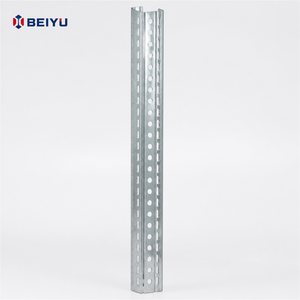
Furthermore, upright uprights fabricated from high-strength cold-formed steel (Q235B / S235JR or S355MC) undergo automated progressive roll-forming to retain high residual ductility. Perforations are punched at an exact 50 mm or 75 mm vertical pitch, ensuring total flexibility for French facility managers who must regularly reconfigure bay clear heights to match evolving carton packaging formats without compromising torsional rigidity.
How medium-duty pallet racking systems solve complex floor-space, throughput, and product safety challenges across strategic French industrial zones.
Distribution hubs surrounding Paris (Evry, Marne-la-Vallée, Roissy) handle massive multi-SKU retail lines. Medium-duty racking provides rapid 100% pallet accessibility for reach trucks, optimizing picking speed while staying within standard warehouse clear-height clearances.
Within the chemical corridor south of Lyon and Grenoble, intermediate-weight chemical goods and temperature-sensitive medical supplies require corrosion-protected racking. Galvanized or epoxy-coated medium-duty systems support cleanroom pallet storage under strict safety mandates.
Positioned near Lille, Dunkirk, and Calais, logistics centers operating between France, Belgium, and the UK utilize adjustable medium-duty configurations to rapidly buffer cross-docked goods, containerized freight, and seasonal retail inventory.
Wine bottling estates, beverage distributors, and spirits cellars require stable pallet storage for glass bottles and cased products (typically 900–1,200 kg per pallet). Fitted with timber decking or wire mesh shelves, our racks eliminate point-load collapse risks.
How the "Zéro Artificialisation Nette" (ZAN) target and workplace safety standards (INRS ED 771) are reshaping French warehouse architecture.
The regulatory and operational environment for French warehousing is experiencing structural disruption driven by statutory environmental legislation and supply chain modernization:
Under the French Climate and Resilience Law (Loi Climat et Résilience), the government instituted the Zéro Artificialisation Nette (ZAN) objective, requiring a 50% reduction in the consumption of natural land by 2031, aiming for zero net soil artificialization by 2050. As building permits for new greenfield logistics parks become increasingly restricted across France, warehouse operators must maximize the volumetric cubic meter capacity of existing footprints. Medium-duty pallet racking combined with rack-supported mezzanine platforms allows facilities to double usable storage surface areas without expanding building envelopes.
Workplace health and safety inspectors in France (under CARSAT and CRAM) vigorously enforce the guidelines detailed in INRS ED 771 ("Les rayonnages métalliques"). These directives mandate that pallet racking must incorporate engineered impact protectors on all perimeter corner uprights (capable of absorbing an energy impact of at least 400 Joules). Additionally, clear beam safety locking pins must be mechanically secured to prevent accidental dislodgement during forklift lifting, and bilingual maximum load warning plaques (plaques de charge) detailing exact UDL levels per shelf and frame must be affixed to every end-frame.
With warehouse labor shortages across Western Europe, French facilities are integrating Autonomous Mobile Robots (AMRs) and automated pallet stackers. This shift demands higher fabrication precision from pallet rack manufacturers. Upright tolerances, hole spacing accuracy, and frame squareness must adhere strictly to NF EN 15620 Class 300 & 400, ensuring optical sensors and navigation systems on automated equipment operate without spatial distortion or mechanical jamming.
Guangzhou Heda Shelves Co., Ltd. delivers factory-direct engineering integrity, eliminating trading intermediary markups while maintaining verified EU compliance.
Founded in 2001, our facility has manufactured warehouse storage systems for over two decades. Over 10,000 successful projects deployed across 120+ countries guarantee deep engineering insight into regional building codes and freight logistics.
Our integrated plant houses automated cold-roll forming lines, high-precision automated column punching machinery, robotic welding cells, and an automated continuous electrostatic powder-coating line, producing up to 30,000 metric tonnes monthly.
We hold verified CE Certificate No. 2435-CPR-8605159 and ISO 9001:2015 Certificate No. 18624Q00169R0M. Load tables, structural stress calculations, and steel metallurgical test certificates are routinely provided for European third-party inspections.
Before steel cutting begins, our structural engineering team delivers free comprehensive AutoCAD layout plans, DWG files, and 3D visual models calculating clear building heights, aisle turning radii (AST), and pallet clearances tailored to your site.
Our direct export workflow is structured specifically for French and European commercial consignments. Components are grouped, numbered, and bundled with seaworthy corrosion-inhibiting wrapping to endure ocean transit from Guangzhou to major French maritime gateways—principally HAROPA Port (Le Havre / Rouen / Paris) on the northern Atlantic corridor and the Port of Marseille-Fos on the Mediterranean. We provide complete commercial documentation, packing lists, CE declarations of conformity, and installation manuals, supporting FOB, CIF, or DDP terms directly to your inland project site.
Key structural, regulatory, and logistics answers for warehouse managers, equipment installers, and procurement officers.
Whether you are outfitting a high-throughput 3PL facility in Île-de-France, expanding automotive spare-parts capacity, or upgrading regional distribution hubs, our structural engineers are ready to configure an engineered layout tailored to your operational specifications.
Contact Us