300kg / Layer
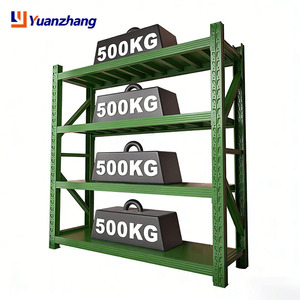
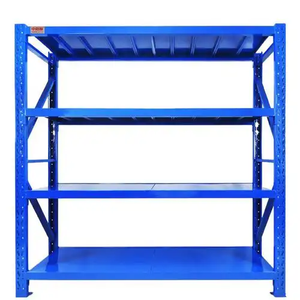
Boltless Adjustable Heavy Duty 300kg/Layer Steel Storage System
- Interlocking modular clip connections
- 50mm pitch vertical adjustability
- Pre-treatment phosphating finish
Modern high-bay rack storage systems represent the structural core of today's intralogistics ecosystems. Far beyond static steel shelving, modern installations above 12 meters demand rigorous metallurgical tolerances, finite element analysis (FEA), and strict compliance with international structural codes such as EN 15512, FEM 10.2.02, and the American RMI MH16.1. Sourcing direct from tier-one Chinese factories provides logistics operators, general contractors, and distribution network planners with uncompromised engineering integrity and superior total cost of ownership (TCO).
Manufactured using high-tensile Q235B and Q355B structural steel, processed via CNC cold-roll-forming lines with automated optical punch indexing.
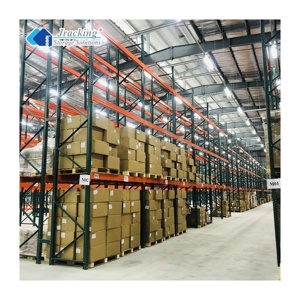
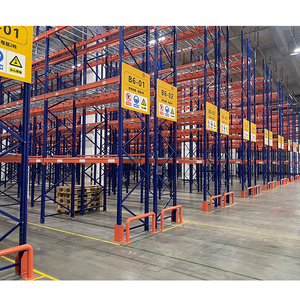
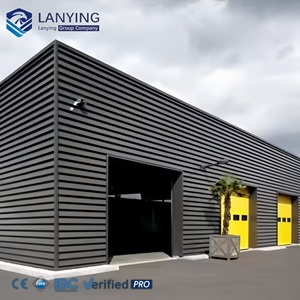
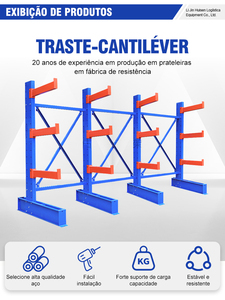
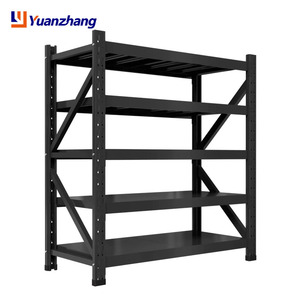
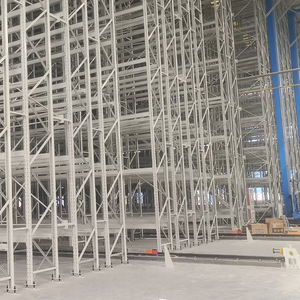
High-bay installations (heights from 12m to over 40m) demand engineering beyond standard mezzanine or pallet rack configurations. Below are the design imperatives implemented by China's leading export factories.
High bay columns require continuous multi-flange uprights with high torsional rigidity. Chinese automated roll-forming lines execute continuous punching with +/-0.5mm cumulative pitch precision over a 12-meter single column segment. The inclusion of complex return lips increases the cross-sectional radius of gyration, counteracting Euler buckling modes under severe axial dead-weight and secondary dynamic loads imparted by high-speed narrow-aisle stacker cranes.
The stability of unbraced or semi-braced racking down-aisle depends on the rotational stiffness ($C_d$) of the beam end-connectors. Premium manufacturers utilize 4-prong and 5-prong drop-forged or precision-stamped connector brackets welded via 6-axis robotic MIG fixtures. This guarantees repeatable moment-rotation curves verifiable under EN 15512 Annex A testing protocols, delivering predictable deflection limits under combined dead and live working loads.
In high-bay warehousing, seismic performance is dictated by base plate ductility and floor slab interaction. Engineering involves oversized base plates fabricated from hot-rolled carbon steel, anchor-drilled with torque-controlled mechanical or chemical resin anchors. Non-linear dynamic analysis verifies performance against site-specific spectral acceleration coefficients, preserving structural frame equilibrium during lateral sway events.
Enterprise procurement teams must verify that domestic Chinese raw materials and manufacturing lines directly satisfy destination market engineering criteria.
| Engineering Criteria | European Union (EN 15512 / FEM) | North America (RMI MH16.1 / ANSI) | Top Tier China Factory Standards |
|---|---|---|---|
| Primary Steel Grade | S235JR, S355JR according to EN 10025 | ASTM A1011 / A653 Commercial Grades | Q235B / Q355B (Yield matched to European S355 and ASTM Gr 50) |
| Safety Factor Formulation | Limit State Method (Partial load factors $\gamma_M1, \gamma_M2$) | Allowable Stress Design (ASD) & LRFD methodologies | Dual compliance: Certified engineering analysis per customer destination |
| Upright Hole Spacing | 50mm or 75mm standardized metric centers | 2-inch (50.8mm) or 3-inch Teardrop configuration | Custom CNC punching lines supporting both Metric & Teardrop tooling |
| Deflection Limit Criteria | $L/200$ for standard pallets; $L/300$ for automated handling | $L/180$ maximum under full designed pallet beam load | Automated laser-inspected camber control ensuring $≤ L/250$ to $L/350$ |
| Surface Pretreatment | Strict environmental constraints; zinc-phosphate or nano-ceramic | Iron phosphate or standard wash coats | Continuous 9-stage alkaline wash, pickling, phosphating & electrostatic bake |
Combining heavy metallurgical scale with precision automated assembly, China's top storage manufacturing hubs eliminate third-party markup while maintaining rigorous factory-floor traceability.
Direct supply contracts with tier-one domestic steel mills (such as Baosteel and Shougang) ensure mill test certificates (MTC) verifying chemical composition, elongation rates, and carbon equivalents for every coil batch.
Over 20 dedicated continuous cold-roll profiling lines equipped with servo-driven feeding, hydraulic post-cutting, and multi-roller leveling ensure zero internal residual stress in finished columns.
Beam connectors and structural cantilever arms are welded using dual-torch robotic cells with continuous gas shield coverage, eliminating slag inclusions and cold-lap weld defects.
Individual bundle cushioning, heavy structural steel strapping, waterproof shrink-wrapping, and engineered container loading diagrams safeguard component straightness through ocean transit.
Global warehouse automation, cold-chain expansion, and sustainability mandates are transforming procurement specifications across five key dimensions.
The proliferation of Automated Storage and Retrieval Systems (ASRS) has shifted racking from a static framework to dynamic structural machine guides. Tolerances for crane guide-rail mounting brackets now fall within sub-millimeter parameters. Leading Chinese high-bay manufacturers collaborate directly with Swisslog, Dematic, and domestic automation leaders, engineering built-in anchor plates and busbar supports directly into the structural columns.
With pharmaceutical and cold-chain logistics rising globally, standard structural carbon steel risks brittle transition fractures at temperatures below -25°C. Modern procurement trends require impact testing at -40°C (Charpy V-Notch test). Chinese suppliers incorporate micro-alloyed elements (such as Vanadium and Niobium) into custom steel melts, providing ductile yield characteristics in blast-freezer environments.
Logistics operators increasingly eliminate the standalone civil building envelope altogether. In Rack-Clad construction, the high-bay racking forms the main load-bearing framework of the facility, supporting wall siding, insulated roof panels, wind loads, and seismic forces directly. Procuring rack-clad packages from Chinese structural engineering mills slashes building construction timelines by up to 40% and drastically lowers capital deployment per pallet slot.
A major information gap among international buyers revolves around mitigating supplier delivery risk. High-bay rack installations can fail catastrophically if quality inspection is deferred until jobsite delivery. Premium Chinese manufacturers employ an exhaustive Quality Assurance framework starting at coil slitting.
Crucial quality control checks include: Continuous Ultrasonic Testing (UT) along high-stress beam-end weld seams, Dry Film Thickness (DFT) verification guaranteeing 60 to 90 microns of thermosetting polyester coating (cross-hatch adhesion tested per ISO 2409), and optical comparator profiling on perforated upright slots to confirm absolute connector-locking clearances. Importers must demand third-party witnessing (SGS, TUV, BV) covering stub column compression tests, connector shear tests, and looseness tests according to standard EN 15512 Annex A before container dispatch.
Furthermore, structural traceability is maintained by stamping batch IDs directly into the cold-formed profiles. This enables instant field verification of steel heat number, production line operator, and raw material mill provenance years after commissioning.
Direct technical and logistical answers addressed by licensed warehouse structural engineers.
Connect with our technical engineering department for tailored project evaluations, custom CAD bay designs, finite element calculations, and containerized FOB/CIF estimates configured to your logistics operations.