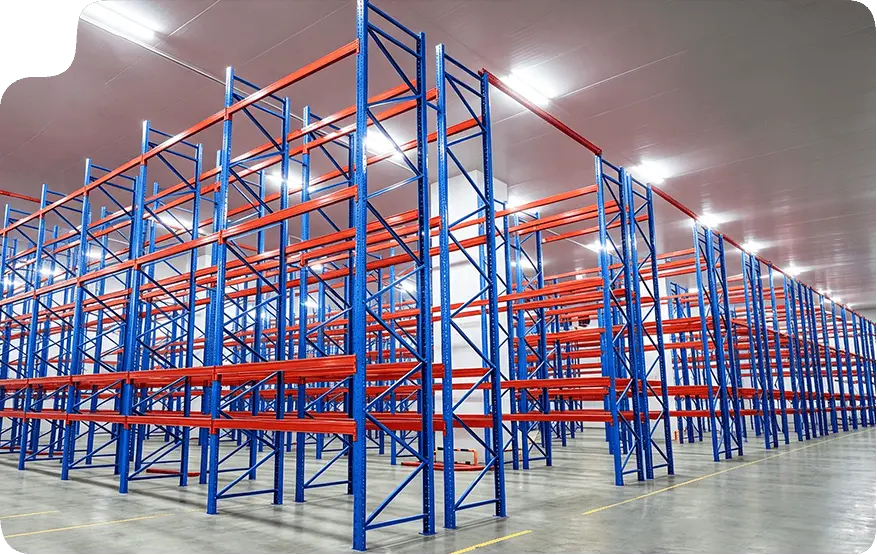
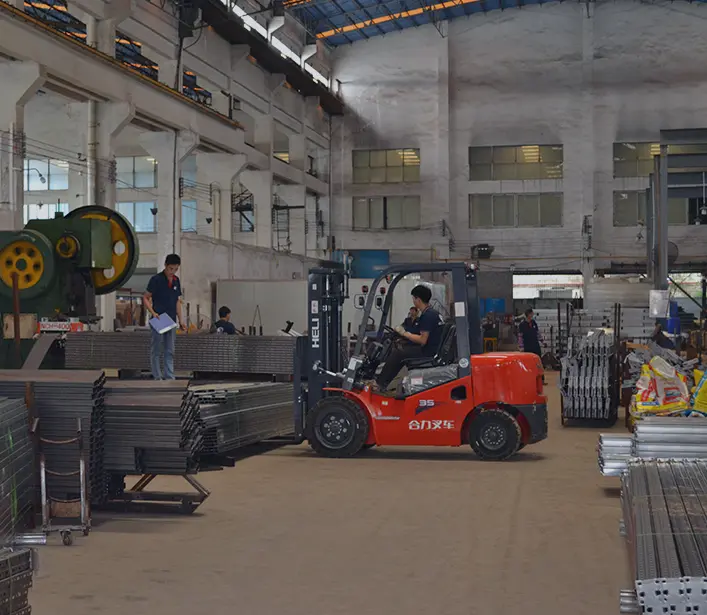
Direct from our 30,000 m² Guangzhou production facility. Tested under strict deflection limits and cycle fatigue requirements to support heavy unit-loads, high throughput, and strict FIFO/LIFO warehousing protocols.
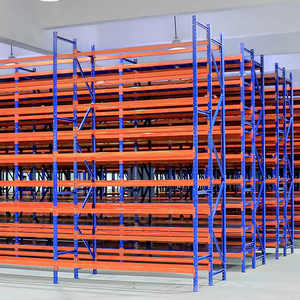
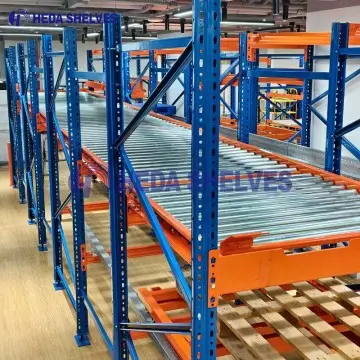
Live Pallet Racking, commonly known across European and global logistics terminals as Pallet Flow Racking or Gravity Roller Racking, operates as a dynamic, high-density First-In, First-Out (FIFO) material handling system. By utilizing inclined steel roller tracks set at a precisely calculated gradient—typically between 3.0% and 4.0% (1.7° to 2.3°)—unitized pallets roll autonomously under gravity from the charge (loading) aisle to the discharge (picking) face.
Unlike standard selective racking, a pallet flow installation consolidates floor space by eliminating intermediate travel aisles, reducing total warehouse footprint requirements by up to 60%. However, the integrity of a dynamic gravity flow lane depends heavily on dynamic braking physics, roller track metallurgy, and mechanical separators designed to counter back-pressure.
As a leading Chinese industrial rack manufacturer, Guangzhou Heda Shelves engineers live storage lanes with centrifugal and eddy-current magnetic brake rollers positioned along the track at 1-pallet intervals. These governors regulate the terminal rolling speed to a safe 0.25 to 0.30 m/s, preventing heavy unit loads (up to 1,500 kg per pallet) from accelerating unchecked toward the discharge end stop.
At the unloading face, our proprietary automatic pallet separation mechanism mechanically isolates the first retrieval pallet from subsequent queue line pallets. By absorbing cumulative line pressure, the forklift operator can disengage the lead pallet smoothly without dangerous friction jams or sudden load surges.
| System Architecture | Floor Space Utilization | Stock Rotation Logic | Roller / Rail Technology | Forklift Cycle Efficiency | Capital Expenditure vs ROI |
|---|---|---|---|---|---|
| Live Pallet Racking (FIFO) | Ultra High (85%+) | Strict FIFO (Continuous Flow) | Cylindrical full-width rollers, magnetic brake rollers, end-stop separators | Maximum: Loading and retrieval aisles are 100% separated | High initial CapEx; rapid 18-24 mo ROI via thermal/space consolidation |
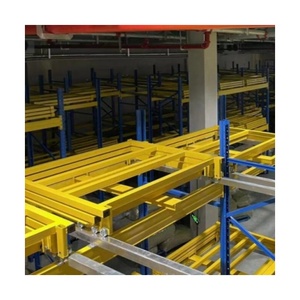
| Push Back Racking (LIFO) | High (70-75%) | Strict LIFO (Last-In, First-Out) | Nested nested carriage carts rolling on structural inclined channels | Moderate: Single aisle shared for charge and discharge picking | Medium CapEx; lower maintenance due to fewer rotating mechanical parts |
| Drive-In Racking (LIFO) | High (65-75%) | Strict LIFO (Lane Dependent) | Continuous cantilevered side-support guide rails without rollers | Slow: Trucks drive into deep structural bays, higher impact risk | Low initial CapEx; higher structural repair & column maintenance overhead |
| Radio Shuttle Racking | Ultra High (85-90%) | Flexible FIFO or LIFO | Reinforced shuttle run tracks with semi-automated 24V lithium cart | High: Shuttles transfer pallets internally while driver stays at aisle face | High CapEx; requires ongoing battery, sensor and motor maintenance |
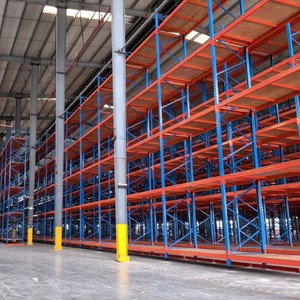
| Standard Selective Racking | Baseline (40-45%) | Unrestricted Access | Static cold-formed step or box beams with wire mesh or timber decking | Baseline: Forklifts require wide 3.0m - 3.8m turning aisles for every bay | Lowest initial CapEx; high real estate footprint cost over building lifetime |
Navigating raw material price cycles, automation interfacing, and sustainability mandates requires global supply chain directors to evaluate live storage systems through an evolved technical lens.
Modern distribution centers increasingly phase out counterbalanced human forklifts in favor of Autonomous Mobile Robots (AMRs) and Automated Guided Vehicles (AGVs). Live pallet racking discharge points now incorporate optical pallet position sensors, robotic centering guide funnels, and pneumatic zero-backpressure stops that interface with AGV hydraulic forks without sensor blind spots.
With refrigerated real estate electricity costs rising globally, ambient aisle volume in cold-storage warehouses (-25°C to -30°C) is an expensive operational liability. Live pallet flow racking consolidates chilled space up to 2× higher than static bays. Specifiers now mandate low-temperature synthetic synthetic ester lubricants and cryogenic-grade bearings in roller assemblies to prevent viscosity lockup.
Under the European Union's Carbon Border Adjustment Mechanism (CBAM) and global ESG frameworks, overseas procurement managers require complete mill test certificates documenting Scope 1, 2, and 3 emissions of the steel. Top Chinese suppliers like HEDA Shelves utilize certified electric-arc furnace (EAF) steel and non-toxic thermoset polyester coatings with complete RoHS and chemical compliance verification.
Fluctuations in hot-rolled coil (HRC) commodities can introduce price volatility for mega-scale projects exceeding 2,000 tonnes of steel racking. Enterprise procurement teams now negotiate framework contracts with Tier-1 Chinese mills via manufacturers that offer staged pricing pegged to Shanghai Futures Exchange (SHFE) indexes, guaranteeing budget stability over long-cycle EPC buildouts.
Cross-border logistics operators prioritize manufacturers capable of unified structural calculation across regional building codes: EN 15512 (Europe), ANSI MH16.1 (USA), and AS 4084 (Australia). This eliminates redundant redesign cycles when expanding supply chain infrastructure across multiple continents, maintaining standard component interchangeability across global nodes.
The progression of live pallet racking from simple skate-wheel channels to precision-engineered dynamic roller lanes represents decades of material handling refinement. The primary engineering challenge has always been **dissipating kinetic energy reliably without component fatigue**.
Historically, mechanical friction brakes wore down quickly under continuous abrasive contact with dirty wooden pallet runners, shedding brake dust and necessitating frequent lane inspections. Modern live systems deployed by HEDA Shelves employ non-contact eddy-current magnetic brake rollers.
As the conductive roller shell spins against permanent neodymium magnetic stators, opposing electromagnetic fields generate deceleration torque directly proportional to the pallet's velocity. A light 300 kg pallet experiences low braking drag, while a 1,500 kg chemical liquid pallet generates strong braking forces—ensuring consistent, safe speed regulation along the entire track.
Furthermore, our split-roller architectures permit Euro pallet (1200 × 800 mm) and Industrial pallet (1200 × 1000 mm) cross-compatibility within identical lanes, accommodating non-uniform bottom boards without bottom-runner deflection or channel climbing.
Established in 2001, Guangzhou Heda Shelves Co., Ltd. has grown from a specialized roll-forming workshop into a globally recognized industrial racking powerhouse, serving over 10,000 enterprise warehouse projects across 120+ countries.
Our structural integrity is verified by accredited bodies: CE Certificate No. 2435-CPR-8605159 and ISO 9001:2015 Certificate No. 18624Q00169R0M. Load tables, yield stress tests, and weld penetration radiography comply rigorously with EN 15512 and EN 15620 for effortless review by local municipal safety inspectors.
Before fabrication begins, our senior logistics architects provide complete structural CAD blueprints, beam deflection models, and interactive 3D simulations. We analyze building column grids, forklift turning radiuses, fire sprinkler clear-spaces, and concrete slab load capacities at zero upfront cost to ensure seamless on-site deployment.
From spectrographic analysis of incoming Q235B/Q355B coil stock to automatic CNC multi-hole punching, robotic beam connector welding, continuous 8-tank pickling & phosphating, and electrostatic powder curing lines, every batch is fully trackable. We guarantee optimal dry-film paint adhesion without orange peel, rust creep, or flaking.
Exporting industrial structural steel requires rigorous export bundling and seaworthy corrosion protection. HEDA Shelves components are custom-packed with protective corrugated interleaving, heavy-duty edge guards, and steel strapping over custom-dimensioned skids to prevent bending or abrasion inside 40ft High Cube containers.
We maintain dedicated shipping agreements with major ocean freight lines providing direct sailings from Guangzhou, Shenzhen, and Hong Kong to key international logistics hubs: Rotterdam, Hamburg, Antwerp, Felixstowe, Valencia, Long Beach, and Singapore.
Clear, highly detailed technical answers to guide procurement managers, warehouse architects, and distribution operations directors during system specification.
Send us your warehouse CAD floor plan, building height clearances, pallet dimensions, and operational throughput targets. Our engineering department will deliver an optimized structural layout, load deflection analysis, and factory-direct price quotation within 24 working hours.