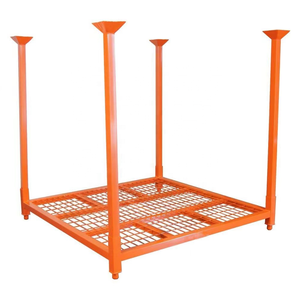
Heavy-Duty Warehouse Storage Portfolios
Engineered Adjustable Racking Configurations
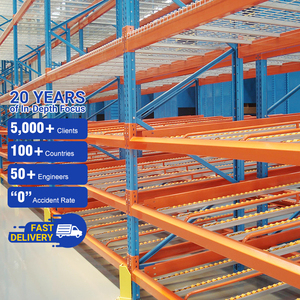
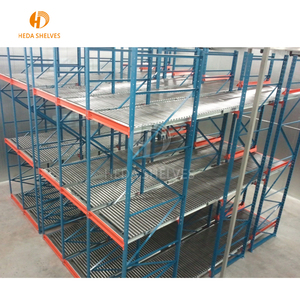
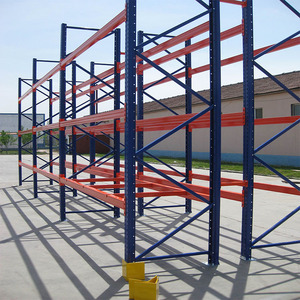
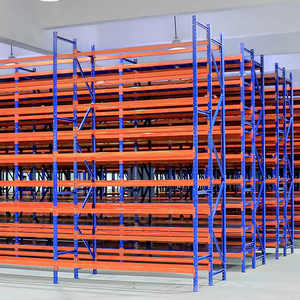
Precision cold-formed rack systems customized for selective pallet density, dynamic gravity flow, cryogenic applications, and high-throughput distribution hubs.
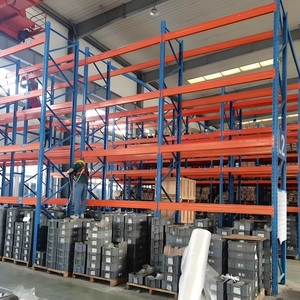
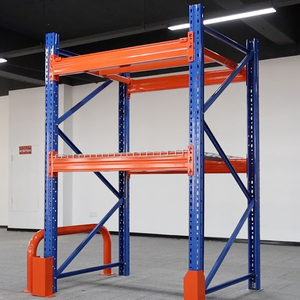
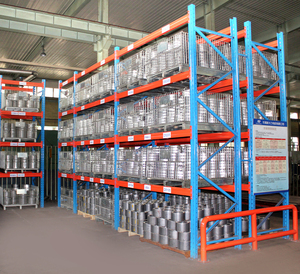
Metallurgy & Structural Physics
Engineering Principles of Adjustable Racking Systems
An exploration of cold-rolled profile geometry, yield strength mechanics, and torsional-flexural buckling resistance under EN 15512 and RMI MH16.1 design parameters.
Micro-Alloyed Cold-Formed Steel
Structural integrity begins with mill-certified Q235B, Q355B, and European grade S355JR coil steel. Through multi-pass continuous cold-roll forming, the grain structure undergoes controlled work hardening, boosting yield strength across outer bending radii up to 355–420 MPa without embrittlement.
Multi-Point Clamping Connectors
Beam end connectors utilize proprietary 3, 4, or 5-claw stamped hook plates engineered for precise wedging action against tapered upright perforations. Under load, this interface creates a semi-rigid moment connection that resists portal sway, transferring rotational moments back to vertical frames efficiently.
Surface Passivation & Adhesion
Prior to powder application, components pass through a 9-stage degreasing, ultrasonic rinse, acid pickling, and zirconium phosphating sequence. This nanoscale conversion layer ensures 100% mechanical paint interlock, preventing sub-surface oxidation when exposed to 500-hour ASTM B117 salt spray tests.
| Racking Architecture | Material Standard | Pitch Adjustability | Deflection Limit ($\delta$) | Load Capacity (Bay) | Safety Code Benchmark |
|---|---|---|---|---|---|
| Selective Pallet Racking | Q235B / S275JR Structural Steel | 50 mm / 75 mm Pitch | $L / 200$ Beam Midspan | Up to 24,000 kg | EN 15512:2020 / RMI |
| Drive-In / Drive-Through | Q355B Heavy Cold-Formed | 75 mm Stamped Cantilever | $L / 250$ Cantilever Arm | Up to 18,000 kg | ISO 9001 / FEM 10.2.07 |
| Radio Shuttle High-Density | Galvanized S355 / Q355B Rail | 50 mm Sub-Frame Spacing | $L / 300$ Guide Rail Spec | Up to 30,000 kg | CE Machinery CPR-8605159 |
| Gravity Flow Dynamic Lanes | Carbon Steel + Aluminum Track | 25 mm Gradient Adjust | $L / 300$ Roller Track | Up to 1,500 kg / Pallet | EN 15620 / OSHA Safe |
| Sanitary Stainless (Cold Chain) | AISI 304 / 316 Welded Tubing | 50 mm Welded Bushing | $L / 250$ Rigid Shelf | Up to 12,000 kg | HACCP / GMP Compliant |
Market Intelligence
Future Procurement Trends in Industrial Storage (2025–2035)
How supply chain directors, contract logistics giants (3PLs), and engineering EPCs are restructuring procurement paradigms to de-risk CAPEX investments.
Scope 3 Emissions & Green Steel
European Corporate Sustainability Due Diligence Directive (CSDDD) and carbon border adjustment mechanisms (CBAM) are compelling Tier-1 buyers to mandate low-embodied-carbon steel. Sourcing from EAF (Electric Arc Furnace) mills utilizing scrap steel and green hydrogen powered reduction facilities is rapidly moving from optional ESG metrics to contractual pre-requisites.
Freight-Optimized Nesting Engineering
With ocean freight volatility becoming a permanent baseline, advanced OEM suppliers engineer custom roll-formed uprights and diagonal bracings that telescope or nest into compact bundles. This volumetric densification increases container cube-out efficiencies by up to 28%, drastically lowering logistics expenditure per stored pallet location.
Standardized Sub-Assembly Modularity
Modern distribution hubs require rapid SKU re-profiling. Procurement strategies have abandoned rigid welded frames in favor of full bolt-together adjustable sub-assemblies. Universal punching patterns on 50 mm / 75 mm pitch enable plug-and-play conversion between standard selective racking, drop-in carton flow shelves, and mezzanine platform supports.
R&D & Automation Convergence
Technological Evolution: Smart, Resilient & AMR-Ready Racking
The transition from passive warehouse steel structures into dynamic, sensor-integrated cyber-physical infrastructure.
Tighter Tolerances for AMR/AGV Fleets
Autonomous Mobile Robots require tighter corridor dimensional tolerances ($\pm 1.5\text{ mm}$) than human-operated forklifts. Modern roll-forming lines feature laser positioning and inline CNC punching to deliver absolute plumbness across 14-meter clear-span bays.
Digital Twin & Strain Monitoring
Integration of IoT strain gauges within high-stress beam-column joints allows facility managers to monitor dynamic live-load deflections and impact anomalies in real time via digital twins, alerting safety engineers prior to structural yield.
Advanced Cold-Roll Anti-Corrosion
High-grade thermoset polyester resins with UV-inhibitors and micro-porous zinc primer coatings provide cathodic self-healing protection on sheared edges, extending racking lifespans in humid non-climate-controlled logistics hubs beyond 25 years.
Seismic Energy Dissipation Bases
Next-generation baseplates incorporate sacrificial ductile dampers and slotted anchor pin geometries designed according to Eurocode 8 and ASCE 7, dissipating ground shear acceleration during high-magnitude seismic events without catastrophic frame collapse.
Manufacturing Pedigree
Global OEM/ODM Scale, Verification & Factory Standards
Headquartered in Guangzhou, our integrated manufacturing plant operates under rigorous international quality frameworks, supplying turn-key storage engineering across 120+ countries since 2001.
Verified Global Compliance
Fully verified and certified manufacturing facilities holding CE Certificate No. 2435-CPR-8605159, ISO 9001:2015 Certificate No. 18624Q00169R0M, and comprehensive RoHS compliance testing, ensuring zero legal or inspection barriers across European, North American, and Australasian jurisdictions.
Complimentary 3D & CAD Engineering
Our engineering department utilizes advanced CAD/BIM software, generating complete 3D warehouse layout simulations, point-load stress calculations, and forklift turning radius clearance diagrams within 48 hours of initial floor plan submission, avoiding costly on-site installation retrofits.
Full Bespoke OEM/ODM Tooling
We support private-label custom manufacturing for global racking distributors, material handling dealers, and integrators. From custom RAL powder coat matching and bespoke perforation hole shapes (teardrop, hex, keyhole) to private brand stamping and custom seaworthy export packaging.
2001.
Year Established & Registered
30,000m²
Modern Production Facility
30,000t
Monthly Cold-Formed Steel Capacity
10,000+
Global Projects Successfully Deployed
Strict 10-Step Quality-Controlled Manufacturing Cycle
Step 01
Spectrometry & Steel QC
Mill test verification of tensile strength, carbon, and silicon alloy ratios.
Step 02
Precision Slitting
High-speed CNC slitting to sub-millimeter coil width tolerances.
Step 03
CNC Column Punching
Automated punching of 50mm / 75mm pitch holes with optical positioners.
Step 04
Cold-Roll Forming
Progressive 20-station roll-forming lines creating structural omega uprights.
Step 05
Beam Interlock Forming
Dual-C profile cold nesting and automated continuous seam rolling.
Step 06
Robotic Welding
Multi-axis robotic arms weld connector brackets with uniform penetration.
Step 07
Shot Blasting & Polishing
Surface scaling and welding bead grinding to achieve clean profile contours.
Step 08
Chemical Pretreatment
9-stage immersion: degrease, ultrasonic wash, pickling, and zirconium seal.
Step 09
Electrostatic Powder Coat
Automated Swiss Gema powder booths baking at 200°C for durable polymer finish.
Step 10
Testing & Export Packaging
Cross-hatch adhesion testing, strapping, edge corner guards, and container crating.
Technical Directives
B2B Procurement & Engineering Specification FAQ
Detailed structural engineering, testing, and contractual answers addressing critical due-diligence concerns of global procurement leads.
How do you verify structural compliance with European EN 15512:2020 and US RMI MH16.1 codes?
Compliance verification requires both empirical physical testing and Finite Element Analysis (FEA) modeling. Under EN 15512:2020, structural calculations cannot rely solely on classical beam theory due to the perforations and cold-formed profile geometries. We perform stub column tests to determine cross-sectional compression area ($A_{eff}$), beam-to-column connector bending tests to verify rotational stiffness ($k_b$), and frame shear tests ($k_f$) for portal sway stability. Test certificates and signed structural calculation packages verified by independent structural engineers are provided for local authority building approvals.
Can standard selective pallet racking be reconfigured for automated shuttle carts or AMR integration?
Yes, provided initial upright profile sections are engineered with sufficient torsional rigidity and reserve load factors. For Radio Shuttle retrofits, standard crossbeams are replaced by heavy-duty galvanized running guide rails equipped with optical target stops. For Autonomous Mobile Robot (AMR) or Automated Guided Vehicle (AGV) floor transit, bottom beam levels must be elevated, requiring bolted baseplate reinforcements, anchor pin pull-out verification, and specialized floor-level heavy channel wheel guidance guards to absorb accidental lateral deviation.
What specific steel grade should be specified for sub-zero (-30°C) blast freezers versus ambient warehouses?
For ambient distribution centers, certified Q235B or Q355B (equivalent to S235JR and S355JR) provides superior yield strength ($f_y \ge 235–355\text{ MPa}$) with high ductility. However, in cold chain facilities operating below -20°C to -30°C, ordinary structural carbon steels experience ductile-to-brittle transition, significantly increasing catastrophic shear failure risk under forklift impact. For cryogenic environments, we specify Charpy V-notch impact-tested grades (such as Q355D or S355J2) tested to absorb a minimum of 27 Joules at -20°C, combined with hot-dip galvanizing to prevent micro-fissure condensation corrosion.
What are the permissible beam deflection limits before an installation is deemed structurally unsafe?
International structural standards (including EN 15620 and ANSI/RMI MH16.1) mandate maximum vertical deflection of a pallet rack beam under normal static working load to not exceed $1/200$ of the beam's clear span length ($L/200$). In automated environments or systems utilizing push-back carts and narrow aisles (VNA), a more conservative deflection threshold of $L/300$ or maximum $10\text{ mm}$ is strictly enforced to avoid pallet bind-up and equipment hang-ups. Any permanent residual deflection after load release exceeding $L/1000$ indicates yield deformation and requires immediate component replacement.
What is your production throughput, minimum order quantity (MOQ), and shipping lead time for multi-bay projects?
Operating our 30,000 square meter plant with multiple automated roll-forming lines, our monthly processing capacity exceeds 30,000 metric tons of steel. Our baseline MOQ for custom OEM engineering is typically one 40-foot high-cube container (approx. 20–22 tons of packed steel). Manufacturing lead time for standard project sizes (5,000 to 20,000 pallet positions) averages 15 to 25 calendar days. Transit times from our Guangzhou port facilities range from 18 to 24 days to US West Coast, and 28 to 35 days to primary European ports (Rotterdam, Hamburg, Antwerp).
How does your factory accommodate private-label OEM distributor branding and custom profile designs?
We provide full turnkey OEM/ODM services for established racking distributors and industrial brands. This includes in-house tooling creation for custom perforation geometry, matching proprietary beam connector hook formats, continuous corporate RAL color powder coating, laser-etched distributor branding on component tags, and customized installation documentation. Furthermore, products can be packaged with localized barcode labels and nested crating engineered specifically for third-party job site dispatch.
What seismic design parameters are calculated for projects located in active fault zones?
For installations in seismically active regions (such as California, Southern Europe, Japan, or New Zealand), designs are computed according to equivalent lateral force procedures or response spectrum analysis specified in Eurocode 8 or ASCE 7 / FEMA 460. We calculate structural ductility reduction factors ($q$ or $R$), check second-order ($P\text{-}\Delta$) sway moments, specify oversized baseplates with dual concrete chemical capsule anchor studs, and engineer heavy tubular back-to-back cross bracing systems to guarantee global structural stability under ground acceleration.
Direct Factory Engineering Engagement
Submit Your Logistics Layout & Pallet Specifications
Connect directly with our senior racking structural engineering division. Share your facility CAD drawings or project requirements to receive comprehensive load-capacity data sheets, 3D visualization layouts, and a direct factory quotation within 24–48 hours.
Complimentary 2D/3D CAD Layouts
EN 15512 & RMI Structural Calculations
Custom RAL Colors & OEM Labeling
Direct Ocean Container FOB/CIF Pricing