Industrial Whitepaper & Strategic Sourcing Guide

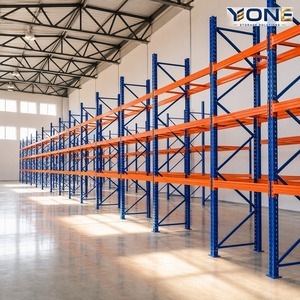
Top Trusted Gravity Flow Pallet Racking Systems Manufacturers & Exporters

High-Density FIFO Dynamics, European Standard Engineering (EN 15512), and Turnkey Global Logistics Infrastructure for Intralogistics Excellence

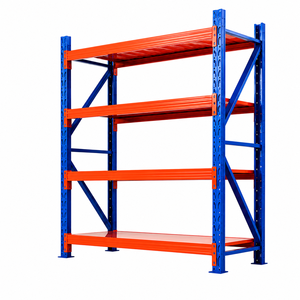
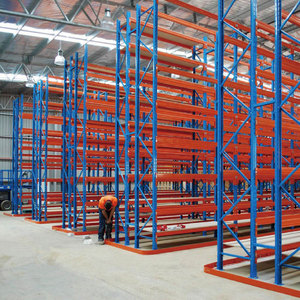
Engineered Racking Portfolio

High-Efficiency Warehouse Storage & Material Handling Systems

Explore heavy-duty, factory-direct structural configurations designed to integrate seamlessly with dynamic roller tracks, drive-in systems, and automated fulfillment hubs worldwide.

Engineering Foundations

The Mechanics of Gravity Flow Pallet Racking: Kinematics & Safety Control

Gravity flow pallet racking—also designated as live pallet storage or dynamic pallet flow—relies on an engineered incline plane (typically 3% to 4%) integrated with high-durability roller tracks to glide unitized pallet loads autonomously from the loading face to the discharge picking face.

Controlled Incline & Roller Track Dynamics

Proper pallet flow requires exact kinetic balance. If the bed slope is too shallow, varied bottom-deck timber friction arrests the descent; if too steep, impact velocity at the discharge aisle risks structural strain. Our systems utilize computer-simulated gradients of 3.2%–3.8%, matching pallet specifications from Euro EPAL 1200×800 mm to GMA 48×40 inch footprints.

Centrifugal Brake Rollers & Velocity Damping

To eliminate unchecked acceleration over deep run configurations (up to 20–25 pallets deep), centrifugal speed-controllers are spaced strategically every 1.5 to 2 meters. These maintenance-free mechanical internal-gear brake rollers dynamically restrict terminal pallet velocity to a safe walking pace below 0.3 m/s, safeguarding operators and stock integrity.

Separator Mechanics & Pressure Relief

At the picking discharge face, accumulating pallets can exert intense hydrostatic backpressure on the leading pallet. Our heavy-duty mechanical separation stop locks trailing pallets 150–200 mm behind the picking position. Once the lead pallet is safely hoisted by the forklift, the separator automatically trips to release the next pallet down the lane.

Racking Architecture Stock Rotation Rule Floor Space Utilization Aisle Requirements Throughput Speed Best Sector Match
Gravity Flow (Live Pallet) Strict FIFO Up to 85% volumetric density 2 Aisles (Loading & Discharge) Continuous Rapid Flow Food, Beverage, Pharma, Perishables
Drive-In / Drive-Through LIFO (FIFO rare) Up to 75% volumetric density 1–2 Dedicated Aisles Moderate (Forklift Enters Rack) Seasonal Bulk, Cold Storage
Radio Shuttle Racking Flexible FIFO / LIFO Up to 88% volumetric density 1–2 Aisles (Semi-Automated) High Semi-Autonomous Freezer Rooms, 3PL FMCG Depots
Selective Pallet Racking Universal Access 40%–50% volumetric density Multiple Wide/Narrow Aisles Direct Individual Access Multi-SKU E-commerce, General Parts
Industry Horizon 2025–2030

Future Procurement Trends in Industrial Pallet Flow Systems

Enterprise procurement directors and supply chain engineers are no longer purchasing static steel racks in isolation. The market is shifting toward automated compatibility, environmental traceability, and low total cost of ownership (TCO).

AGV/AMR End-Effector Integration

Modern warehouse distribution centres are converting loading and extraction faces from manual counterbalanced trucks to autonomous mobile robots (AMRs) and automated guided vehicles (AGVs). Gravity flow beds now require millimeter-level centering guides, optical sensors, and precision mechanical end stops to guarantee sub-millimeter positioning tolerances during robotic transfer.

Cold-Chain & Ultra-Low Temp Formulations

With global demand expanding in frozen food distribution and biopharmaceutical cold-chain (-25°C to -35°C), standard roller bearings and lubricants suffer viscosity breakdown and premature lockups. Future-ready procurement focuses on specialized synthetic sub-zero lubricants, stainless steel roller axles, and specialized high-impact polymers resistant to cryogenic embrittlement.

Circularity, Low-Carbon Steel & ESG Standards

Enterprise tenders in Europe and North America increasingly demand Environmental Product Declarations (EPD) and compliance with CBAM (Carbon Border Adjustment Mechanism). Forward-looking manufacturers are shifting to electric arc furnace (EAF) certified steel billets, solvent-free electrostatic powder coatings, and fully modular components that can be reused rather than scrapped.

Manufacturer Authority

Guangzhou Heda Shelves Co., Ltd. — 25 Years of Engineering Trust

Founded in 2001, Guangzhou Heda Shelves Co., Ltd. has grown from a specialized roll-forming facility into an international leader in structural storage solutions. We provide complete end-to-end manufacturing, custom layout engineering, and sea-freight logistics support to over 120 countries.

2001
Founded & Established
25+ years of continuous innovation in heavy-duty racking design and fabrication.
30,000 m²
Modern Production Plant
Automated cold-bending roll-formers, laser punching, and electrostatic coating lines.
30,000 t
Monthly Output Capacity
Scalable capacity to deliver large-scale multinational projects without scheduling delays.
10,000+
Completed Projects
Supplying world-class storage installations across Europe, Americas, APAC & the Middle East.

Independently Audited Certifications

We maintain full verified compliance for mission-critical industrial installations: CE Certificate No. 2435-CPR-8605159, ISO 9001:2015 Certification No. 18624Q00169R0M, and comprehensive RoHS raw material non-toxicity compliance for environmental assurance.

European Normative Standards (EN 15512)

Our engineering proposals include structural load calculation documentation adhering to EN 15512, EN 15620, and FEM 10.2.02 guidelines. Each layout delivers safety validation for local EU, UK, and municipal building code structural checks.

Turnkey Global Export & Port Shipping

We routinely manage ocean freight logistics, seaworthy container consolidation, and customs documentation into major international maritime hubs including Rotterdam, Hamburg, Antwerp, Felixstowe, Valencia, Long Beach, and Singapore with full DDP, CIF, or FOB terms.

Production Integrity

10-Stage Heavy-Duty Precision Manufacturing Workflow

From primary steel coil inspection through automated profile forming and electrostatic surface protection, every component undergoes stringent quality gates before loading.

01
Raw Material Test
Spectrometric & tensile verification of certified Q235B/Q355B coil stock.
02
Precision Slitting
CNC automated shearing and slitting to exact section dimension profiles.
03
Column Punching
High-speed CNC multi-pitch punching for drop-pin accuracy and beam fit.
04
Cold-Roll Bending
Progressive continuous cold-roll forming to create structural upright profiles.
05
Profile Calibration
Automated laser straightness checking and structural squaring verification.
06
Deburring & Polish
Mechanical grinding of edges and contact surfaces for operator handling safety.
07
Robotic Welding
CO2 shielded automated welding of beam connector brackets and end plates.
08
Chemical Pretreatment
Multi-bath immersion pickling, degreasing, and rust-inhibiting phosphating.
09
Powder Coating
Electrostatic curing at 180°C–200°C for exceptional abrasion & corrosion resistance.
10
QC & Seaworthy Pack
Dimensional audit, strapping, corner-board edge guarding, and container stowage.
Procurement Diligence

Frequently Asked Questions on Gravity Flow Pallet Racking Procurement

In-depth technical answers addressing load dynamics, maintenance requirements, floor slab anchoring, and compliance standards for warehouse project engineers.

What is the optimum bed gradient for gravity flow pallet racking systems?
The standard engineering slope for heavy-duty pallet flow beds ranges between 3.0% and 4.0% (approximately 30 to 40 mm of elevation drop per linear meter of lane depth). The exact gradient is calibrated to the weight profile of the loaded unit (typically 500 kg to 1,500 kg), the timber quality and contact area of the bottom skids (e.g., three-skid Euro pallets vs. perimeter-base industrial pallets), and ambient temperature conditions.
How are pallet speeds controlled to prevent high-velocity collisions at the pick face?
Speed control is managed through internal-gear centrifugal brake rollers integrated directly into the roller track lanes. These brake rollers remain inactive at low rotation speeds; however, as pallet velocity approaches 0.3 m/s, internal centrifugal brake shoes engage against the roller housing, creating proportional mechanical resistance. This limits descending acceleration and maintains an even, controlled descent velocity across lanes up to 25 pallets deep.
Can gravity flow racking handle poor-quality or damaged wooden pallets?
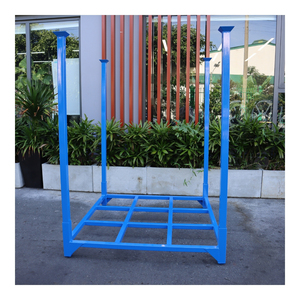
Gravity flow systems require uniform bottom-deck contact to operate reliably. Loose bottom boards, broken runners, or protruding nails can hook into roller shafts or trigger track blockages. In facilities handling mixed-grade timber or irregular rental pallets, we recommend utilizing full-width cylindrical steel rollers rather than twin-wheel tracks, or transferring loads onto standardized slave steel pallets (such as our stackable reinforced steel pallets) to guarantee continuous line operation.
What engineering documentation is supplied for European and North American building permits?
Every export project includes complete structural CAD layout drawings (DWG/PDF), beam-end connector moment capacities, upright frame load limit tables, anchor pull-out force data, and structural calculation reports referencing EN 15512, EN 15620, or RMI (MH16.1) design standards. These documents allow local structural engineers and municipal inspectors to review slab point-loads and seismic classifications swiftly.
How does gravity flow racking perform in sub-zero cold storage (-30°C)?
Gravity flow is exceptionally effective in refrigerated and freezer environments because it concentrates pallet volume, shrinking the cubic airspace that requires energy-intensive refrigeration. For sub-zero operations, our engineering team specifies low-temperature synthetic lubricants inside sealed roller bearings, zinc-electroplated or hot-dip galvanized roller assemblies to resist condensation corrosion, and specialized alloy structural steels to prevent low-temperature ductile-to-brittle transitions.
What information is required from the client to generate a free layout and commercial proposal?
To prepare an optimized CAD layout and price schedule, we require: (1) A warehouse architectural floor plan showing column grids, clear ceiling heights, and door openings; (2) Pallet specifications (width, depth, overall height including cargo, and maximum/minimum weight); (3) Forklift model, mast height, and turning radius; (4) Total SKU count, pallets per SKU, and required daily turnover rate; and (5) The delivery destination port or inland logistics hub.
What maintenance procedures are essential for dynamic gravity flow roller lanes?
Because gravity flow systems are powered purely by mechanical forces and gravity, operational maintenance is minimal. Routine preventive maintenance entails: (1) Quarterly visual inspection for broken bottom timber fragments or stretch-wrap debris caught around roller shafts; (2) Checking the free spin of centrifugal brake rollers; (3) Verifying the latch-and-release actuation of the mechanical separator stops; and (4) Annual inspection of floor anchor torque and column guard integrity in accordance with EN 15635 guidelines.
Can customized RAL corporate colors and private-label OEM markings be supplied?
Yes. We offer complete OEM and ODM contract manufacturing for industrial racking distributors, system integrators, and material handling dealers. Custom requirements including client-branded nameplates, custom component stamping, specific RAL powder coating colors (e.g., RAL 5010 Blue, RAL 2004 Orange, RAL 7035 Grey), and tailor-made assembly instructions can be specified for all volume container orders.
Request an Engineered Layout & Project Cost Analysis

Send our senior engineering team your warehouse dimensions, pallet parameters, and throughput targets. We will supply a preliminary 2D/3D CAD layout, load capacity calculation, and detailed container shipping quotation within 24 hours.