Certified Factory Direct Whitepaper

Top Trusted Pallet Storage System Factories & Suppliers

Engineering Whitepaper: Validating Direct Manufacturers, EN 15512 Limit-State Structural Calculations, CE Compliance, and Future Automated Logistics Architecture

Factory Verification & Compliance

Guangzhou HEDA Shelves: 25 Years of Advanced Structural Manufacturing

Operating from our modern 30,000 m² smart fabrication base in Guangzhou, China, HEDA Shelves engineers structural integrity into global logistics networks. With over 300 experienced technical specialists and ISO 9001:2015 quality oversight, we ship upwards of 30,000 tonnes of heavy steel racking every month to European, North American, and Asia-Pacific ports.

2001
Founded Year · 25+ Yrs Field Mastery
30,000m²
Industrial Manufacturing Plant
30,000t
Monthly Cold-Formed Steel Capacity
10,000+
Global Logistics Projects Deployed

Audited Structural Certifications

Fully certified under CE Certificate No. 2435-CPR-8605159 and ISO 9001:2015 No. 18624Q00169R0M. All engineering documentation, weld integrity checks, and finite element stress analyses conform to European standards EN 15512, EN 15620, and US RMI specifications.

EN 15512 Design CE Marked FEM Tested

Bespoke Engineering & Free 3D CAD

Eliminate expensive spatial miscalculations. Our in-house structural engineering department generates full 3D layout renderings, bay profile schematics, clear aisle turning simulations, and dead/live load calculation reports within 24 to 48 hours—prior to production release.

DWG & BIM Models Seismic Damping Turning Radius Sim

Direct Export & Global Project Packaging

Exporting to over 120 nations with dedicated multimodal shipping support. Steel frames and beams receive custom seaworthy bundling, steel strapping, corner edge guards, and vapor corrosion inhibitor (VCI) protection for sea freight arrival in Rotterdam, Hamburg, Los Angeles, and Felixstowe.

FOB / CIF / DDP Numbered Marking On-Site Supervision

Our 10-Step Precision Manufacturing Process

End-to-end metallurgical quality control under continuous ISO 9001 supervision

STEP 01

Raw Steel Assay

Spectrometric tensile and yield verification of hot/cold rolled Q235B/Q355B coils.

STEP 02

Precision Slitting

High-speed laser and rotary shear cutting within sub-millimeter tolerances.

STEP 03

CNC Column Punching

Multi-station automated punch presses forming exact 50mm/75mm hook profiles.

STEP 04

Cold Bending Forming

Progressive 18-stage roll-forming dies shaping rigid multi-flange upright posts.

STEP 05

Beam Seam Welding

Automated continuous interlock seam welding for double-C welded box profiles.

STEP 06

Shot-Blast Polishing

Surface descaling and mechanical polishing to Sa 2.5 surface roughness standards.

STEP 07

Robotic Connector Welds

CO₂ shielded multi-point robotic welding connecting beam hooks and lock plates.

STEP 08

Pickling & Phosphating

7-stage chemical immersion pre-treatment forming an anti-rust phosphate micro-layer.

STEP 09

Electrostatic Coating

GEMA automatic powder spray applying 60–80μm durable epoxy-polyester finish.

STEP 10

Curing, QA & Packaging

200°C thermal curing oven, beam deflection testing, barcoding, and export crating.

Engineering Selection Guide

Comparative Analysis: Selecting the Optimal Structural Pallet System

Procurement teams must evaluate warehouse footprint efficiency against capital expenditure and throughput requirements. Review the engineering matrix below to identify the structural system aligning with your operational SKU velocity and storage density objectives.

Racking Typology Storage Density Pallet Accessibility Stock Rotation Handling Equipment Required Best Suited Application
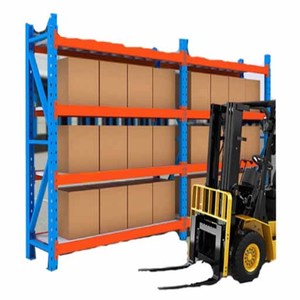
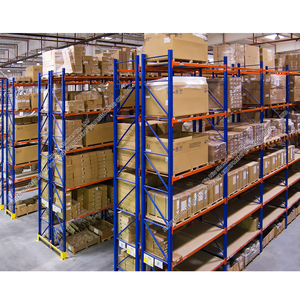
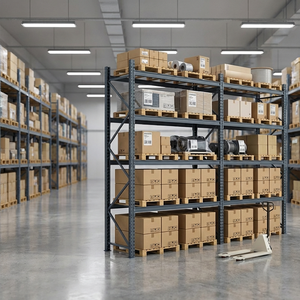
Selective Pallet Racking Standard (40-45%) 100% Direct Immediate FIFO / LIFO Standard Counterbalance, Reach Trucks General Warehousing, Multi-SKU 3PL Distribution
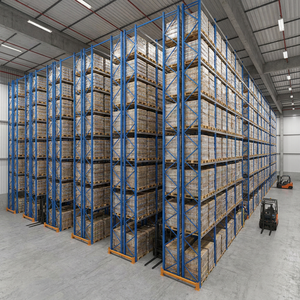
Double-Deep Pallet Rack Medium (55-60%) 50% Direct (2 Pallets Deep) LIFO Pantograph / Deep-Reach Forklifts Cold Storage, Bulk Products with 2-4 Pallets/SKU
Drive-In / Drive-Through High (70-75%) Lane Specific Access LIFO (Drive-In) / FIFO (Through) Counterbalance, Narrow-Mast Reach Trucks Beverage, Cold Chain, Homogeneous Seasonal SKUs
Radio Shuttle System Maximum (80-85%) Automated Lane Access FIFO or LIFO Configurable Standard Forklift + Autonomous Shuttle Cart Frozen Food, Pharmaceutical, Deep Lane Consolidation
Gravity Pallet Flow High (75-80%) Picking Face Dedicated Strict FIFO Standard Loading/Unloading Forklifts Perishable Goods, High-Turnover Buffers, FMCG
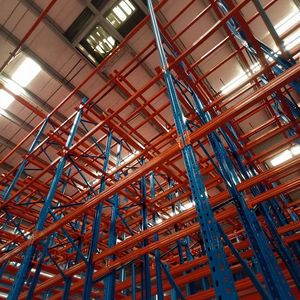
Very Narrow Aisle (VNA) High (65-70%) 100% Direct Immediate FIFO / LIFO VNA Turret Trucks / Wire-Guided Stacker High-Bay E-Commerce Hubs with Tall Ceilings (>12m)
Market Intelligence 2026–2030

Future Pallet Storage Procurement & Sourcing Trends

As global supply chains confront inflationary pressures, rising logistics real estate lease rates, and strict ESG mandates, enterprise procurement officers are adopting structured sourcing methodologies.

1. Direct Manufacturer Disintermediation & TCO

Procurement directors are shifting away from regional distributors in favor of direct collaboration with primary fabrication facilities like HEDA Shelves. Bypassing middle-tier agents eliminates markup layers (averaging 25–40%), ensures clear metallurgical traceability back to steel mill ladle numbers, and directly binds factory structural warranties to the end facility.

2. Standardized Modularity Over Bespoke Lock-In

Proprietary punch holes and unique beam connectors that lock operators into a single supplier for legacy expansions are falling out of favor. Global enterprises increasingly demand internationally standardized upright and teardrop/diamond hook configurations that allow cross-compatible bay extensions, mezzanine floor retrofits, and interchangeable wire mesh decking accessories.

3. Low-Carbon Steel & Eco-Certified Coatings

Cross-border carbon regulations (such as the EU's CBAM) require verified declarations of embedded carbon in structural steel framing. Leading manufacturers are investing in electric arc furnace (EAF) steel sourcing, water-based chemical recovery circuits in phosphating lines, and zero-VOC electrostatic polyester powder coat processes verified under RoHS directives.

Technological Evolution

Structural & Automation Architecture Developments

The modern warehouse is transforming from a passive steel skeleton into an integrated, semi-automated structural platform capable of supporting intelligent materials handling systems.

Radio Shuttle & AS/RS Hybrid Integration

The transition from pure forklift-driven lanes to semi-autonomous radio shuttle channels drastically reduces transit times and mast-impact accidents. Deep-lane pallet channels integrated with automated guided vehicles (AGVs) permit 24/7 dark-warehouse operation without human lighting or heating, generating massive cold-store energy savings.

Finite Element Damping & Dynamic Seismic Design

Traditional static stress calculations are yielding to dynamic structural modeling per EN 15512:2020 limit-state requirements. Using non-linear FEA simulation, rack engineers optimize upright column profiles with multi-bend return flanges, providing elevated torsional rigidity during seismic events and accidental vehicle impacts.

Multi-Tier Mezzanine-Supported Picking Hubs

With warehouse land costs at historic highs, operations are capitalizing on vertical building cubic volume. Rack-supported and structural column mezzanines integrate selective pallet racks on the ground level with carton-flow picking, conveyor sortation, and operator walk-paths on suspended tiers, multiplying usable floor area up to 300%.

B2B Procurement Knowledge Base

Frequently Asked Questions: Technical Engineering & Sourcing

Authoritative technical answers to critical engineering, safety certification, and cross-border project delivery questions encountered during international warehouse rack procurement.

How does HEDA Shelves ensure compliance with European EN 15512 and US RMI structural standards? +
Every structural racking configuration manufactured by HEDA Shelves undergoes rigorous engineering validation according to EN 15512 (European standard for adjustable pallet racking systems) and RMI MH16.1 specifications. Our project engineering reports document limit-state analyses, material yield properties (tested across Q235B and Q355B structural steel alloys), and allowable beam deflection ratios (restricted strictly to $L/200$ under full uniform distributed load). Physical stub-column compression and beam-connector shear tests are documented under our audited ISO 9001:2015 quality control regimen, with CE certificates (No. 2435-CPR-8605159) supplied with shipping dossiers for local fire and municipal building sign-offs.
Can racking systems be configured simultaneously for Euro (1200×800mm) and GMA (48×40") pallets? +
Yes. Bay engineering is custom-tailored to your exact operational pallet mix. For standard EUR/EPAL 1 pallets (1200mm deep × 800mm wide), we recommend 1,000mm or 1,100mm frame depths to guarantee a 50mm safe overhang at both the front and rear beam faces. For North American GMA pallets (48" × 40" / 1219mm × 1016mm), a 42" (1,067mm) frame depth is typically specified. If your logistics facility handles mixed fleet pallet profiles, our engineers incorporate heavy-duty galvanized wire mesh decking or top-hat pallet support bars, providing safe intermediate support for undersized, damaged, or turned pallets without compromising structural load ratings.
Why is wire mesh decking preferred over solid timber or steel panel decking for high-bay racks? +
Wire mesh decking is widely required by commercial warehouse property insurers (such as FM Global) and local fire authorities due to National Fire Protection Association (NFPA) compliance. Unlike solid timber or solid steel shelves, open wire mesh decks provide an open area exceeding 70%, allowing in-rack sprinkler water to penetrate down through multiple pallet tiers during a fire emergency. Additionally, open wire grids prevent dust and dirt accumulation, allow overhead lighting to illuminate lower bays for safer forklift operation, and feature welded underside channel supports that distribute point loads evenly across the load beams.
What documentation and information are required to produce a free, turnkey 3D CAD proposal? +
To generate an actionable layout, our structural design team requires: (1) An architectural warehouse floor plan (DWG, DXF, or clear PDF) indicating interior building dimensions, column locations, building egress, and dock door placements; (2) Clear internal building height to the lowest overhead obstruction (sprinkler heads, HVAC ducts, or roof purlins); (3) Pallet specifications, including width, depth, overall cargo height (including pallet base), and maximum gross weight; (4) Forklift truck specifications, specifically maximum mast lift height, collapsed mast height, and minimum right-angle aisle stacking turning clearance ($A_{st}$); (5) Targeted operational pallet position count and SKU turnover velocity.
What surface treatment and corrosion protection are applied for cold stores or humid environments? +
For cold stores (-30°C freezer rooms) and high-humidity maritime logistics hubs, surface preparation is crucial to prevent premature paint peeling and oxidation. HEDA Shelves employs a complete multi-tank pre-treatment procedure comprising hot alkaline degreasing, acid pickling, rinse passivations, and zinc phosphating. Racks are then coated with specialized exterior-grade thermosetting epoxy-polyester powder applied via automated electrostatic spray guns to a uniform thickness of 60 to 80 microns. The powder is cured in a precision thermal tunnel at 180°C to 200°C, achieving 500-hour ASTM B117 salt spray resistance. For outdoor lumber/cantilever yards, continuous hot-dip galvanization (HDG per ISO 1461) is available.
What is the typical manufacturing lead time and ocean logistics transit schedule to major ports? +
Standard production turnaround for standard selective or drive-in pallet racking projects (1 to 5 forty-foot high-cube containers) is typically 15 to 25 business days following formal CAD layout approval. Larger custom turnkey schemes (10+ containers or mezzanine-supported schemes) are staged over 30 to 40 days. Ocean freight from our Guangzhou/Shenzhen port terminals spans approximately 24 to 32 days to European base ports (Rotterdam, Antwerp, Hamburg), 18 to 24 days to US West Coast (Long Beach, Oakland), and 28 to 35 days to US East Coast (Savannah, New York). All cargo is shipped with barcoded part lists, color-coded installation manuals, and pre-sorted structural hardware.

Connect Directly with Our Certified Structural Engineers

Send your warehouse floor plans and storage requirements today. Receive a complimentary DWG layout proposal, comprehensive load capacity tables, and a transparent factory-direct quotation within 24 hours.