Custom Building
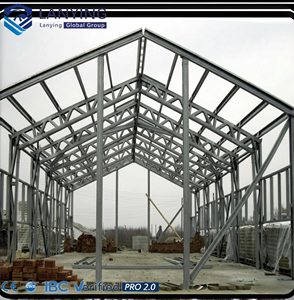
Engineered to eliminate structural deflection under asymmetric loads. Our structural steel systems handle heavy timber, extruded aluminum profiles, steel rebar, and multi-tier pallet stock with absolute stability.
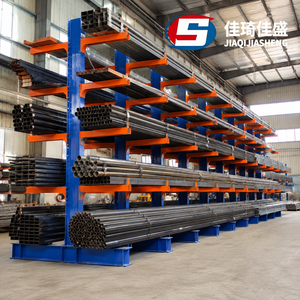
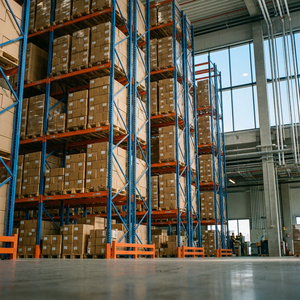
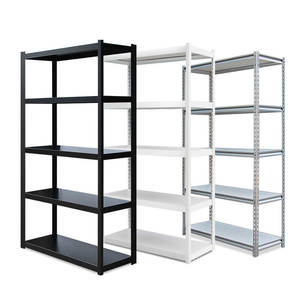
Cantilever racking requires specific engineering calculations due to pure bending moments, torsional stress, and unbraced horizontal arm projections. Understanding how structural I-beams behave under non-uniform loading prevents catastrophic warehouse rack failures.
Unlike standard uprights that endure pure axial compression, cantilever uprights act as vertical beams subject to intense eccentric bending moments ($M = P \times L$). Our structural uprights leverage hot-rolled wide flange I-beams (IPE or HEA sections) that maintain maximum yield resilience against cyclical crane loading and dynamic impacts.
Rigid bolted arms can cause column flange shearing when fork trucks clip the rack. Our engineered cantilever arms use a free-pivot pin system or high-tensile Grade 8.8 bolted saddle connectors that flex upward when hit, protecting the central upright from critical section buckling.
Torsional rigidity across cantilever bays is maintained via heavy cross-bracing bays combining tension rods and structural tubular struts. This longitudinal network arrests lateral torsion, ensuring uniform alignment when storing asymmetric structural steel pipes, bundles, or wood timber packs.
Warehouse logistics are moving from manual static storage to automated, software-driven, high-density layouts. Procurement teams must account for automation, corrosion resistance, and total cost of ownership across multi-decade operating windows.
Heavy cantilever systems now integrate directly with automated guided forklifts and automated stacker cranes. Continuous arm planes eliminate pallet upright obstacles, enabling side-loading AGVs to store 12-meter extruded aluminum bars and structural tubing without human error.
Key Requirement: Millimeter-precise horizontal and vertical tolerances specified according to FEM 9.831 / EN 15620 guidelines.
Outdoor lumber yards and chemical ports demand finishes that exceed standard powder coating. Modern procurement specifies continuous EN ISO 1461 hot-dip galvanizing with 85µm minimum zinc thickness to resist salt spray, high humidity, and acidic industrial airborne contaminants.
Outcome: 30+ year maintenance-free lifecycle outdoors with zero rust streaking or structural load derating.
Forward-thinking supply chain directors require finite element analysis (FEA) reports prior to roll-forming steel. Digital twin models verify unbraced arm twist, beam stress concentration, and seismic floor reactions under irregular point loads before manufacturing starts.
Advantage: Optimizes steel volume while eliminating over-engineering costs, reducing ocean container counts.
With over two decades of technical production in Guangzhou, China, our 30,000 m² automated facility engineers custom warehouse storage systems for distributors, 3PL logistics hubs, and industrial manufacturers worldwide.
All steel is sourced from primary state-owned mills with Mill Test Certificates (MTC) verifying yield strengths for Q235B, Q355B, and EN 10025 S355JR structural sections.
Automated punch presses, cold roll-forming lines, robotic welding stations, and an uninterrupted 10-stage pre-treatment powder coating line output 30,000 tonnes monthly.
Fully certified with CE (Certificate No. 2435-CPR-8605159), ISO 9001:2015 Quality Management, and verified RoHS surface finish safety credentials.
Our structural team delivers free complete 2D CAD layouts, realistic 3D renderings, and verifiable load capacity calculation matrices within 24–48 hours of brief receipt.
Direct technical answers addressing structural capacity, international export compliance, freight handling, and safe warehouse operations.
Cantilever arms are rated based on uniformly distributed loads (UDL). When storing variable bundles or heavy timber packs, capacity is calculated by dividing total payload weight by the minimum number of supporting arms contacting the load, applying a mandatory dynamic impact factor of 1.25 to 1.40.
Roll-formed cantilever uses cold-coiled steel (usually under 3.5mm thick) suitable for light, uniform goods up to 500kg per arm. Structural cantilever uses hot-rolled wide-flange IPE/HEA I-beams designed to absorb heavy forklift collisions and hold up to 3,000kg per arm without torsional fatigue.
Every shipment comes complete with Factory Test Certificates, Mill Test Reports (MTR), CE compliance documentation under CPR 305/2011, detailed assembly layout diagrams, static load charts, and structural design calculations referencing EN 15512 or ANSI MH16.1 standards.
Standard fabrication takes 15 to 25 business days. Heavy components are bundled using non-slip wooden blocks, protective film, and high-tensile steel strapping for ocean freight directly from Guangzhou/Shenzhen to major hubs like Rotterdam, Hamburg, Los Angeles, and Felixstowe in 25–38 days.
Send your warehouse architectural drawings (DWG, PDF) along with SKU dimensions and forklift models. Our senior structural logistics engineers will generate your free 3D CAD proposal, load capacity matrix, and firm FOB/CIF export pricing within 24 hours.