Engineered Double Deep Racking System Configurations
High-yield structural steel racking precision-engineered to ISO 9001:2015, FEM 10.2.02, and EN 15512 standards. Configured for EUR-pallet (1200×800mm), ISO-pallet (1200×1000mm), and heavy industrial loads up to 4,500 kg per bay.
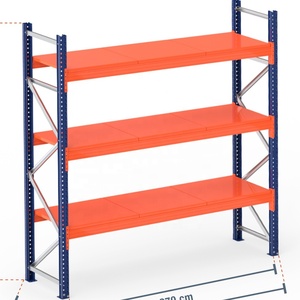 Heavy-Duty Standard
Heavy Duty Warehousing Racking Systems
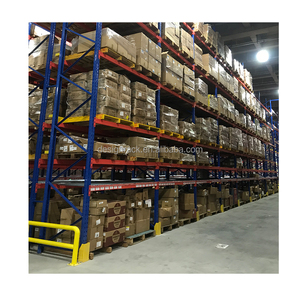 Space-Saving Dual Deep
High Density Logistics Center Double Deep Rack
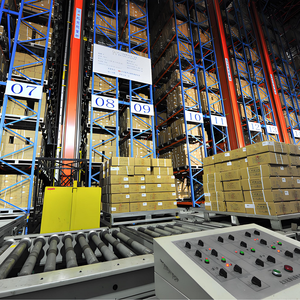 Automated Ready
Automatic Double Deep Pallet Assembly & Racking Line
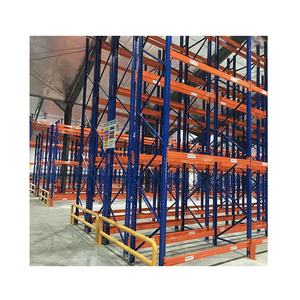 Galvanized Anti-Rust
Industrial Galvanized Steel Double Deep / VNA Rack
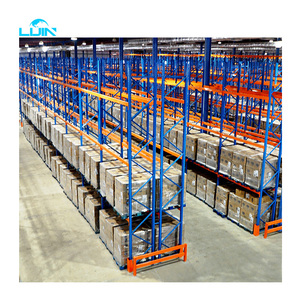 Multi-Purpose
Multipurpose Double Deep Carpet & Pallet Storage Rack
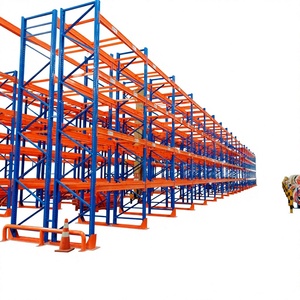 Flexible Logistics
Double Deep Racking System for Distribution Centers
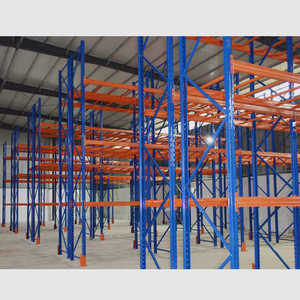 Direct Mill Source
Direct Factory High-Density Double Deep Metal Rack
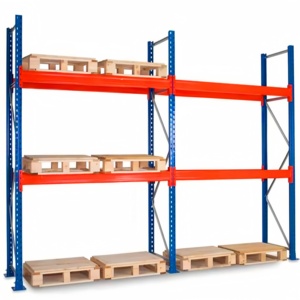 Modular High-Bay
High Quality Double Deep & Selective Hybrid Rack
Engineering Architecture of Double Deep Pallet Racking Systems
In modern high-velocity warehousing, industrial footprint costs represent up to 38% of total supply chain overhead. Facility managers and intralogistics architects are constantly constrained between two opposing storage archetypes: standard Selective Pallet Racking (APR), which delivers 100% direct pallet selectivity at the expense of an aggressive 60% aisle footprint waste; and bulk systems such as Drive-In or Gravity Flow Racking, which maximize volumetric mass but severely hinder stock SKU variability and accessibility.
The Double Deep Pallet Racking System represents the optimum mathematical equilibrium. By configuring pallet positions two-deep per aisle side (four pallets back-to-back between operating aisles), this structural geometry eliminates 50% of the interior access aisles required in selective installations. The tangible outcome is an immediate 30% to 45% expansion in net volumetric pallet storage capacity within an identical building envelope, creating a transformative return on capital expenditure (ROCE) for high-throughput distribution hubs, manufacturing spare-parts centers, and cold-chain facilities.
Core Engineering Axiom (FEM 10.2.02 & EN 15512:2020 Compliance): Double deep upright frames must be engineered not only for pure dead and live gravity loads ($G_k$ and $Q_k$), but critically for second-order sway effects ($P\text{-}\Delta$), eccentric placement moments induced by pantograph reach extensions, and horizontal forklift placement forces ($S_h$). Beam deflection limits under dynamic working conditions must strictly adhere to $\delta \le L/200$ for standard industrial clearances, and $\delta \le L/300$ for semi-automated or automated narrow aisle reach-truck environments.
Kinematic Forklift Mechanics: Pantograph Scissor vs. Telescopic Forks
A double deep rack bay cannot be serviced by counterbalanced or standard reach trucks. Operating at depths of up to 2,400mm requires specialized industrial trucks equipped with either a pantograph scissor reach mechanism or hydraulic telescopic forks. As depth doubles, the truck’s center-of-gravity shifts forward dramatically, introducing substantial overturning moments. Consequently, rack engineers must coordinate precisely with materials handling equipment (MHE) suppliers (e.g., Linde, Toyota, Jungheinrich, Crown):
1. Top Beam Level Deflection & Overhang Allowances: Beam profiles are roll-formed with reinforced interlocking connectors (3 or 4 claw tabs) to resist beam-end rotational slippage. A rear-pallet placement clearance of 75mm to 100mm between back-to-back pallets prevents puncturing adjacent loads.
2. Guide Rail Infrastructure: At heights exceeding 7,500mm, double deep aisle operations mandate low-profile floor guide rails (typically 100×50×5mm cold-formed angle or structural channel) or wire-guidance inductive loops to eliminate driver sway errors and prevent high-impact column collisions.
Comparative Engineering Matrix: Double Deep vs. Alternative Warehouse Racking
Data-backed trade-off analysis comparing volumetric density, access selectivity, handling velocity, capital expenditure, and forklift requirements.
| Storage System Type | Floor Space Utilization | Direct Selectivity | Stock Rotation Logic | Forklift Equipment Needed | CapEx Index (Selective = 1.0) | Primary Industrial Use-Case |
|---|---|---|---|---|---|---|
| Standard Selective (APR) | 40% – 45% (High Aisle Ratio) | 100% Instant | FIFO or LIFO | Standard Counterbalance / Reach | 1.0 (Baseline Low) | High SKU variety, rapid single-pallet picking |
| Double Deep Racking | 60% – 68% (+35% Gain) | 50% Direct (2 Pallets/SKU) | LIFO per lane pair / 2-FIFO | Double-Reach Pantograph Truck | 1.25 – 1.35 (Highly Cost-Effective) | Medium SKU count, 2-10 pallets/batch, cold chain |
| Drive-In / Drive-Through | 70% – 78% (Aisle-Free Block) | 10% – 20% (Lane Deep) | Strict LIFO (FIFO with Drive-Thru) | Standard Reach / Counterbalance | 1.50 – 1.70 | Homogeneous bulk raw materials, seasonal surges |
| Push-Back (2–5 Deep Carts) | 65% – 72% (Dynamic Slope) | Lane Face Only | Strict LIFO | Standard Reach Truck | 2.20 – 2.80 (Mechanical Trays) | Food processing buffers, high SKU density |
| Radio Shuttle Automation | 80% – 88% (Ultra-High Density) | Semi-Automated Lane | Software Controlled FIFO/LIFO | Forklift + Lithium Shuttle Carts | 3.50 – 4.80 (Electrical Automation) | Mega-scale distribution, blast freezers (-30°C) |
Why Global Tier-1 Logistics Sourcing Chooses Our Facility
Founded in 2001 in Guangzhou, China, our 30,000 m² state-of-the-art facility integrates continuous roll-forming lines, automated CNC stamping, robotic welding, and environmental surface finishing with a monthly fabrication capacity of 30,000 metric tons.
Verified CE & ISO Quality Control
Certified under EU Construction Products Regulation with CE Certificate No. 2435-CPR-8605159, ISO 9001:2015 Management System No. 18624Q00169R0M, and RoHS testing. Comprehensive traceability from raw coil mill test certificates (MTC) to final galvanizing / powder coating adhesion inspections.
Complimentary 3D & CAD Layout Engineering
Senior structural engineers calculate building column clearance, sprinkler head offsets, forklift turning radiuses ($A_{st}$), and finite-element structural behavior in seismic zones before quote sign-off. Full DWG schematics and 3D warehouse renderings delivered within 24 to 48 hours.
Sea-Freight Component Tagging & Global Delivery
Shipped directly to key worldwide deepwater gateways: Rotterdam, Hamburg, Antwerp, Valencia, Felixstowe, Long Beach, Santos, and Middle East terminals. Bundles feature heavy-duty steel strapping, protective corner edge boards, seaworthy shrink-wrapping, and barcoded piece-marked IDs for fast site assembly.
The 10-Stage Precision Fabrication Workflow
In-house vertical integration guarantees millimetre-level dimensional consistency across columns, beams, and diagonal bracing.
Raw Material QC
Chemical & tensile verification of certified Q235B / Q355B coils (GB/T 700 / EN 10025).
High-Speed Slitting
Automated uncoiling and laser/mechanical shear cutting to tight cross-section tolerances.
CNC Column Punching
Automated 50mm / 75mm teardrop and diamond pitch perforations with ±0.1mm accuracy.
Cold Roll-Forming
24-stage progressive cold bending creating high-stiffness Omega (Ω) upright profiles.
Box Beam Interlock
Twin C-profile roll-forming with continuous automatic seam-clinching for ultimate torsion strength.
Precision Polishing
Automated deburring, shot-blasting, and mechanical slag removal for smooth finishes.
Robotic Welding
Multi-axis MIG/MAG robotic welding connecting beam ends and claw brackets defect-free.
Pickling & Phosphating
Multi-tank immersion cleaning, degreasing, and rust-stripping for optimal molecular bond.
Electrostatic Powder
Thermoset epoxy-polyester powder baking at 200°C for durable 70-90µm scratch resistance.
Final QC & Pack
Weld ultrasound testing, load testing, and seaworthy steel-banded bundling with pallet runners.
Future Procurement & Technological Trends in High-Density Storage
How international supply chain leaders are navigating automation convergence, steel price volatility, robotic reach forklifts, and ESG carbon mandates.
AGV & Autonomous AMR Reach Integration
The global shortage of skilled double-reach pantograph drivers is accelerating adoption of Autonomous Reach Trucks. Future-ready double deep racks require sub-millimeter beam punching accuracy, optical visual fiducials, and anti-deflection structural stiffeners for LiDAR and 3D time-of-flight camera guidance.
Cold Chain Thermal Efficiency Engineering
With refrigerated warehouse power costs spiking globally, double deep layouts cut aisle air volume by 35% compared to selective systems, directly reducing kilowatt-hour consumption per stored pallet. Galvanized cold-room rack coatings rated for -30°C eliminate hydrogen embrittlement risks.
Dynamic Indexing & Raw Material Hedging
Steel plate accounts for 65% to 75% of double deep racking manufacturing costs. Tier-1 enterprise buyers are migrating away from static quotes toward dynamic contract models linked directly to the Shanghai Steel Index (SHFE) with transparent bill-of-materials (BOM) metric tonnage pricing.
ESG Carbon Auditing & Structural Lightweighting
Corporate Scope 3 decarbonization targets mandate lower embodied carbon in warehouse steel assets. High-strength micro-alloyed steels (such as Q355B and Q460 cold-formed alloys) reduce total steel weight by 14% to 18% without sacrificing pallet load capacity or safety factors.
Frequently Asked Questions by Industrial Sourcing Teams
Key technical answers covering structural engineering standards, reach truck clearances, Euro/ISO pallet tolerances, seismic certifications, and ocean shipping.
What are the exact operating aisle width (AST) requirements for double deep reach trucks?
Standard selective reach trucks operate in aisles of 2,700mm to 3,000mm. A double-reach pantograph forklift servicing pallets up to 1,200mm deep typically requires an aisle width of 3,100mm to 3,400mm, depending on the chassis length, mast configuration, and turning radius ($A_{st}$).
While the aisle itself is marginally wider (+10% to +12%), eliminating alternate aisles across a 10,000 m² warehouse reduces total aisle square meters by 40%, generating a net pallet capacity increase of 30% to 45%.
How does double deep racking affect inventory rotation (LIFO vs. FIFO)?
Double deep storage functions naturally as LIFO (Last-In, First-Out) on an individual lane-pair level, because the rear pallet cannot be extracted until the front pallet is removed.
Modern Warehouse Management Systems (WMS) overcome this restriction through Batch FIFO logic. By assigning pairs of identical SKUs with the same manufacturing batch or expiration window to each double deep slot, operations achieve 100% stock rotation compliance without honeycombing or excessive restacking.
Can one system accommodate both Euro pallets (1200×800mm) and ISO pallets (1200×1000mm)?
Yes. We engineer double deep frame depths and pallet support bars specifically for mixed-pallet operations. For European customers handling EUR/EPAL 1200×800mm pallets inserted short-side first alongside standard 1200×1000mm industrial pallets, frame depths are engineered at 1,000mm to 1,050mm, equipped with roll-formed pallet support cross-beams or galvanized wire decking.
Every project includes custom CAD bay elevation drawings verifying bottom clearances, vertical level pitches, and back-to-back flue spaces of 150mm to 200mm for fire sprinkler water penetration compliance.
Which structural standards, calculation reports, and certificates are provided?
We provide comprehensive project calculation dossiers referencing EN 15512:2020 (Steel Static Storage Systems – Adjustable Pallet Racking Systems), EN 15620 (Tolerances, Deformations and Clearances), and FEM 10.2.02. For North American export projects, calculations conform to RMI ANSI MH16.1.
Official credentials supplied with orders include CE Certificate No. 2435-CPR-8605159, ISO 9001:2015 certification, mill steel chemical analysis test sheets, and structural load plaques indicating maximum permissible bay load and beam level capacities.
What protective accessories are necessary to prevent deep-reach impacts?
Because the reach truck mast operates deeper into the rack structure, visibility at heights above 6 meters is challenged. We strongly recommend equipping double deep installations with:
1. Heavy-duty wraparound column protectors (polyethylene or 5mm structural steel) at all aisle entrances.
2. Pallet back-stops (mechanical steel tube beams) at the rear of deep levels to prevent rearward over-travel into the cross-aisle flue space.
3. Laser positioning aids and mast-mounted wireless cameras on forklifts to verify tine engagement in real-time.
What is the lead time, shipping method, and packaging standard from Guangzhou port?
Standard production turnaround is 15 to 25 business days from final CAD layout sign-off. Shipping operates from Guangzhou / Nansha / Shenzhen container ports.
All upright frames and beams are shipped in flat-pack steel-banded bundles supported by wooden or steel dunnage to facilitate container unloading by forklift. Beam connectors are protected with impact-resistant foam wrap, and accessories (nuts, bolts, shims, baseplates) are packed in heavy-duty wooden crate boxes. Typical transit times are 25-35 days to European main ports and 18-25 days to US West Coast ports.
Request Your Free Engineered Double Deep CAD Layout & Factory Quote
Submit your warehouse architectural drawings (DWG/PDF), clear internal heights, and pallet specifications. Our senior structural logistics engineers will prepare an optimized 2D CAD layout, 3D visualization, and detailed structural bill-of-materials within 24 hours.
Speak Directly with a Racking Engineer
Immediate live chat response for project proposals, technical specs, and mill direct pricing.
Inquire Now