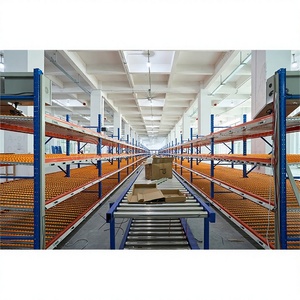
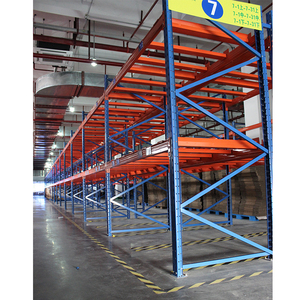
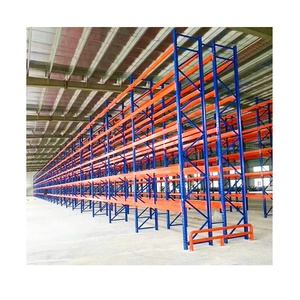
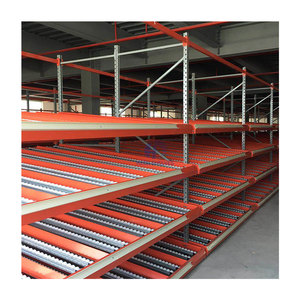
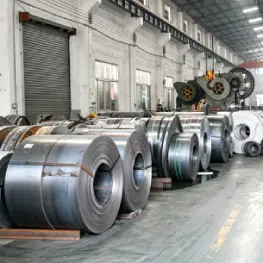
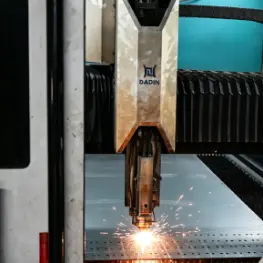
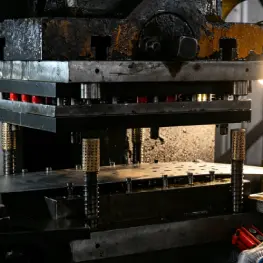
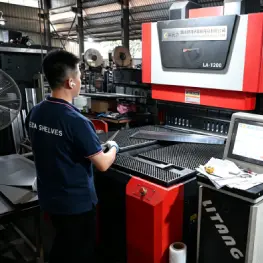
Precision-Engineered Pallet Flow & Carton Live Storage Systems Built to European EN 15512 Standards, Direct from Guangzhou Factory Since 2001
Factory Engineered Catalog
High-Efficiency Roller & Flow Racking Systems
Explore our certified heavy-duty gravity roller racks, live carton storage, and high-density industrial racking configurations tailored for modern FIFO picking facilities and distribution hubs.
Structural Anatomy & Dynamics of Industrial Roller Racking Systems
A rigorous examination of physics-driven gravity flow engineering, material dynamics, brake roller resistance, and space-utilization mathematics for logistics directors and procurement heads.
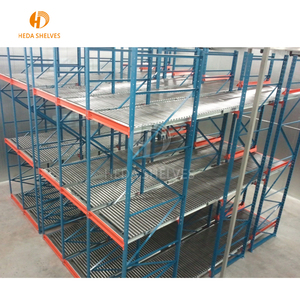
In high-throughput intralogistics ecosystems, roller rack systems (commonly categorized into Carton Flow Racks for split-case fulfillment and Pallet Live / Gravity Flow Racks for unit-load pallets) represent the peak of passive automation. By harnessing kinetic gravitational force, these systems transform static floor footprints into dynamic first-in, first-out (FIFO) conveying corridors. Unlike powered automated storage and retrieval systems (AS/RS) that carry steep capital expenditures, high electricity draw, and continuous software dependencies, engineered gravity roller racking delivers an uninterrupted, maintenance-lean flow channel that slashes operator transit times by up to 65% while driving storage volume density upward by 70% compared with conventional selective pallet setups.
Incline Kinematics & Pitch Precision
The operational heartbeat of gravity racking lies within the gradient: typically calibrated precisely between 2.5% and 4.0% (1.5° to 2.3°). A variance of merely 0.5 degrees dictates whether unit loads halt midway (creating dangerous operator clearance interventions) or accelerate uncontrollably into the discharge stop. Guangzhou Heda Shelves utilizes multi-point laser level alignment with custom vertical column punching on 50mm and 75mm pitches to guarantee load travel consistency regardless of ambient floor deflection.
Centrifugal Speed Controllers
For heavy pallet live lanes extending past 3 pallet depths (often scaling to 20+ pallets in cold stores), velocity dampening is mandatory. Our systems incorporate internal magnetic and centrifugal brake rollers spaced at uniform pallet intervals. These non-powered planetary gear mechanisms resist rotational velocity exponentially: the faster a pallet moves, the higher the counter-torque applied, ensuring terminal velocities remain safely restricted below 0.3 meters per second.
Safety Separators & Ramp Stops
Backpressure in deep-lane systems can reach crushing forces exceeding 15 kilonewtons at the discharge face. HEDA integrates heavy mechanical load separators that lock the rear pallet line behind the lead position. Once the forklift driver extracts the front pallet, the automatic release triggers sequentially, allowing only one unit forward. This completely shields warehouse operators and material handling equipment from uncontrolled kinetic surges.
System Classification
Typical Load Rating
Roller Track Construction
Stock Rotation
Velocity Regulators
Ideal Industry Setting
Light Carton Flow (Pick Lines)
20 – 60 kg / carton
Thermoplastic / High-density PE wheels on zinc track
*All load metrics structural criteria verified against FEM 10.2.02 and EN 15512 static/dynamic loading safety factors.
Industry Strategic Forecasting
Future Procurement & Technological Trends in Roller Racking (2025–2030)
How supply chain decentralization, ESG mandates, and warehouse automation hybridization are redefining how multinational enterprises specify and source roller storage infrastructure.
Procurement Dynamics: What Global Buyers Demand
Total Lifecycle Cost (TCO) Over Nominal Price: Enterprise procurement teams in Europe and North America are shifting away from evaluating initial steel tonnage cost. The focal criteria is now Total Cost of Ownership—factoring in bearing friction loss, powder coat anti-abrasion cycles, and roller swap-out speed. High-spec galvanized steel rollers pay for themselves within 24 months by eliminating lane downtime.
Standardization for Multi-Country Pallet Dimensions: With regional cross-border commerce expanding, racking must simultaneously support EUR 1 (1200×800mm), EUR 2 (1200×1000mm), and US standard GMA (48×40 inch) stringer variations. Advanced 3-track roller bed designs eliminate jams caused by deformed skid bottoms.
Modular Reconfiguration Velocity: Rapidly fluctuating SKU velocity requires warehouse managers to reshape pick lines without welding or re-anchoring uprights. Clip-in roller track connectors with multi-position bracket hooks allow shelf pitch adjustments in minutes.
Direct Factory Procurement with Verified Mill Certs: Disintermediating local middlemen to partner directly with scalable Tier-1 Chinese manufacturers like HEDA Shelves delivers up to 35-45% CapEx savings, paired with mill test certificates (MTC) proving Q235B/Q355B structural steel grade authenticity.
Technological & Engineering Innovations
Magnetic Eddy-Current Non-Contact Brake Rollers: Traditional oil-damped centrifugal brake rollers degrade over years of heat cycles and leak fluid in -30°C cold stores. Next-generation systems employ rare-earth neodymium magnetic eddy-current brake cylinders with zero contact parts, eliminating mechanical friction wear entirely.
AMR & AGV Pick-Face Interfacing: The modern roller rack is no longer isolated to manual operators. Gravity discharge bays are increasingly engineered with cantilevered pickup clearances and optical sensor reflective targets, allowing Autonomous Mobile Robots (AMRs) to pick cartons or pallets directly from roller stops without human intervention.
IoT-Enabled Load-Cell Telemetry: Integration of low-profile strain gauges into flow-track suspension beams enables automated weight tracking. When picking depletes a lane below 15% threshold weight, the WMS (Warehouse Management System) automatically dispatches an upstream replenishment order.
High-Corrosion-Resistant Surface Engineering: Beyond conventional single-coat paints, export-grade roller racks feature continuous pre-galvanized zinc coatings (up to 275g/m²) coupled with electrostatic thermosetting epoxy powder coatings to survive corrosive chemical fumes and condensation cycles.
Enterprise Manufacturing Authority
Guangzhou Heda Shelves Co., Ltd. — 25 Years of Global Racking Engineering
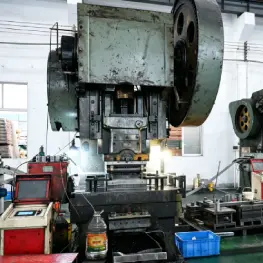
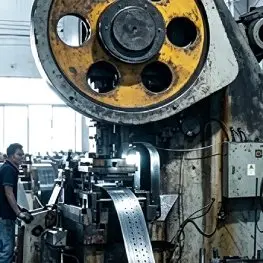
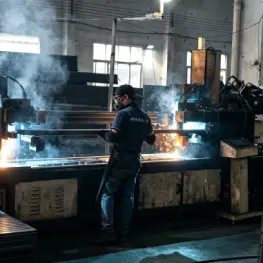
Founded in 2001 and headquartered in the industrial core of Guangzhou, China, Guangzhou Heda Shelves Co., Ltd. (HEDA Shelves) has evolved from an elite regional racking fabricator into one of the world's most trusted manufacturers and exporters of heavy-duty pallet racking, mezzanine floors, carton flow racks, and custom industrial storage solutions.
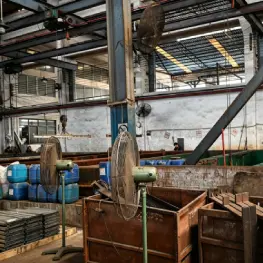
Operating across a modern 30,000 m² automated production facility staffed by more than 300 experienced engineers and skilled technicians, HEDA possesses an impressive in-house manufacturing throughput scaling up to 30,000 metric tonnes per month. Our engineering team utilizes advanced finite element analysis (FEA) software to model structural frame deflection, dynamic roller stress concentrations, and seismic shear resistance in accordance with European standard EN 15512 and American RMI specifications.
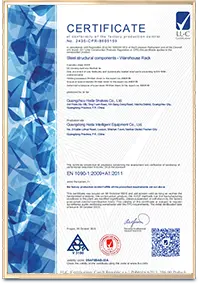
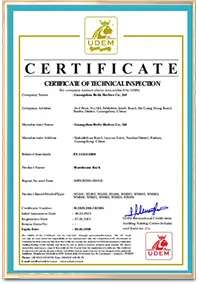
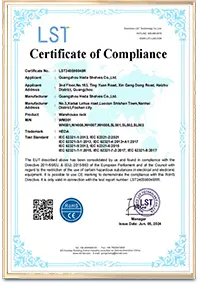
Certified CE ComplianceCertificate No. 2435-CPR-8605159 for European structural standards.
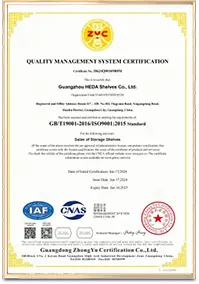
ISO 9001:2015 RegisteredCertificate No. 18624Q00169R0M verifying end-to-end QC traceability.
Complimentary 3D & CAD LayoutsFull DWG/BIM engineering schematics and load charts supplied upfront.
Global Direct Seaport LogisticsFOB, CIF, and DDP shipments to Rotterdam, Hamburg, Antwerp, LA, & 120+ countries.
Authoritative technical answers to common queries raised by international buyers, structural inspectors, and supply chain project managers.
What parameters determine the incline angle of a gravity roller rack?
The optimum gradient typically ranges from 2.5% to 4.0% (approximately 1.5° to 2.3°). This is determined by four empirical parameters: pallet bottom deck quality (smooth planed timber vs raw uneven boards vs plastic skids), total unit payload (light cartons of 10kg require steeper angles than 1200kg pallets), ambient operating temperature (cold storage grease viscosity increases friction), and total lane depth. HEDA Shelves conducts physical test bed simulations on customer sample loads at our factory before finalizing beam connector hole assignments.
Can standard wooden EUR-pallets (1200 x 800 mm) run safely on roller tracks?
Yes, EUR-pallets can run reliably on our roller tracks, provided the bottom deck boards travel perpendicularly to the roller axles, or a three-track roller configuration is used to ensure unbroken contact with the bottom runners. If lower boards are broken, warped, or have protruding nails, twin-flanged entry guides, full-width steel roller barrels, or supplementary slave trays are integrated to avert lane blockage.
How does HEDA guarantee compliance with European EN 15512 and local seismic regulations?
All HEDA storage systems are calculated using limit state structural analysis software under EN 15512 (Steel static storage systems – Adjustable pallet racking systems – Principles for structural design) and EN 15620 for clearances and tolerances. Our engineering deliverables package includes complete structural calculations, member deflection checks, baseplate anchor pull-out verification, and certified load notices (stamped with maximum bay capacities) suitable for submission to European building authorities and workplace safety inspectors.
What are typical production lead times and ocean transit schedules to Europe and the Americas?
Factory fabrication for customized roller rack projects typically requires 15 to 25 business days, backed by our monthly 30,000-tonne rolling capacity. Ocean transit from the Port of Guangzhou or Shenzhen to major European ports (such as Rotterdam, Hamburg, Antwerp, Valencia) averages 28 to 35 days, while West Coast North American ports (Los Angeles, Long Beach) require roughly 14 to 18 days. We provide complete export documentation, including Bills of Lading, Certificate of Origin, packing lists, and commercial invoices under FOB, CIF, or DDP terms.
Can carton flow lanes be retrofitted into our existing selective pallet racking?
Absolutely. HEDA's modular carton flow bed assemblies are universally adaptable. Utilizing universal drop-in beam brackets, our pre-assembled aluminum or steel roller tracks can be suspended directly across standard box beams or step beams from Dexion, SSI Schaefer, Stow, Interlake, or Mecalux profiles without drilling, cutting, or compromising the structural integrity of your existing upright frames.
Do you offer OEM / ODM private labeling for material handling distributors and rack installers?
Yes. Approximately 40% of our export output is manufactured under OEM/ODM partnerships for overseas racking suppliers, system integrators, and industrial distributors. We offer customized upright perforation patterns, bespoke RAL powder-coat color matching, customer-branded load capacity warning signs, custom component tagging, and neutral or branded seaworthy packaging.
Ready to Optimize Your Warehouse Picking Velocity?
Submit your warehouse architectural drawing (DWG or PDF) with load parameters. Our senior structural engineers will generate a complimentary 3D layout, load-capacity matrix, and comprehensive factory-direct quotation within 24 hours.