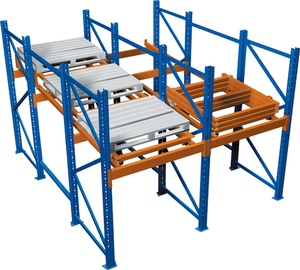
 2–6 Pallets Deep
URGO Heavy Duty Push Back Pallet Rack Intensive System
LIFO Dynamic
Nested Carts
Up to 1500kg/plt
Compare heavy-duty structural steel push-back lanes, nested cart arrays, and hybrid high-density systems manufactured in strict compliance with EN 15512, EN 15620, and ISO standards.
2–6 Pallets Deep
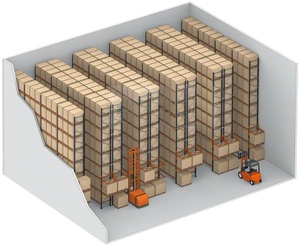 VNA System
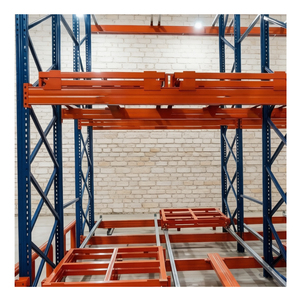 Gravity Cart
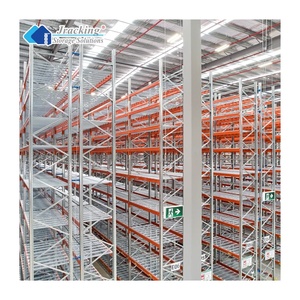 Cold Chain Ready
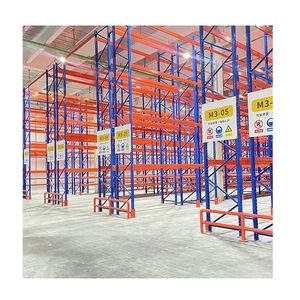 Heavy Duty
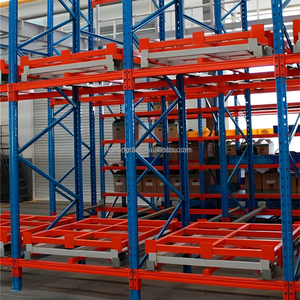 Adjustable Incline
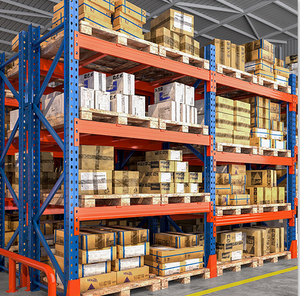 30000kg Bay
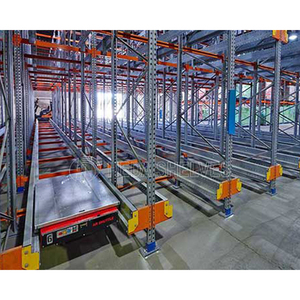 Automated Alternative
Understanding how inclined gravity rails, low-friction sealed bearings, and fail-safe nesting geometries solve the storage-versus-selectivity paradox.
Push back racking operates on a cascading series of nested steel carriages riding atop structural channel rails angled at an engineered 2.5% to 3.0% slope. The first pallet placed by the counterbalanced or reach truck rests on the topmost nesting cart. When feeding the second pallet, the forklift operator pushes the first cart backward, exposing the subsequent carriage below it. Lanes accommodate up to 6 pallets deep per bay face.
Unlike drive-in racking where mast carriages travel into structural bays—introducing severe collision exposure to upright posts—push back racking confines all forklift activity entirely to the clear aisle. Forklifts deposit and pick purely at the bay pick-face. This eliminates upright impact damages, drastically accelerates cycle times by up to 45%, and extends structural equipment longevity.
Premium factory design integrates anti-derail flanges, mechanical stops, and calibrated dynamic friction dampening. The cart-on-cart linkage guarantees that carriages advance forward smoothly under gravitational momentum at controlled velocities (not exceeding 0.3 m/s) when a pallet is extracted. Pallets rest securely within custom-formed steel perimeter lips that prevent load shift or dislodgement.
A quantified multi-dimensional matrix comparing Push Back against Selective, Drive-In, and Automated Shuttle racking architectures across critical operational metrics.
| Storage System Type | Space Utilization | SKU Selectivity Face | Inventory Rotation | Forklift Cycle Time | Structural Damage Risk |
|---|---|---|---|---|---|
| Push Back Pallet Rack | 75% – 85% | High (Each Lane Different) | LIFO (Last-In, First-Out) | Fastest Manual | Extremely Low |
| Selective Pallet Racking | 45% – 55% | 100% Immediate | FIFO or LIFO | Fast Single Pallet | Moderate |
| Drive-In Racking System | 80% – 90% | Low (Per Bay / Depth) | Strict LIFO | Slow (Mast Drives Inside) | High Impact Risk |
| Radio Shuttle Racking | 85% – 92% | Moderate-High | FIFO & LIFO Flexible | Automated Speed | Zero In-Bay Impact |
Key market transitions shifting industrial procurement through 2026–2030: Cold-chain surges, robotic integration, and closed-loop metallurgy.
With global cold chain energy costs escalating, push back racking is replacing low-density selective layouts in frozen distribution centers (-25°C to -30°C). By compressing required aisle footprint into high-density 3-to-5 deep lanes, companies shrink cubic refrigeration demand by up to 40%. Future procurement mandates low-temperature synthetic lubricants and stainless-steel flanged bearings that resist embrittlement and freeze-thaw lockup.
The push-back sector is transitioning from purely manual counterbalance operations to autonomous guided vehicles (AGVs) equipped with computer-vision precision push mechanisms. Forward-looking procurement demands stricter tolerances (±1.5mm) on beam deflection, cart rail leveling, and specialized optical targeting retrofits at pick-faces to support automated reach forklifts safely and repeatably.
Corporate ESG obligations are prioritizing low-carbon structural steel (Q355B with verified mill origin) and zero-VOC heavy-duty electrostatic powder coatings. Thin-profile high-tensile cold-rolled profiles engineered to EN 15512 yield up to 18% steel weight savings without compromising maximum allowable deflection (L/200), translating into lower shipping freight costs and carbon emissions per pallet position.
Operating directly since 2001, we deliver turn-key engineering, 3D CAD modeling, automated cold-roll forming, and verified CE/ISO structural compliance for enterprise logistics.
Our push back systems and structural mezzanines hold verified CE Certificate No. 2435-CPR-8605159 and ISO 9001:2015 Certification No. 18624Q00169R0M. Every project is verified against European EN 15512 and EN 15620 structural deflection limitations, complete with licensed calculation dossiers, signed material mill certificates, and RoHS compliance.
From raw structural steel testing to CNC continuous punching, robotic seam welding, 11-stage pre-treatment pickling & phosphating, and German Wagner electrostatic powder coating, our 30,000 m² automated facility ensures absolute precision. Cart rolling carriages maintain ±0.5mm track alignment across extreme temperature and load cycles.
Supplying 120+ countries including major European container hubs (Rotterdam, Hamburg, Antwerp, Valencia, Felixstowe). Every shipment incorporates custom steel strapping, bubble encasing, component marking, and exploded 3D installation manuals. On-site technical supervision or remote structural guidance is provided end-to-end.
Direct technical clarity for supply chain managers, warehouse directors, and industrial procurement officers specifying dynamic storage solutions.
Send your building dimensions, clear roof heights, pallet specifications, and handling equipment model to our senior engineering desk. Receive an optimal 3D CAD layout, load capacity calculation, and direct factory-gate quotation within 24 business hours.
Get a Quote